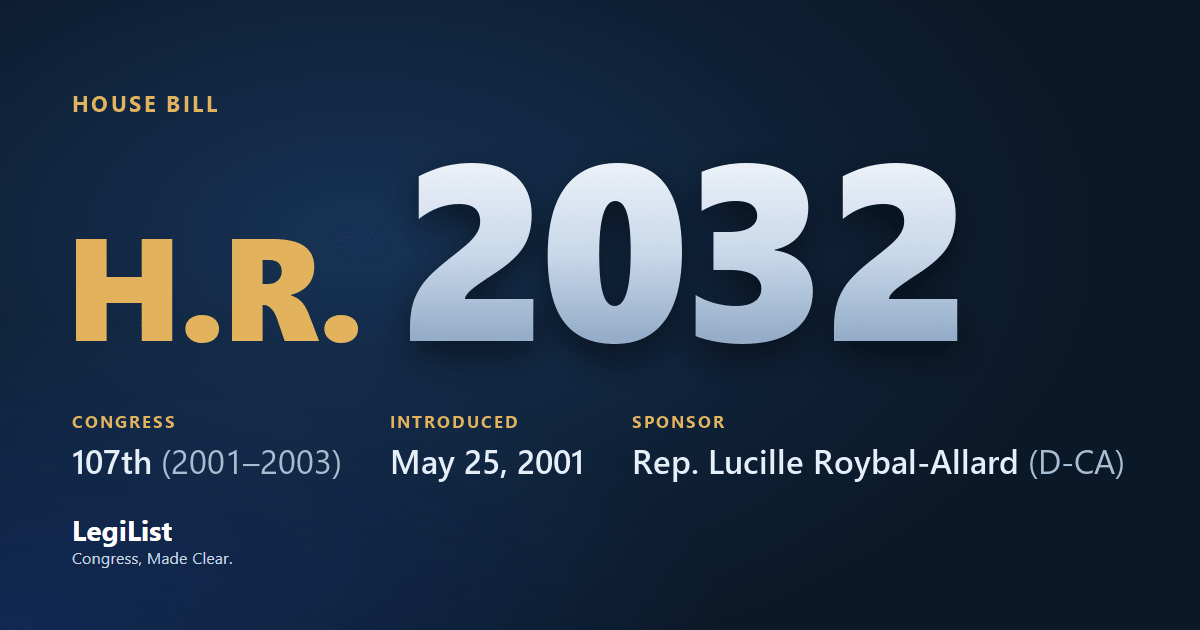
Credit Card Consumer Protection Act of 2001
Latest action · Jun 18, 2001 Referred to the Subcommittee on Financial Institutions and Consumer Credit.
Progress
Where this bill reached, and when. A stage with no date was not reached; one that failed a vote and later carried shows the date it carried.
- IntroducedMay 25, 2001
- Passed HouseNot reached
- Passed SenateNot reached
- To the PresidentNot reached
- Became lawNot reached
Summary
Mandates disclosure to a credit card account holder of the fees and interest rates imposed upon credit advances through the use of third party checks.
Proscribes over-the-limit fees in creditor-approved transactions, and two-cycle billing.
Prescribes additional notice requirements governing: (1) introductory ("teaser") rates to identify the fixed and variable interest rate which will apply following the introductory period; (2) last payment date and payment processing date before imposition of late fees; and (3) the period of time required to pay off the outstanding balance if only the minimum payment is forwarded.
Cosponsors 18
Members who signed on, in the order they did. Signatures ran from May 25, 2001 to Oct 30, 2001; 17 are original cosponsors, there from the day it was introduced.
| Seat | Cosponsor | Signed on | |
|---|---|---|---|
| D-PR | Anibal Acevedo-Vila | Original | May 25, 2001 |
| D-CA | Barbara Lee | Original | May 25, 2001 |
| D-MA | Barney Frank | Original | May 25, 2001 |
| D-MS | Bennie G. Thompson | Original | May 25, 2001 |
| D-CA | Bob Filner | Original | May 25, 2001 |
| D-MI | David E. Bonior | Original | May 25, 2001 |
| D-OH | Dennis J. Kucinich | Original | May 25, 2001 |
| D-NC | Eva M. Clayton | Original | May 25, 2001 |
| D-CA | George Miller | Original | May 25, 2001 |
| D-CA | Hilda L. Solis | Original | May 25, 2001 |
| D-CA | Loretta Sanchez | Original | May 25, 2001 |
| D-CA | Lynn C. Woolsey | Original | May 25, 2001 |
| D-MI | Lynn N. Rivers | Original | May 25, 2001 |
| D-TX | Martin Frost | Original | May 25, 2001 |
| D-GU | Robert A. Underwood | Original | May 25, 2001 |
| D-TX | Sheila Jackson Lee | Original | May 25, 2001 |
| D-WI | Tammy Baldwin | Original | May 25, 2001 |
| R-GA | Nathan Deal | Oct 30, 2001 |
Committees 1
Where it was sent and what each committee and subcommittee did with it, in order.
| Chamber | Committee | What it did |
|---|---|---|
| House | Financial Services Committee | Referred May 25, 2001 |
| Consumer Protection and Financial Institutions Subcommittee | Referred Jun 18, 2001 |
Actions 3
Everything that happened, newest first.
- Jun 18, 2001Referred to the Subcommittee on Financial Institutions and Consumer Credit.
- May 25, 2001Introduced in House
- May 25, 2001Referred to the House Committee on Financial Services.
Titles 2
Every title it has carried, official and short, at each stage.
- Official Title as Introduced
- To amend the Truth in Lending Act to protect consumers from certain unreasonable practices of creditors which result in higher fees or rates of interest for credit cardholders, and for other purposes.
- Short Titles as Introduced
- Credit Card Consumer Protection Act of 2001
Subjects
Assigned by the Library of Congress. Policy area: Finance and Financial Sector.
Text 1
Each version as it was printed, newest first.
- May 25, 2001Introduced in House
Support LegiList
This page is free, carries no paywall, and is built and maintained by one person. If the record here is useful to you, a few dollars keeps it going.
Everything here is as published by Congress: the summary is the Congressional Research Service's, the action wording is the clerks', and the subjects are the Library of Congress's. How far it got is read from the actions themselves, taking the most recent one of each kind, so a bill that failed a vote and later passed is shown as having passed. Records come from this bill on Congress.gov and govinfo.gov; cost estimates are the Congressional Budget Office's, and the hearings are the printed hearings GovInfo publishes, which can appear months after the hearing.