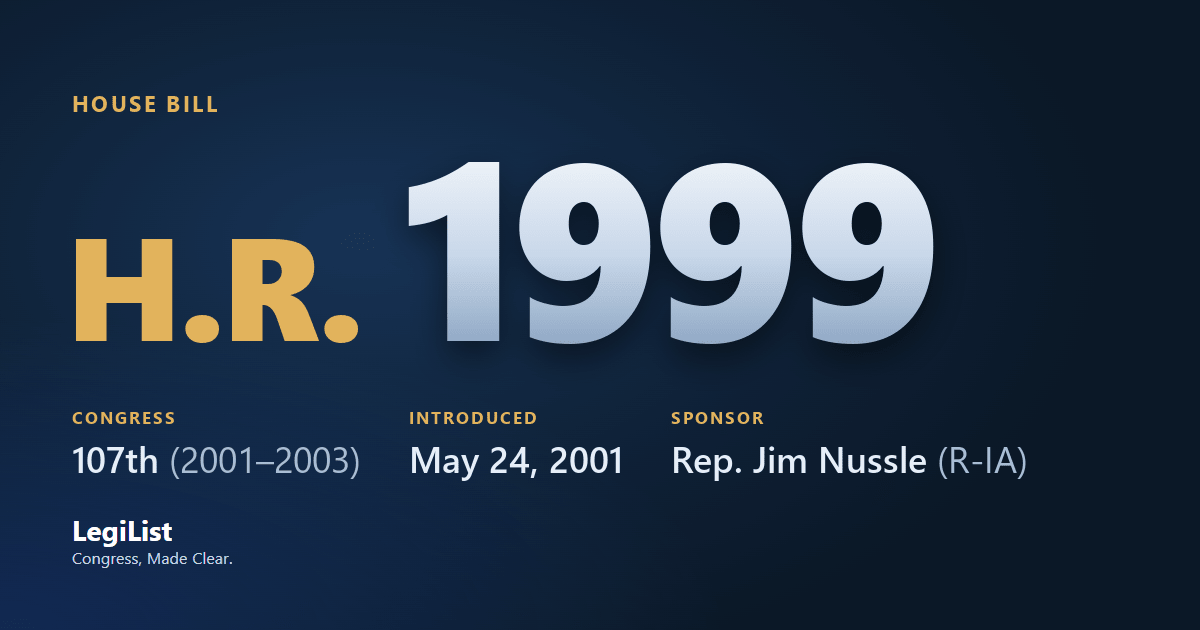
Ethanol Energy Promotion Act of 2001
Latest action · Jun 8, 2001 Referred to the Subcommittee on Energy and Air Quality.
Progress
Where this bill reached, and when. A stage with no date was not reached; one that failed a vote and later carried shows the date it carried.
- IntroducedMay 24, 2001
- Passed HouseNot reached
- Passed SenateNot reached
- To the PresidentNot reached
- Became lawNot reached
Summary
Removes authority of the Administrator of the Environmental Protection Agency to waive the reformulated gasoline oxygen content requirement for an ozone nonattainment area.
Directs the Administrator to promulgate regulations permitting a person who refines, blends, or imports and certifies gasoline with an oxygen content exceeding the minimum to take a volatility credit, based on the gasoline's ozone forming potential, to offset applicable Reid Vapor Pressure levels requirements.
Requires Federal agency fleet vehicles to be certified as capable of using ethanol and to use ethanol wherever economically feasible.
Amends the Internal Revenue Code with respect to the small ethanol producer credit to: (1) authorize credit allocation among a cooperative's patrons; (2) increase the gallon capacity for eligible producers; (3) make the credit a non-passive income credit; and (4) remove the credit from the alcohol fuel credit gross income inclusion.
Cosponsors
Members who signed on, in the order they did.
Committees 2
Where it was sent and what each committee and subcommittee did with it, in order.
| Chamber | Committee | What it did |
|---|---|---|
| House | Energy and Commerce Committee | Referred May 24, 2001 |
| Energy Subcommittee | Referred Jun 8, 2001 | |
| House | Ways and Means Committee | Referred May 24, 2001 |
Actions 3
Everything that happened, newest first.
- Jun 8, 2001Referred to the Subcommittee on Energy and Air Quality.
- May 24, 2001Introduced in House
- May 24, 2001Referred to the Committee on Energy and Commerce, and in addition to the Committee on Ways and Means, for a period to be subsequently determined by the Speaker, in each case for consideration of such provisions as fall within the jurisdiction of the committee concerned.
Research
What has been written about this bill: committee reports, cost estimates, the sponsor’s authority statement, printed hearings and the Congressional Research Service’s work.
Printed hearings 2
Hearings whose printed record names this bill, newest first: hearings on it, and wider hearings where it came up.
| Number | Hearing | Committee | Held |
|---|---|---|---|
| Serial No. 107-27 | SECOND IN SERIES ON EFFECT OF FEDERAL TAX LAWS ON THE PRODUCTION, SUPPLY, AND CONSERVATION OF ENERGY130 pages | Ways and Means Committee | Jun 12, 2001 |
| Serial No. 107-5 | ISSUES RAISED BY HUMAN CLONING RESEARCH157 pages | Energy and Commerce Committee | Mar 28, 2001 |
Titles 2
Every title it has carried, official and short, at each stage.
- Official Title as Introduced
- To amend the Clean Air Act to prohibit the use of methyl tertiary butyl ether as a fuel additive, to require Federal vehicles to use ethanol fuel, and for other purposes.
- Short Titles as Introduced
- Ethanol Energy Promotion Act of 2001
Subjects
Assigned by the Library of Congress. Policy area: Environmental Protection.
- Administrative procedure
- Agricultural cooperatives
- Agriculture and Food
- Air quality
- Alcohol as fuel
- Business income tax
- Commerce
- Cooperative societies
- Energy
- Energy tax credits
- Environmental Protection
- Environmental Protection Agency
- Government Operations and Politics
- Government procurement
- Government vehicles
- Income tax
- Law
- Minimum tax
- Motor vehicle pollution control
- Oxygen
- Oxygenates
- Ozone
- Reformulated gasoline
- Standards
- Tax exclusion
- Taxation
- Transportation and Public Works
Text 1
Each version as it was printed, newest first.
- May 24, 2001Introduced in House
Support LegiList
This page is free, carries no paywall, and is built and maintained by one person. If the record here is useful to you, a few dollars keeps it going.
Everything here is as published by Congress: the summary is the Congressional Research Service's, the action wording is the clerks', and the subjects are the Library of Congress's. How far it got is read from the actions themselves, taking the most recent one of each kind, so a bill that failed a vote and later passed is shown as having passed. Records come from this bill on Congress.gov and govinfo.gov; cost estimates are the Congressional Budget Office's, and the hearings are the printed hearings GovInfo publishes, which can appear months after the hearing.