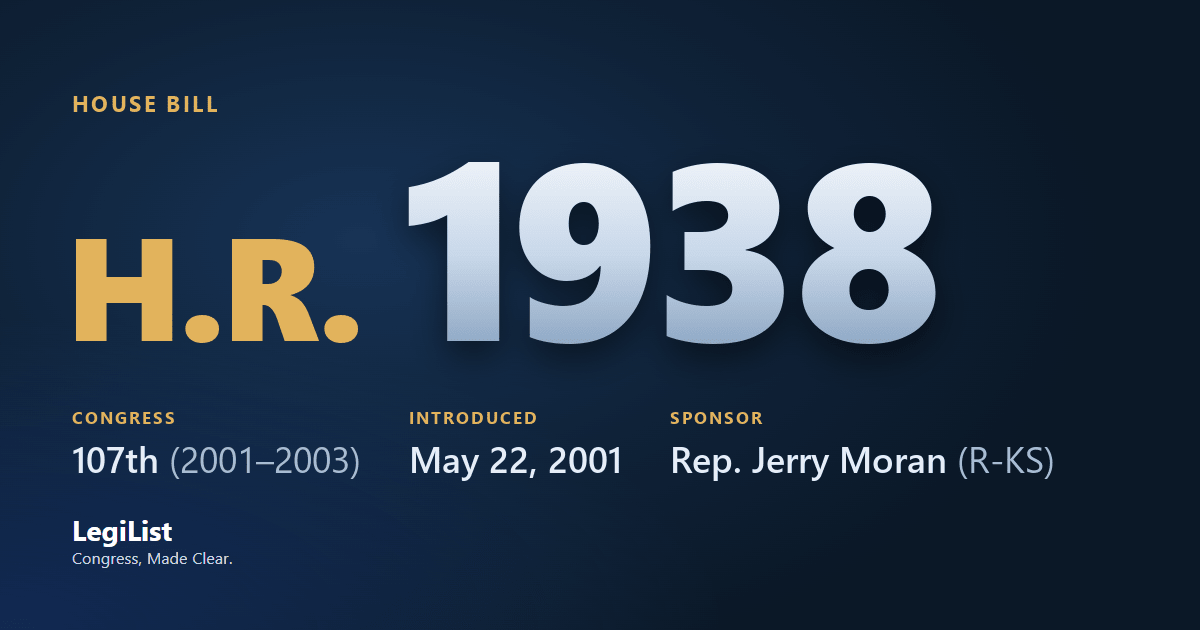
Conservation Enhancement Act of 2001
Latest action · Jun 4, 2001 Executive Comment Requested from USDA.
Progress
Where this bill reached, and when. A stage with no date was not reached; one that failed a vote and later carried shows the date it carried.
- IntroducedMay 22, 2001
- Passed HouseNot reached
- Passed SenateNot reached
- To the PresidentNot reached
- Became lawNot reached
Summary
Amends the Federal Agriculture Improvement Act of 1996 to extend and increase funding for the wildlife habitat incentives program.
Amends the Food Security Act of 1985 to revise the environmental quality incentives program respecting: (1) land management practices; (2) minimum contract term; (3) fund carryover; and (4) confined animal feeding operations and conservation priority areas.
Amends the Federal Agriculture Improvement and Reform Act of 1996 to direct the Secretary of Agriculture to use specified funds for pilot programs to prevent listing of threatened or endangered species through the development of critical habitats for such species.
Amends the Food Security Act of 1985 respecting the conservation reserve program to: (1) direct the Secretary to carry out at least ten pilot programs that address local and regional cropland and conservation issues; (2) expand haying and grazing authority; and (3) revise base history provisions.
Increases maximum wetlands reserve program acreage.
Expresses the sense of Congress concerning minimum funding for, and the importance of, conservation technical assistance.
Cosponsors 8
Members who signed on, in the order they did. Signatures ran from May 22, 2001 to Jul 11, 2001; 3 are original cosponsors, there from the day it was introduced.
| Seat | Cosponsor | Signed on | |
|---|---|---|---|
| R-MS | Charles W. "Chip" Pickering | Original | May 22, 2001 |
| R-LA | John Cooksey | Original | May 22, 2001 |
| R-NC | Robin Hayes | Original | May 22, 2001 |
| R-CO | Bob Schaffer | May 24, 2001 | |
| R-PA | James C. Greenwood | Jun 12, 2001 | |
| R-TX | Pete Sessions | Jun 12, 2001 | |
| R-NC | Walter B. Jones | Jun 12, 2001 | |
| D-IL | Rod R. Blagojevich | Jul 11, 2001 |
Committees 1
Where it was sent and what each committee and subcommittee did with it, in order.
| Chamber | Committee | What it did |
|---|---|---|
| House | Agriculture Committee | Referred May 22, 2001 |
| Commodity Markets, Digital Assets, and Rural Development Subcommittee | Referred Jun 4, 2001 | |
| Forestry and Horticulture Subcommittee | Referred Jun 4, 2001 |
Actions 5
Everything that happened, newest first.
- Jun 4, 2001Referred to the Subcommittee on Department Operations, Oversight, Nutrition and Forestry.
- Jun 4, 2001Referred to the Subcommittee on Conservation, Credit, Rural Development and Research.
- Jun 4, 2001Executive Comment Requested from USDA.
- May 22, 2001Introduced in House
- May 22, 2001Referred to the House Committee on Agriculture.
Titles 2
Every title it has carried, official and short, at each stage.
- Official Title as Introduced
- To extend and expand conservation programs administered by the Department of Agriculture.
- Short Titles as Introduced
- Conservation Enhancement Act of 2001
Subjects
Assigned by the Library of Congress. Policy area: Agriculture and Food.
- Agricultural conservation
- Agricultural runoff
- Agricultural subsidies
- Agricultural wastes
- Agriculture and Food
- Animals
- Appropriations
- Civil Rights and Liberties, Minority Issues
- Commerce
- Conservation easements
- Cropland conversion program
- Department of Agriculture
- Economics and Public Finance
- Endangered species
- Environmental Protection
- Farmland protection
- Federal employees
- Government Operations and Politics
- Government regulation
- Grazing
- Habitat conservation
- Land use
- Livestock industry
- Public Lands and Natural Resources
- Recruiting of employees
- Refuse and refuse disposal
- Right of property
- Soil conservation
- Water conservation
- Water pollution control
- Water quality
- Water Resources Development
- Wetland conservation
- Wetland restoration
Text 1
Each version as it was printed, newest first.
- May 22, 2001Introduced in House
Support LegiList
This page is free, carries no paywall, and is built and maintained by one person. If the record here is useful to you, a few dollars keeps it going.
Everything here is as published by Congress: the summary is the Congressional Research Service's, the action wording is the clerks', and the subjects are the Library of Congress's. How far it got is read from the actions themselves, taking the most recent one of each kind, so a bill that failed a vote and later passed is shown as having passed. Records come from this bill on Congress.gov and govinfo.gov; cost estimates are the Congressional Budget Office's, and the hearings are the printed hearings GovInfo publishes, which can appear months after the hearing.