Pupil instruction: dual enrollment.
- Introduced Feb 20, 2025
- In committee Mar 10, 2025
- Passed the Assembly Next
- Passed the Senate
- To the governor
- Became law
What it does
The legislature's own summary of the bill, or its official long title.
Existing law authorizes the governing board of a school district to authorize a pupil who meets specified criteria to attend community college as a special part-time or full-time student. Existing law authorizes a community college district to admit to any community college under its jurisdiction as a special part-time or full-time student a pupil who is eligible to attend community college under these provisions.…
Read the full title (266 words)
Existing law authorizes the governing board of a school district to authorize a pupil who meets specified criteria to attend community college as a special part-time or full-time student. Existing law authorizes a community college district to admit to any community college under its jurisdiction as a special part-time or full-time student a pupil who is eligible to attend community college under these provisions. This bill would require, commencing with the 2029–30 academic year, a local educational agency serving high school pupils that does not have an existing dual enrollment program to establish a dual enrollment program through a formal partnership or agreement with the governing board of a community college district, as provided. The bill would require a local educational agency that does not have an existing dual enrollment program to establish a formal partnership through a College and Career Access Pathways partnership or an early or middle college high school, as specified. The bill would require courses offered through a dual enrollment program pursuant to these provisions to lead to a degree, credential, certificate, or transfer. To the extent the bill would impose additional duties on local educational agencies and community college districts, the bill would impose a state-mandated local program. The California Constitution requires the state to reimburse local agencies and school districts for certain costs mandated by the state. Statutory provisions establish procedures for making that reimbursement. This bill would provide that, if the Commission on State Mandates determines that the bill contains costs mandated by the state, reimbursement for those costs shall be made pursuant to the statutory provisions noted above.
Every action
9 steps, oldest first, as the legislature records them.
- AssemblyRead first time. To print.
- AssemblyFrom printer. May be heard in committee March 23.
- CommitteeReferred to Coms. on HIGHER ED. and ED. · Assembly Higher Education
- CommitteeFrom committee: Amend, and do pass as amended and re-refer to Com. on ED. (Ayes 9. Noes 0.) (April 8). · Assembly Higher Education
- AssemblyRead second time and amended.
- CommitteeRe-referred to Com. on ED. · Assembly Education
- CommitteeIn committee: Set, first hearing. Hearing canceled at the request of author. · Assembly Education
- CommitteeDied pursuant to Art. IV, Sec. 10(c) of the Constitution. · Assembly Education
- CommitteeFrom committee: Filed with the Chief Clerk pursuant to Joint Rule 56. · Assembly Education
Roll calls
1 recorded vote: 0 on the floor, 1 in committee. Each shows how every member voted.
Committee votes
| Date | Where | Question | Result |
|---|---|---|---|
| Apr 8, 2025 | Assembly Higher Education | Do pass as amended and be re-referred to the Committee on [Education] MembersYes · 9
Not voting · 1 |
Passed 9–0 |
Sponsors
The member who introduced it, joined by 2 cosponsors: 2 Republicans.
-
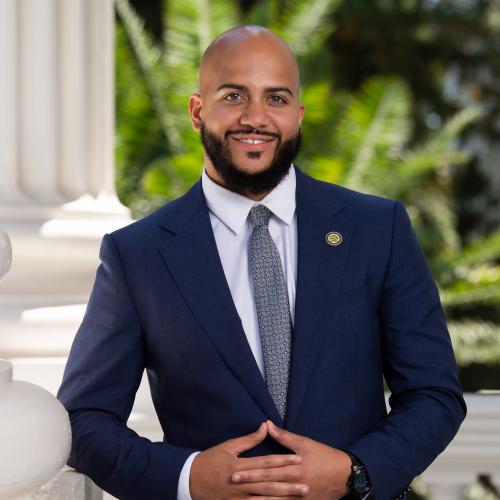 Isaac G. BryanD Primary sponsor · District 55
All 2 cosponsors
Support LegiList
This page is free, carries no paywall, and is built and maintained by one person. If the record here is useful to you, a few dollars keeps it going.
From California's official records (downloads.leginfo.legislature.ca.gov), checked Nov 18, 2026. Text links go to the official versions; LegiList does not copy bill text.