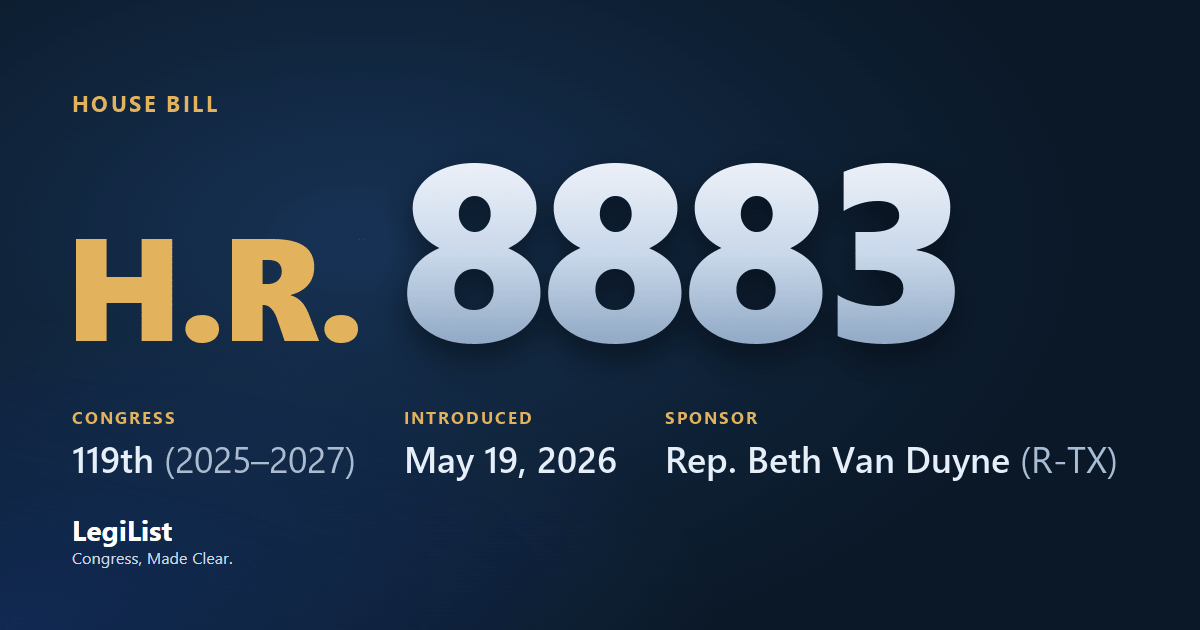
Protecting Seniors and Stopping Fraudsters Act
Latest action · May 21, 2026 Ordered to be Reported in the Nature of a Substitute by the Yeas and Nays: 27 - 16.
Progress
Where this bill reached, and when. A stage with no date was not reached; one that failed a vote and later carried shows the date it carried.
- IntroducedMay 19, 2026
- Passed HouseNot reached
- Passed SenateNot reached
- To the PresidentNot reached
- Became lawNot reached
Summary
Protecting Seniors and Stopping Fraudsters Act
This bill establishes additional requirements for hospice programs and home health agencies under Medicare, particularly in relation to oversight and transparency.
Specifically, the bill subjects hospice programs to revalidation within one year if the program (1) is located in a state in which new hospice programs are subject to enhanced oversight, as determined by the Centers for Medicare & Medicaid Services (CMS); and (2) has not been subject to revalidation over the previous 18 months.
Additionally, hospice programs and home health agencies that are newly enrolled, have undergone a change in ownership, or have had billing privileges reactivated must undergo surveys at least once every 12 months over the 36-month period following their change in status. The bill also requires hospice programs and home health agencies that do not submit required data to the CMS or that have an unusual rate of admissions or discharges to undergo additional surveys. The bill also subjects hospice programs and home health agencies that fail to submit required data to the CMS to larger payment reductions beginning in FY2029.
The CMS must identify hospice programs and home health agencies that are located in a state or county for which the total number of such programs and agencies significantly exceeds the totals for the previous year. The CMS must flag these programs and agencies as being at extreme risk of fraud and institute additional screening requirements, including fingerprinting requirements for certain personnel.
Cosponsors
Members who signed on, in the order they did.
Committees 2
Where it was sent and what each committee and subcommittee did with it, in order.
| Chamber | Committee | What it did |
|---|---|---|
| House | Ways and Means Committee | Referred May 19, 2026Markup May 21, 2026 |
| House | Energy and Commerce Committee | Referred May 19, 2026 |
Actions 4
Everything that happened, newest first.
- May 21, 2026Committee Consideration and Mark-up Session Held
- May 21, 2026Ordered to be Reported in the Nature of a Substitute by the Yeas and Nays: 27 - 16.
- May 19, 2026Introduced in House
- May 19, 2026Referred to the Committee on Ways and Means, and in addition to the Committee on Energy and Commerce, for a period to be subsequently determined by the Speaker, in each case for consideration of such provisions as fall within the jurisdiction of the committee concerned.
Research
What has been written about this bill: committee reports, cost estimates, the sponsor’s authority statement, printed hearings and the Congressional Research Service’s work.
Constitutional authority
The sponsor’s statement, as printed in the Congressional Record, vol. 172, no. 85, May 19, 2026, page H3628.
Titles 2
Every title it has carried, official and short, at each stage.
- Official Title as Introduced
- To amend title XVIII of the Social Security Act to provide for additional oversight of hospice programs and home health agencies under the Medicare program, and for other purposes.
- Short Title(s) as Introduced
- Protecting Seniors and Stopping Fraudsters Act
Subjects
Assigned by the Library of Congress. Policy area: Health.
Text 1
Each version as it was printed, newest first.
- May 19, 2026Introduced in House
Support LegiList
This page is free, carries no paywall, and is built and maintained by one person. If the record here is useful to you, a few dollars keeps it going.
Everything here is as published by Congress: the summary is the Congressional Research Service's, the action wording is the clerks', and the subjects are the Library of Congress's. How far it got is read from the actions themselves, taking the most recent one of each kind, so a bill that failed a vote and later passed is shown as having passed. Records come from this bill on Congress.gov and govinfo.gov; cost estimates are the Congressional Budget Office's, and the hearings are the printed hearings GovInfo publishes, which can appear months after the hearing.