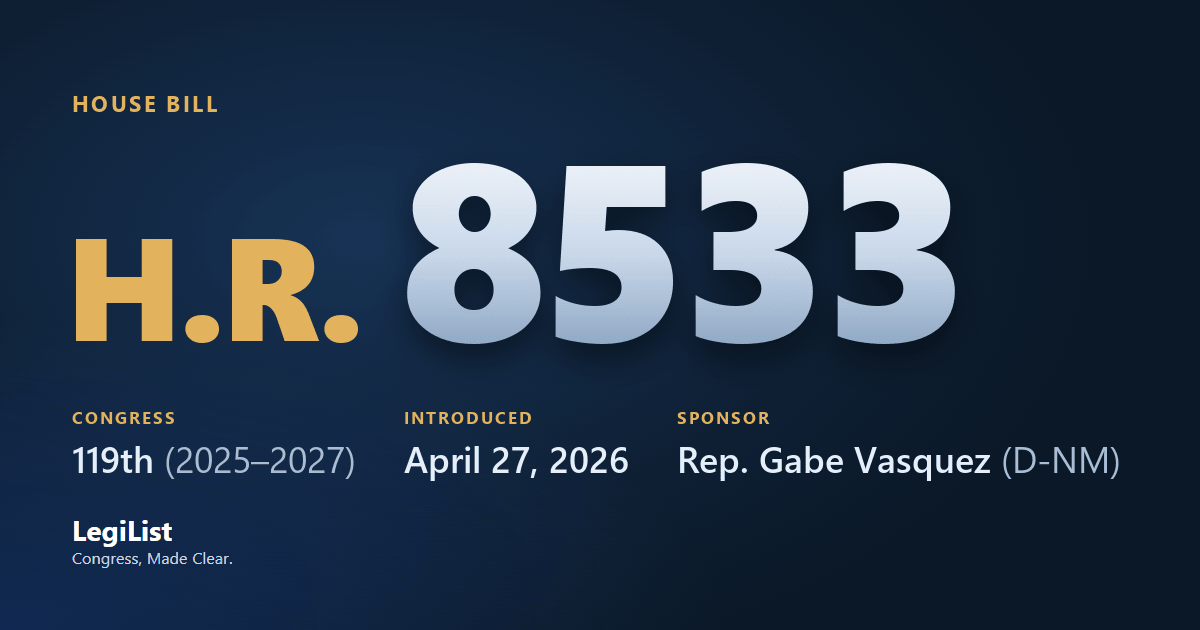
Farmer to Farmer Education Act of 2026
Latest action · Apr 27, 2026 Referred to the House Committee on Agriculture.
Progress
Where this bill reached, and when. A stage with no date was not reached; one that failed a vote and later carried shows the date it carried.
- IntroducedApr 27, 2026
- Passed HouseNot reached
- Passed SenateNot reached
- To the PresidentNot reached
- Became lawNot reached
Summary
Farmer to Farmer Education Act of 2026
This bill expands the authority of the Department of Agriculture (USDA) to provide technical assistance for farmer-to-farmer networks. USDA must use annual appropriations provided for Natural Resources Conservation Service conservation operations to implement this program.
A farmer-to-farmer network means any affiliation or association of farmers that share information, technical assistance, or any other type of mutually beneficial support.
Under the bill, USDA may enter into cooperative agreements with eligible entities to (1) provide assistance to farmer-to-farmer networks to build network capacity, connect farmers with mentors or group learning opportunities, and support goal setting; (2) increase technical assistance for farmers, ranchers, and forest owners who use different farming models, practices, and scales; (3) establish and steward the networks; and (4) establish reporting requirements for these activities.
Those eligible for the program include nonprofit entities, farmer-to-farmer networks, tribal entities, local governments, institutions of higher education, and states. USDA must prioritize agreements with entities that seek to meet the specific needs of certain farmers, ranchers, and forest owners who are historically underserved or operating in high-poverty areas.
The bill also provides for subawards to plan and conduct events, as well as to identify and develop innovative activities, in order to increase farmer access to farmer-to-farmer assistance.
Cosponsors 1
Members who signed on, in the order they did. All signed on Jun 11, 2026.
| Seat | Cosponsor | Signed on | |
|---|---|---|---|
| D-CO | Joe Neguse | Jun 11, 2026 |
Committees 1
Where it was sent and what each committee and subcommittee did with it, in order.
| Chamber | Committee | What it did |
|---|---|---|
| House | Agriculture Committee | Referred Apr 27, 2026 |
Actions 2
Everything that happened, newest first.
- Apr 27, 2026Introduced in House
- Apr 27, 2026Referred to the House Committee on Agriculture.
Research
What has been written about this bill: committee reports, cost estimates, the sponsor’s authority statement, printed hearings and the Congressional Research Service’s work.
Constitutional authority
The sponsor’s statement, as printed in the Congressional Record, vol. 172, no. 73, April 27, 2026, page H3125.
Related bills 2
Companion bills and other measures the record links to this one.
| Bill | Title | Relationship | Latest action |
|---|---|---|---|
| S 1769 | Farmer to Farmer Education Act of 2025 | Related bill | May 14, 2025 |
| HR 7567 | Farm, Food, and National Security Act of 2026 | Related bill | May 19, 2026 |
Titles 2
Every title it has carried, official and short, at each stage.
- Official Title as Introduced
- To amend the Food Security Act of 1985 to expand the provision of farmer-led technical assistance, and for other purposes.
- Short Title(s) as Introduced
- Farmer to Farmer Education Act of 2026
Subjects
Assigned by the Library of Congress. Policy area: Agriculture and Food.
Text 1
Each version as it was printed, newest first.
- Apr 27, 2026Introduced in House
Everything here is as published by Congress: the summary is the Congressional Research Service's, the action wording is the clerks', and the subjects are the Library of Congress's. How far it got is read from the actions themselves, taking the most recent one of each kind, so a bill that failed a vote and later passed is shown as having passed. Records come from this bill on Congress.gov and govinfo.gov; cost estimates are the Congressional Budget Office's, and the hearings are the printed hearings GovInfo publishes, which can appear months after the hearing.