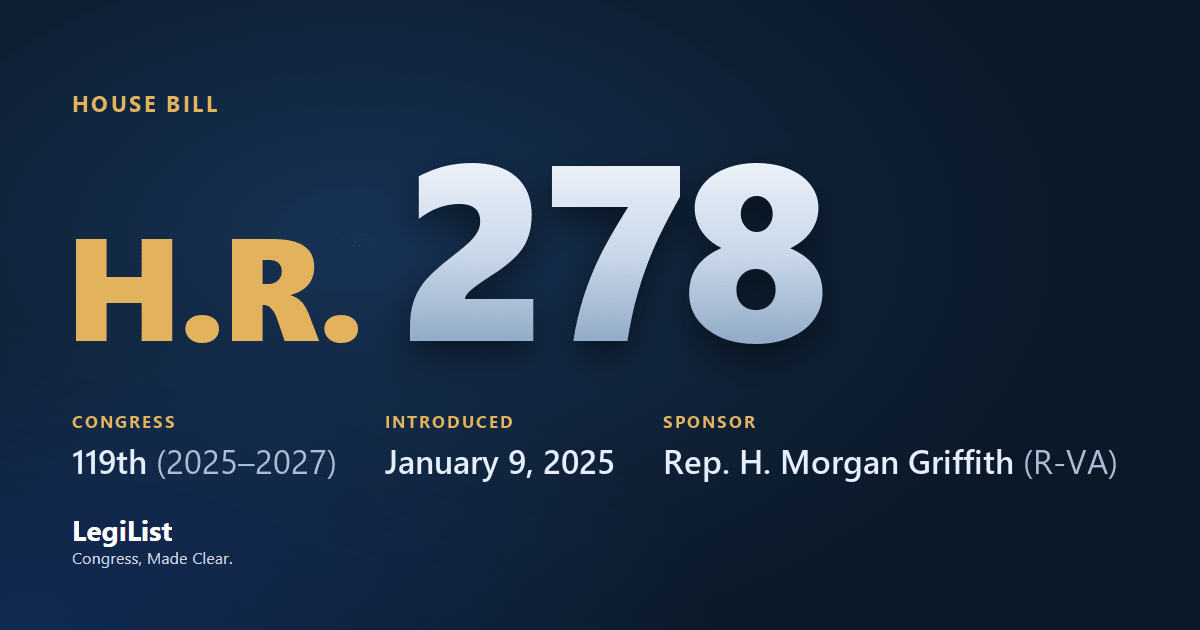
BROADBAND Leadership Act
Latest action · Jan 9, 2025 Referred to the House Committee on Energy and Commerce.
Progress
Where this bill reached, and when. A stage with no date was not reached; one that failed a vote and later carried shows the date it carried.
- IntroducedJan 9, 2025
- Passed HouseNot reached
- Passed SenateNot reached
- To the PresidentNot reached
- Became lawNot reached
Summary
Barriers and Regulatory Obstacles Avoids Deployment of Broadband Access and Needs Deregulatory Leadership Act or the BROADBAND Leadership Act
This bill limits the authority of a state or locality to regulate the placement, construction, or modification of telecommunications service facilities.
States and localities may not discriminate in such regulations among providers of telecommunications services, including based on the technology used to provide services. In addition, states and localities may not regulate in a manner that effectively prohibits the provision or improvement of interstate or intrastate telecommunications services.
However, states and localities may charge reasonable, cost-based fees (1) to review requests to place, construct, or modify telecommunications service facilities; or (2) for the use of property owned or managed by the state or locality for the placement, construction, or modification of those facilities.
States or localities must respond to requests to place, construct, or modify facilities and for other related actions by specified deadlines. Such deadlines may only be tolled by a mutual agreement between the applicant and the state or locality, or in the event that the application is incomplete and requires a supplemental submission. If a decision is not made by the deadline, the request is deemed to be approved. Further, denials of requests must be made in writing, supported by evidence, and promptly released to the public.
A person adversely affected by an alleged violation of these provisions may petition the courts for expedited review of the actions of the state or locality.
Cosponsors
Members who signed on, in the order they did.
Committees 1
Where it was sent and what each committee and subcommittee did with it, in order.
| Chamber | Committee | What it did |
|---|---|---|
| House | Energy and Commerce Committee | Referred Jan 9, 2025 |
Actions 2
Everything that happened, newest first.
- Jan 9, 2025Introduced in House
- Jan 9, 2025Referred to the House Committee on Energy and Commerce.
Research
What has been written about this bill: committee reports, cost estimates, the sponsor’s authority statement, printed hearings and the Congressional Research Service’s work.
Constitutional authority
The sponsor’s statement, as printed in the Congressional Record, vol. 171, no. 5, January 9, 2025, page H92.
CRS reports 1
Congressional Research Service work that CRS links to this bill or the law it became, newest first.
Cite it 1
Products on other subjects that cite it, usually among other measures.
| Product | Title | Kind | Published |
|---|---|---|---|
| R48992 | Pole Attachments in Broadband Deployment: Selected Issues | Report | Jun 16, 2026 |
Titles 3
Every title it has carried, official and short, at each stage.
- Official Title as Introduced
- To amend the Communications Act of 1934 to streamline siting processes for telecommunications service facilities, and for other purposes.
- Short Title(s) as Introduced
- BROADBAND Leadership Act
- Barriers and Regulatory Obstacles Avoids Deployment of Broadband Access and Needs Deregulatory Leadership Act
Subjects
Assigned by the Library of Congress. Policy area: Science, Technology, Communications.
Text 1
Each version as it was printed, newest first.
- Jan 9, 2025Introduced in House
Everything here is as published by Congress: the summary is the Congressional Research Service's, the action wording is the clerks', and the subjects are the Library of Congress's. How far it got is read from the actions themselves, taking the most recent one of each kind, so a bill that failed a vote and later passed is shown as having passed. Records come from this bill on Congress.gov and govinfo.gov; cost estimates are the Congressional Budget Office's, and the hearings are the printed hearings GovInfo publishes, which can appear months after the hearing.