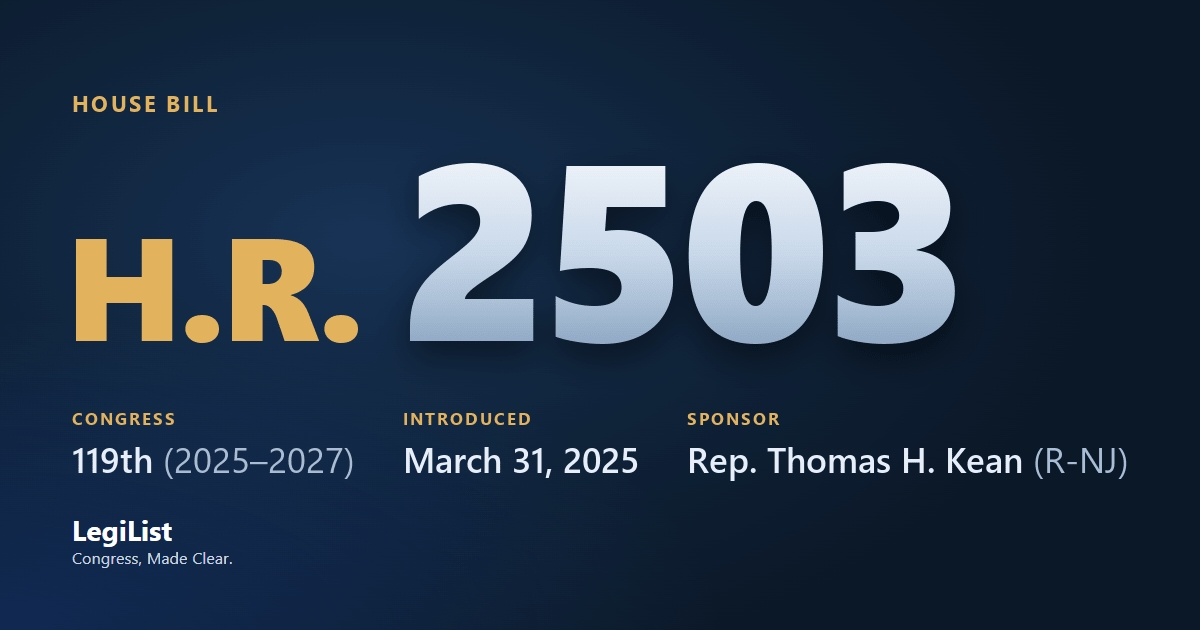
Undersea Cable Control Act
Latest action · Sep 3, 2025 Received in the Senate and Read twice and referred to the Committee on Banking, Housing, and Urban Affairs.
Progress
Where this bill reached, and when. A stage with no date was not reached; one that failed a vote and later carried shows the date it carried.
- IntroducedMar 31, 2025
- Passed HouseSep 2, 2025
- Passed SenateNot reached
- To the PresidentNot reached
- Became lawNot reached
Summary
Undersea Cable Control Act
This bill requires the President and the Department of Commerce to take certain actions to prevent foreign adversaries from acquiring items needed to support the construction, maintenance, or operation of undersea cable projects. For the purposes of this bill, a foreign adversary is any foreign government or nongovernment person (entity or individual) engaged in certain conduct that significantly and adversely affects U.S. national security.
Within one year of the bill's enactment, the President must seek to enter into agreements with allies and partners to prevent such items from being available to foreign adversaries.
Furthermore, Commerce must determine the appropriate level of export and transfer controls for such items under the Export Administration Regulations.
The bill also requires Commerce to develop a strategy to prevent such items from being available to foreign adversaries. The President must report annually to Congress on this strategy.
Cosponsors 2
Members who signed on, in the order they did. All signed on Apr 8, 2025.
| Seat | Cosponsor | Signed on | |
|---|---|---|---|
| D-CA | Brad Sherman | Apr 8, 2025 | |
| R-NY | Michael Lawler | Apr 8, 2025 |
Committees 2
Where it was sent and what each committee and subcommittee did with it, in order.
| Chamber | Committee | What it did |
|---|---|---|
| House | Foreign Affairs Committee | Referred Mar 31, 2025Markup Apr 9, 2025 |
| Senate | Banking, Housing, and Urban Affairs Committee | Referred Sep 3, 2025 |
Actions 10
Everything that happened, newest first.
- Sep 3, 2025Received in the Senate and Read twice and referred to the Committee on Banking, Housing, and Urban Affairs.
- Sep 2, 2025Mr. Baumgartner moved to suspend the rules and pass the bill.
- Sep 2, 2025Considered under suspension of the rules. (consideration: CR H3733-3734)
- Sep 2, 2025DEBATE - The House proceeded with forty minutes of debate on H.R. 2503.
- Sep 2, 2025Passed/agreed to in House: On motion to suspend the rules and pass the bill Agreed to by voice vote. (text: CR H3733-3734)
- Sep 2, 2025Motion to reconsider laid on the table Agreed to without objection.
- Apr 9, 2025Committee Consideration and Mark-up Session Held
- Apr 9, 2025Ordered to be Reported by Voice Vote.
- Mar 31, 2025Introduced in House
- Mar 31, 2025Referred to the House Committee on Foreign Affairs.
In the Congressional Record 1
Days the Record’s own index lists this bill, newest first, with the pages and the members it names. Pages starting H are the House, S the Senate, E Extensions of Remarks.
| Where | In the Record | Members | Date |
|---|---|---|---|
| House | Debate and remarks H3733, H3734Text printed H3733 | Joaquin Castro D-TX, Michael Baumgartner R-WA, Thomas H. Kean, Jr. R-NJ | Sep 2, 2025 |
Research
What has been written about this bill: committee reports, cost estimates, the sponsor’s authority statement, printed hearings and the Congressional Research Service’s work.
Congressional Budget Office cost estimate
- Apr 28, 2025H.R. 2503, Undersea Cable Control ActAs ordered reported by the House Committee on Foreign Affairs on April 9, 2025
Constitutional authority
The sponsor’s statement, as printed in the Congressional Record, vol. 171, no. 57, March 31, 2025, page H1375.
Printed hearings 1
Hearings whose printed record names this bill, newest first: hearings on it, and wider hearings where it came up.
| Number | Hearing | Committee | Held |
|---|---|---|---|
| Serial No. 119-13 | MARKUP OF VARIOUS MEASURES206 pages | Foreign Affairs Committee | Apr 9, 2025 |
Titles 5
Every title it has carried, official and short, at each stage.
- Official Title as Introduced
- To require the development of a strategy to eliminate the availability to foreign adversaries of goods and technologies capable of supporting undersea cables, and for other purposes.
- Short Title(s) as Introduced
- Undersea Cable Control Act
- Short Title(s) as Passed House
- Undersea Cable Control Act
- Short Titles from RFS (Referred to Senate) bill text
- Undersea Cable Control Act
- Official Title from EH (Engrossed in House) bill text
- To require the development of a strategy to eliminate the availability to foreign adversaries of goods and technologies capable of supporting undersea cables, and for other purposes.
Subjects
Assigned by the Library of Congress. Policy area: International Affairs.
Text 3
Each version as it was printed, newest first.
- Sep 3, 2025Referred in Senate
- Sep 2, 2025Engrossed in House
- Mar 31, 2025Introduced in House
Everything here is as published by Congress: the summary is the Congressional Research Service's, the action wording is the clerks', and the subjects are the Library of Congress's. How far it got is read from the actions themselves, taking the most recent one of each kind, so a bill that failed a vote and later passed is shown as having passed. Records come from this bill on Congress.gov and govinfo.gov; cost estimates are the Congressional Budget Office's, and the hearings are the printed hearings GovInfo publishes, which can appear months after the hearing.