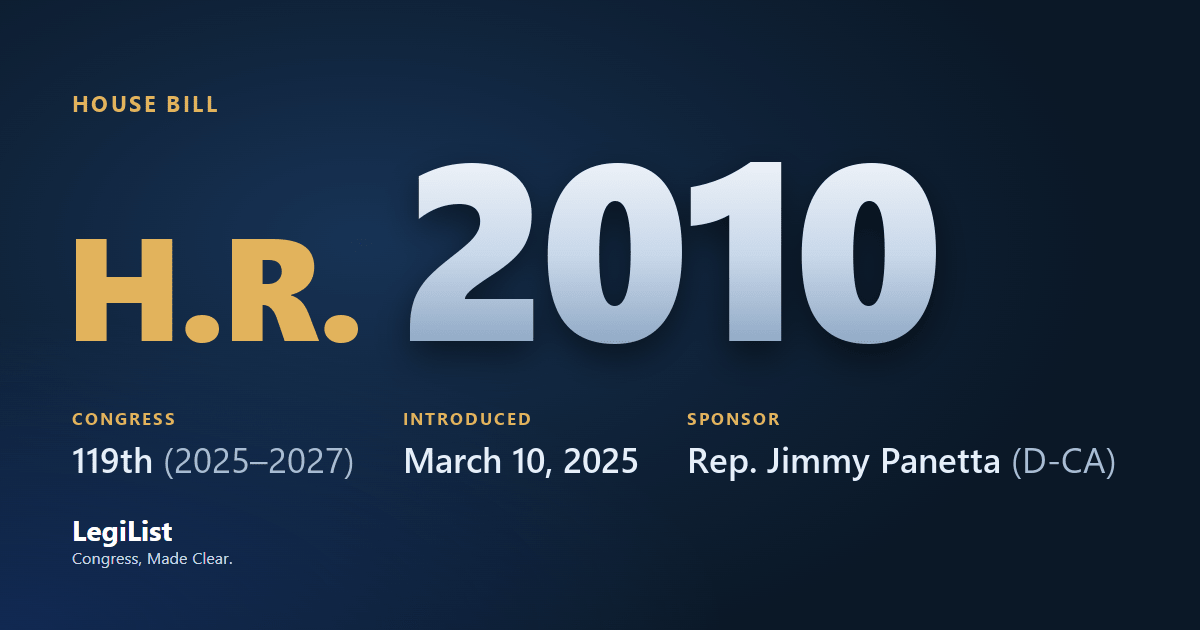
NATO Edge Act
Latest action · Mar 10, 2025 Referred to the Committee on Foreign Affairs, and in addition to the Committee on Rules, for a period to be subsequently determined by the Speaker, in each case for consideration of such provisions as fall within the jurisdiction of the committee concerned.
Progress
Where this bill reached, and when. A stage with no date was not reached; one that failed a vote and later carried shows the date it carried.
- IntroducedMar 10, 2025
- Passed HouseNot reached
- Passed SenateNot reached
- To the PresidentNot reached
- Became lawNot reached
Summary
NATO Edge Act
This bill places additional restrictions on the President's ability to exit from the North Atlantic Treaty, the multilateral collective security agreement that established the North Atlantic Treaty Organization (NATO).
Current law specifies that the President may not exit from this treaty or use federal funds to support such an exit except pursuant to an act of Congress or with the concurrence of two-thirds of the Senate.
The bill adds an additional exit restriction tied to the members of NATO that have not allocated at least 2% of their gross domestic product to annual defense spending. Under the bill, the President may only exit from the treaty or make federal funds available to support an exit if all such nations have not committed to achieving such spending level within five years from the fiscal year to which the President seeks to exit from the treaty.
The Senate or the House of Representatives may adopt a resolution authorizing the Senate Legal Counsel or the General Counsel of the House of Representatives to initiate or intervene in federal court proceedings to oppose any exit from the treaty that does not comply with the statutory requirements.
The bill specifies congressional procedures to follow for any resolution or joint resolution introduced related to exiting from the treaty.
The changes made by this bill expire on September 30, 2033.
Cosponsors 3
Members who signed on, in the order they did. Signatures ran from Mar 10, 2025 to May 20, 2025; 1 is an original cosponsor, there from the day it was introduced.
| Seat | Cosponsor | Signed on | |
|---|---|---|---|
| R-NE | Don Bacon | Original | Mar 10, 2025 |
| R-SC | Joe Wilson | Mar 24, 2025 | |
| D-NY | Thomas R. Suozzi | May 20, 2025 |
Committees 2
Where it was sent and what each committee and subcommittee did with it, in order.
| Chamber | Committee | What it did |
|---|---|---|
| House | Foreign Affairs Committee | Referred Mar 10, 2025 |
| House | Rules Committee | Referred Mar 10, 2025 |
Actions 2
Everything that happened, newest first.
- Mar 10, 2025Introduced in House
- Mar 10, 2025Referred to the Committee on Foreign Affairs, and in addition to the Committee on Rules, for a period to be subsequently determined by the Speaker, in each case for consideration of such provisions as fall within the jurisdiction of the committee concerned.
Research
What has been written about this bill: committee reports, cost estimates, the sponsor’s authority statement, printed hearings and the Congressional Research Service’s work.
Constitutional authority
The sponsor’s statement, as printed in the Congressional Record, vol. 171, no. 44, March 10, 2025, page H1068.
Titles 2
Every title it has carried, official and short, at each stage.
- Official Title as Introduced
- To prevent the President of the United States from withdrawing from the North Atlantic Treaty Organization.
- Short Title(s) as Introduced
- NATO Edge Act
Subjects
Assigned by the Library of Congress. Policy area: International Affairs.
Text 1
Each version as it was printed, newest first.
- Mar 10, 2025Introduced in House
Support LegiList
This page is free, carries no paywall, and is built and maintained by one person. If the record here is useful to you, a few dollars keeps it going.
Everything here is as published by Congress: the summary is the Congressional Research Service's, the action wording is the clerks', and the subjects are the Library of Congress's. How far it got is read from the actions themselves, taking the most recent one of each kind, so a bill that failed a vote and later passed is shown as having passed. Records come from this bill on Congress.gov and govinfo.gov; cost estimates are the Congressional Budget Office's, and the hearings are the printed hearings GovInfo publishes, which can appear months after the hearing.