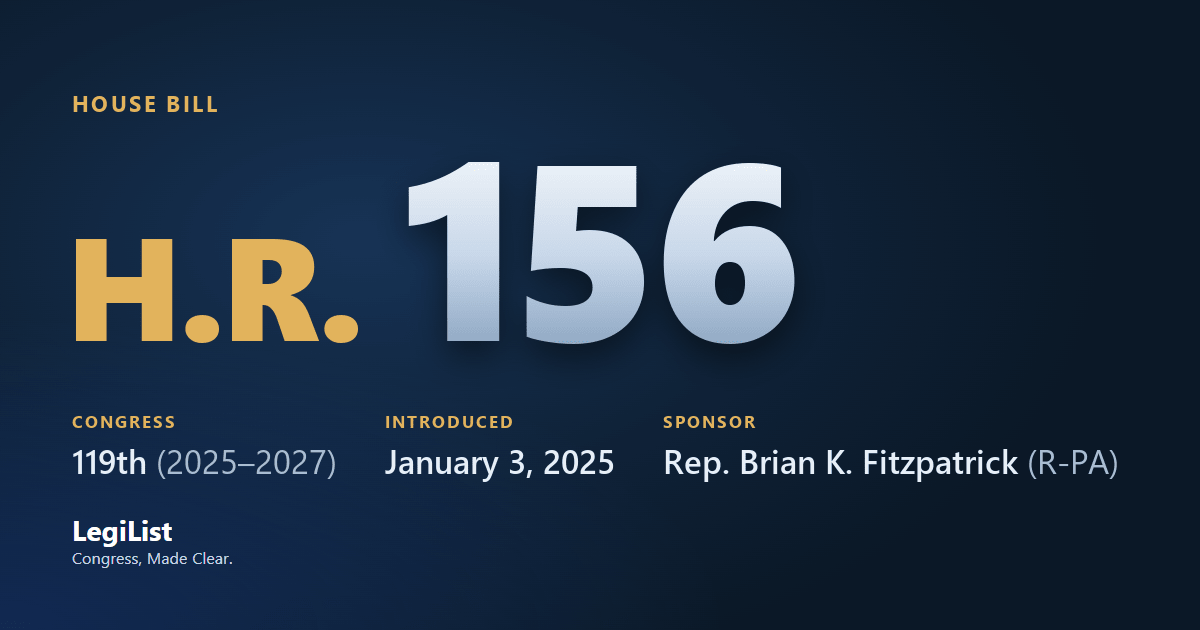
Securing our Elections Act of 2025
Latest action · Jan 3, 2025 Referred to the House Committee on House Administration.
Progress
Where this bill reached, and when. A stage with no date was not reached; one that failed a vote and later carried shows the date it carried.
- IntroducedJan 3, 2025
- Passed HouseNot reached
- Passed SenateNot reached
- To the PresidentNot reached
- Became lawNot reached
Summary
Securing our Elections Act of 2025
This bill establishes certain photo identification requirements for voting in federal elections.
Specifically, the bill prohibits a state or local election official from providing a ballot for a federal election to an individual who does not present valid photo identification.
Next, the bill outlines the availability of provisional ballots and the requirements for counting those ballots. In particular, an individual who does not present a valid photo identification must be permitted to cast a provisional ballot. However, an election official may not determine that the individual is eligible under state law to vote in the election unless, not later than three days after casting the provisional ballot, the individual presents (1) the identification required, or (2) an affidavit attesting that the individual does not possess the identification because of a religious objection to being photographed.
An election official may not allow for voting methods other than in-person voting unless the individual submits the ballot with (1) a copy of their photo identification, or (2) the last four digits of their Social Security number with an affidavit attesting that the individual is unable to obtain a copy of a valid photo identification after making reasonable efforts to obtain a copy. This prohibition shall not apply to overseas military voters.
The bill also requires a state to provide an individual with a valid photo identification without charge if that individual presents an affidavit attesting to an inability to afford or otherwise obtain a valid photo identification.
Cosponsors 1
Members who signed on, in the order they did. All signed on Jan 9, 2025.
| Seat | Cosponsor | Signed on | |
|---|---|---|---|
| R-PA | Ryan Mackenzie | Jan 9, 2025 |
Committees 1
Where it was sent and what each committee and subcommittee did with it, in order.
| Chamber | Committee | What it did |
|---|---|---|
| House | Committee on House Administration | Referred Jan 3, 2025 |
Actions 2
Everything that happened, newest first.
- Jan 3, 2025Introduced in House
- Jan 3, 2025Referred to the House Committee on House Administration.
Research
What has been written about this bill: committee reports, cost estimates, the sponsor’s authority statement, printed hearings and the Congressional Research Service’s work.
Constitutional authority
The sponsor’s statement, as printed in the Congressional Record, vol. 171, no. 1, January 3, 2025, page H41.
CRS reports 2
Congressional Research Service work that CRS links to this bill or the law it became, newest first.
Cite it 2
Products on other subjects that cite it, usually among other measures.
| Product | Title | Kind | Published |
|---|---|---|---|
| R46949 | The Help America Vote Act of 2002 (HAVA): Overview and Ongoing Role in Election Administration Policy | Report | Mar 20, 2026 |
| R48735 | Federal Voter Eligibility and Voter Registration: Overview and Issues for Congress | Report | Nov 21, 2025 |
Titles 2
Every title it has carried, official and short, at each stage.
- Official Title as Introduced
- To ensure election integrity and security by establishing consistent photo identification requirements for voting in elections for Federal office, and for other purposes.
- Short Title(s) as Introduced
- Securing our Elections Act of 2025
Subjects
Assigned by the Library of Congress. Policy area: Government Operations and Politics.
Text 1
Each version as it was printed, newest first.
- Jan 3, 2025Introduced in House
Support LegiList
This page is free, carries no paywall, and is built and maintained by one person. If the record here is useful to you, a few dollars keeps it going.
Everything here is as published by Congress: the summary is the Congressional Research Service's, the action wording is the clerks', and the subjects are the Library of Congress's. How far it got is read from the actions themselves, taking the most recent one of each kind, so a bill that failed a vote and later passed is shown as having passed. Records come from this bill on Congress.gov and govinfo.gov; cost estimates are the Congressional Budget Office's, and the hearings are the printed hearings GovInfo publishes, which can appear months after the hearing.