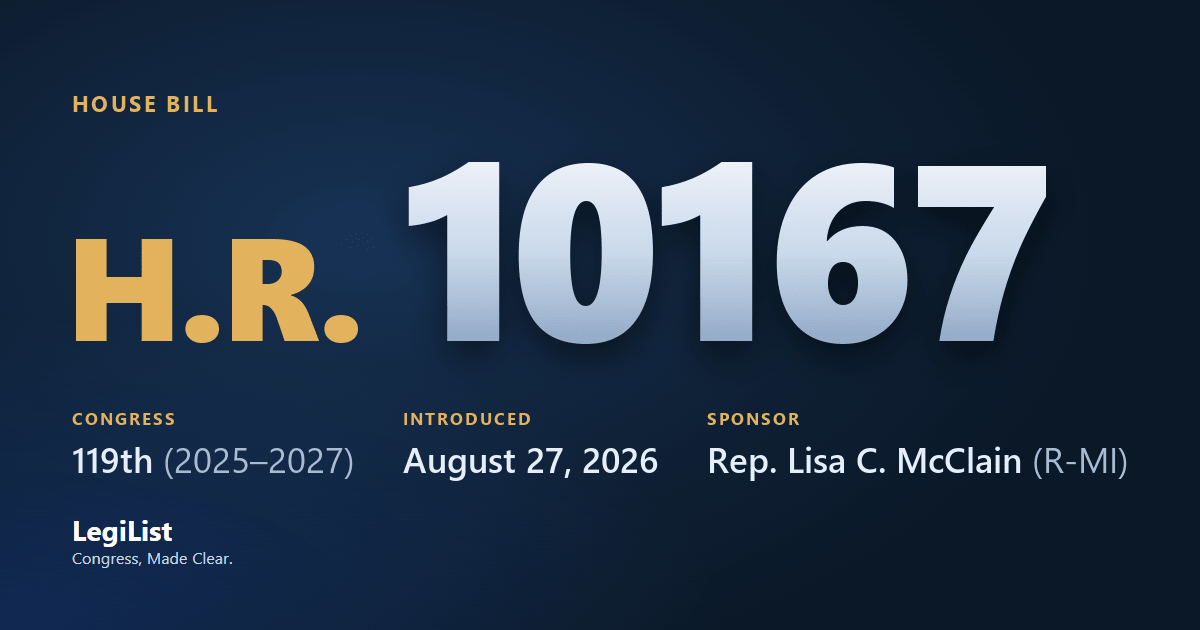
Common Cents Act
Latest action · Oct 14, 2026 Message on Senate action sent to the House.
Progress
Where this bill reached, and when. A stage with no date was not reached; one that failed a vote and later carried shows the date it carried.
- IntroducedAug 27, 2026
- Passed HouseSep 14, 2026
- Passed SenateSep 28, 2026
- To the PresidentNot reached
- Became lawNot reached
Summary
Common Cents Act
This bill ends the production of the penny for general circulation, requires rounding to an amount divisible by five for the payment or transfer of cash, and allows the nickel to be composed of different material.
The Department of the Treasury must stop producing the penny, except to meet collector needs. The penny shall continue to be legal tender.
Any person selling goods or services in a cash transaction, entering into other transfers of cash, or paying cash wages to an employee must round the payment up or down in accordance with the bill.
The bill also allows Treasury to discontinue the minting for circulation of any coin if Treasury follows procedures as outlined by the bill, including providing notice and a briefing to Congress.
The Federal Reserve Board must periodically report on a strategic plan for the acceptance of penny orders and deposits at commercial coin terminals that provide services under agreements with Federal Reserve banks.
Finally, the bill allows for a different material composition of the nickel. In addition to being made from an alloy of copper and nickel, the nickel may also be clad with an inner core of zinc and an outer layer of nickel.
Cosponsors 1
Members who signed on, in the order they did. All signed on Aug 27, 2026.
| Seat | Cosponsor | Signed on | |
|---|---|---|---|
| D-CA | Robert Garcia | Original | Aug 27, 2026 |
Committees 2
Where it was sent and what each committee and subcommittee did with it, in order.
| Chamber | Committee | What it did |
|---|---|---|
| House | Financial Services Committee | Referred Aug 27, 2026 |
| Senate | Banking, Housing, and Urban Affairs Committee | Referred Sep 15, 2026Discharged Sep 29, 2026 |
Actions 11
Everything that happened, newest first.
- Oct 14, 2026Message on Senate action sent to the House.
- Sep 28, 2026Senate Committee on Banking, Housing, and Urban Affairs discharged by Unanimous Consent. (consideration: CR S5120)
- Sep 28, 2026Passed/agreed to in Senate: Passed Senate without amendment by Unanimous Consent.
- Sep 15, 2026Received in the Senate and Read twice and referred to the Committee on Banking, Housing, and Urban Affairs.
- Sep 14, 2026Considered under suspension of the rules. (consideration: CR H5599-5602)
- Sep 14, 2026Ms. De La Cruz moved to suspend the rules and pass the bill.
- Sep 14, 2026DEBATE - The House proceeded with forty minutes of debate on H.R. 10167.
- Sep 14, 2026Passed/agreed to in House: On motion to suspend the rules and pass the bill Agreed to by voice vote. (text: CR H5599-5601)
- Sep 14, 2026Motion to reconsider laid on the table Agreed to without objection.
- Aug 27, 2026Introduced in House
- Aug 27, 2026Referred to the House Committee on Financial Services.
In the Congressional Record 3
Days the Record’s own index lists this bill, newest first, with the pages and the members it names. Pages starting H are the House, S the Senate, E Extensions of Remarks.
| Where | In the Record | Members | Date |
|---|---|---|---|
| Senate | Debate and remarks S5242 | Cynthia M. Lummis R-WY | Sep 30, 2026 |
| Senate | Debate and remarks S5120 | Mike Lee R-UT | Sep 28, 2026 |
| House | Debate and remarks H5599–H5602Text printed H5599–H5601Cost estimates H5601 | Bill Foster D-IL, Brad Sherman D-CA, Lisa C. McClain R-MI, Monica De La Cruz R-TX | Sep 14, 2026 |
Research
What has been written about this bill: committee reports, cost estimates, the sponsor’s authority statement, printed hearings and the Congressional Research Service’s work.
Constitutional authority
The sponsor’s statement, as printed in the Congressional Record, vol. 172, no. 136, August 27, 2026, page H5258.
Related bills 3
Companion bills and other measures the record links to this one.
| Bill | Title | Relationship | Latest action |
|---|---|---|---|
| S 1525 | Common Cents Act | Identical bill | Aug 10, 2026 |
| HR 3074 | Common Cents Act | Related bill | Jul 15, 2026 |
| HR 4459 | MINT Act of 2025 | Related bill | Jul 16, 2025 |
Titles 6
Every title it has carried, official and short, at each stage.
- Official Title as Introduced
- To direct the Secretary of the Treasury to stop minting the penny, to require cash transactions to be rounded up or down to the nearest 5 cents, and for other purposes.
- Short Title(s) as Introduced
- Common Cents Act
- Short Title(s) as Passed House
- Common Cents Act
- Short Titles from ENR (Enrolled) bill text
- Common Cents Act
- Short Titles from RFS (Referred to Senate) bill text
- Common Cents Act
- Official Title from EH (Engrossed in House) bill text
- To direct the Secretary of the Treasury to stop minting the penny, to require cash transactions to be rounded up or down to the nearest 5 cents, and for other purposes.
Subjects
Assigned by the Library of Congress. Policy area: Finance and Financial Sector.
Text 4
Each version as it was printed, newest first.
- —Enrolled Bill
- Sep 15, 2026Referred in Senate
- Sep 14, 2026Engrossed in House
- Aug 27, 2026Introduced in House
Everything here is as published by Congress: the summary is the Congressional Research Service's, the action wording is the clerks', and the subjects are the Library of Congress's. How far it got is read from the actions themselves, taking the most recent one of each kind, so a bill that failed a vote and later passed is shown as having passed. Records come from this bill on Congress.gov and govinfo.gov; cost estimates are the Congressional Budget Office's, and the hearings are the printed hearings GovInfo publishes, which can appear months after the hearing.