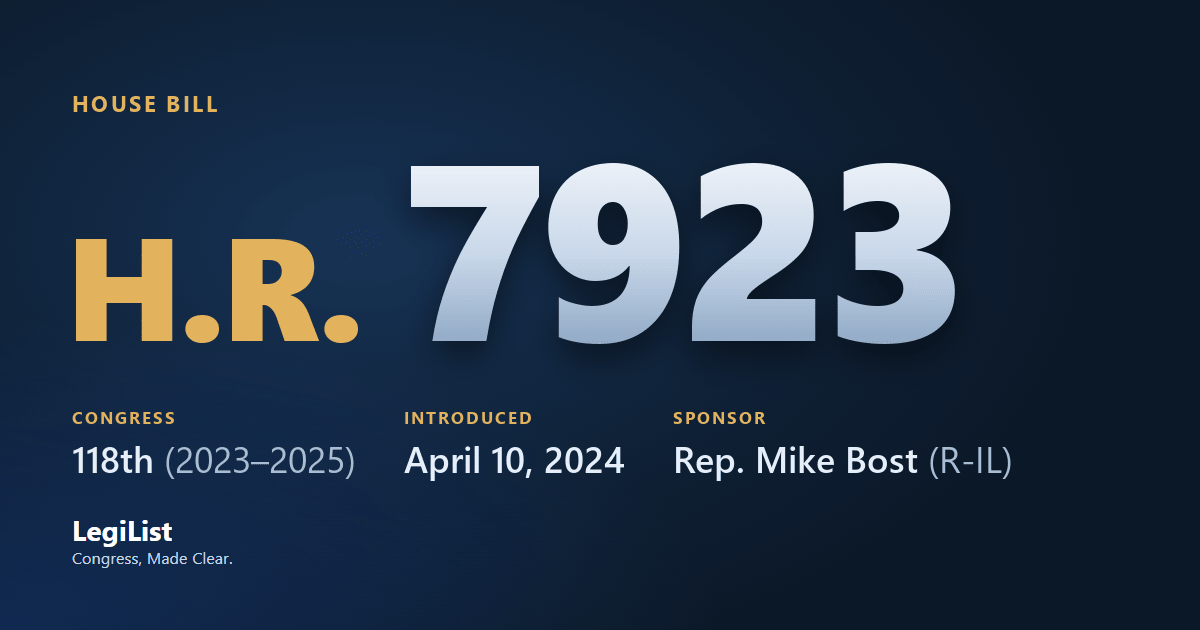
SOLAR Act
Latest action · Sep 3, 2024 Referred to the Subcommittee on Commodity Markets, Digital Assets, and Rural Development.
Progress
Where this bill reached, and when. A stage with no date was not reached; one that failed a vote and later carried shows the date it carried.
- IntroducedApr 10, 2024
- Passed HouseNot reached
- Passed SenateNot reached
- To the PresidentNot reached
- Became lawNot reached
Summary
Securing Our Lands and Resources Act or the SOLAR Act
This bill prohibits the Department of Agriculture (USDA) from providing financial assistance for certain projects that would result in the conversion of covered farmland for solar energy production.
Under the bill, covered farmland generally refers to prime farmland, unique farmland, and farmland that is of statewide or local importance. Conversion means any activity that results in the covered farmland no longer meeting certain requirements for agricultural production, activity, or use.
The bill includes an exception for certain smaller projects that have the approval or support from the local county and municipality. Any project that receives financial assistance from USDA under an exception must (1) develop a mitigation and remediation plan for the project (e.g., implementing best practices to protect future soil health and productivity), and (2) ensure that sufficient funds are provided for the decommissioning of the solar energy production system and the remediation and restoration of the farmland.
Cosponsors 4
Members who signed on, in the order they did. Signatures ran from Apr 10, 2024 to Apr 20, 2024; 3 are original cosponsors, there from the day it was introduced.
| Seat | Cosponsor | Signed on | |
|---|---|---|---|
| R-GA | Austin Scott | Original | Apr 10, 2024 |
| R-MN | Brad Finstad | Original | Apr 10, 2024 |
| R-NY | Nicholas A. Langworthy | Original | Apr 10, 2024 |
| R-WI | Derrick Van Orden | Apr 20, 2024 |
Committees 1
Where it was sent and what each committee and subcommittee did with it, in order.
| Chamber | Committee | What it did |
|---|---|---|
| House | Agriculture Committee | Referred Apr 10, 2024 |
| Commodity Markets, Digital Assets, and Rural Development Subcommittee | Referred Sep 3, 2024 |
Actions 3
Everything that happened, newest first.
- Sep 3, 2024Referred to the Subcommittee on Commodity Markets, Digital Assets, and Rural Development.
- Apr 10, 2024Introduced in House
- Apr 10, 2024Referred to the House Committee on Agriculture.
Research
What has been written about this bill: committee reports, cost estimates, the sponsor’s authority statement, printed hearings and the Congressional Research Service’s work.
Constitutional authority
The sponsor’s statement, as printed in the Congressional Record, vol. 170, no. 61, April 10, 2024, page H2290.
Titles 3
Every title it has carried, official and short, at each stage.
- Official Title as Introduced
- To limit USDA funding for ground-mounted solar energy systems, and for other purposes.
- Short Title(s) as Introduced
- SOLAR Act
- Securing Our Lands and Resources Act
Subjects
Assigned by the Library of Congress. Policy area: Agriculture and Food.
Text 1
Each version as it was printed, newest first.
- Apr 10, 2024Introduced in House
Support LegiList
This page is free, carries no paywall, and is built and maintained by one person. If the record here is useful to you, a few dollars keeps it going.
Everything here is as published by Congress: the summary is the Congressional Research Service's, the action wording is the clerks', and the subjects are the Library of Congress's. How far it got is read from the actions themselves, taking the most recent one of each kind, so a bill that failed a vote and later passed is shown as having passed. Records come from this bill on Congress.gov and govinfo.gov; cost estimates are the Congressional Budget Office's, and the hearings are the printed hearings GovInfo publishes, which can appear months after the hearing.