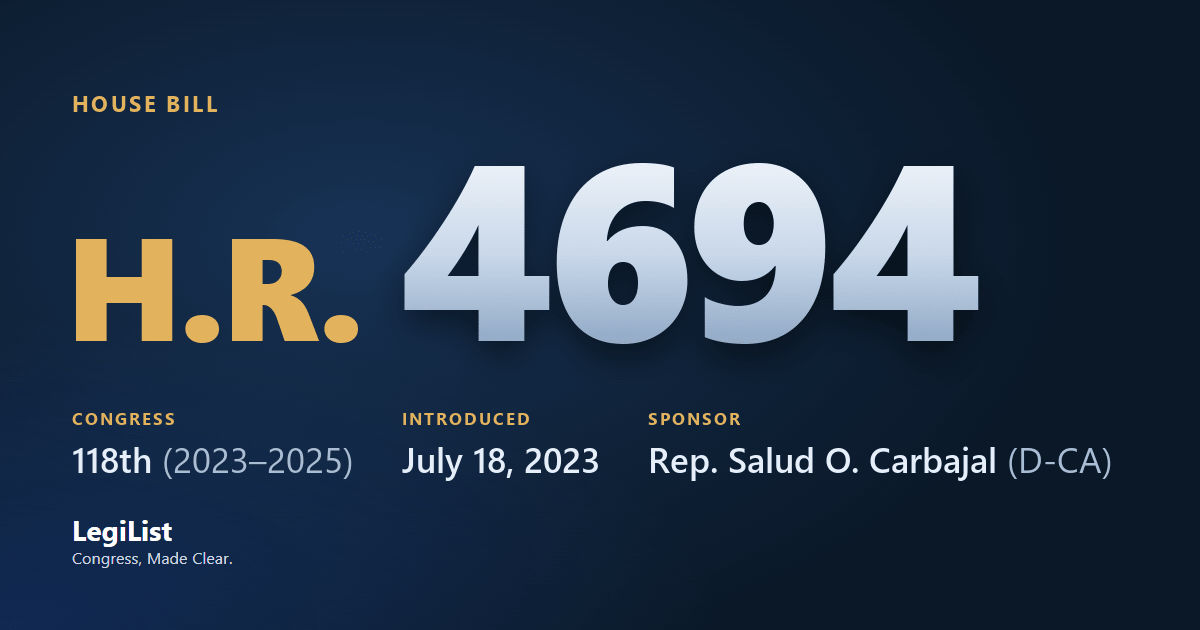
Protect Patriot Parents Act
Latest action · Jul 18, 2023 Referred to the House Committee on the Judiciary.
Progress
Where this bill reached, and when. A stage with no date was not reached; one that failed a vote and later carried shows the date it carried.
- IntroducedJul 18, 2023
- Passed HouseNot reached
- Passed SenateNot reached
- To the PresidentNot reached
- Became lawNot reached
Summary
Protect Patriot Parents Act
This bill makes certain non-U.S. nationals (aliens under federal law) who are parents of a veteran eligible for lawful permanent resident status (also known as a green card).
To be eligible for a green card, an individual must be a parent of a U.S. citizen who serves or served in the Armed Forces. If the U.S. citizen has been discharged from the Armed Forces, such discharge must be under honorable conditions.
Certain factors that would otherwise make an individual inadmissible, such as having entered the United States without being admitted, shall not apply to a parent seeking a green card under this bill. The Department of Homeland Security (DHS) may also waive certain factors that would otherwise make an individual inadmissible, such as having misrepresented a material fact to secure a visa, if the individual does not pose a threat to the public and has not committed any crimes that are unrelated to immigration status.
An eligible individual who was previously removed from (or permitted to leave) the United States before this bill's enactment may apply for a green card under this bill from abroad. DHS and the Department of State must also establish a program where an eligible individual who has applied for a green card under this bill may be admitted into the United States as a nonimmigrant while the application is pending, if DHS and the State Department determine that the individual does not pose a threat to the public or national security.
Cosponsors 2
Members who signed on, in the order they did. All signed on Jul 18, 2023.
| Seat | Cosponsor | Signed on | |
|---|---|---|---|
| D-FL | Darren Soto | Original | Jul 18, 2023 |
| R-FL | Maria Elvira Salazar | Original | Jul 18, 2023 |
Committees 1
Where it was sent and what each committee and subcommittee did with it, in order.
| Chamber | Committee | What it did |
|---|---|---|
| House | Judiciary Committee | Referred Jul 18, 2023 |
Actions 2
Everything that happened, newest first.
- Jul 18, 2023Introduced in House
- Jul 18, 2023Referred to the House Committee on the Judiciary.
Research
What has been written about this bill: committee reports, cost estimates, the sponsor’s authority statement, printed hearings and the Congressional Research Service’s work.
Constitutional authority
The sponsor’s statement, as printed in the Congressional Record, vol. 169, no. 123, July 18, 2023, page H3700.
Related bills 2
Companion bills and other measures the record links to this one.
| Bill | Title | Relationship | Latest action |
|---|---|---|---|
| HR 454 | Protect Patriot Parents Act | Reintroduction of | Mar 5, 2021 |
| HR 4722 | Protect Patriot Spouses Act | Related bill | Jul 18, 2023 |
Titles 2
Every title it has carried, official and short, at each stage.
- Official Title as Introduced
- To render certain military parents eligible for adjustment of status, and for other purposes.
- Short Title(s) as Introduced
- Protect Patriot Parents Act
Subjects
Assigned by the Library of Congress. Policy area: Immigration.
Text 1
Each version as it was printed, newest first.
- Jul 18, 2023Introduced in House
Support LegiList
This page is free, carries no paywall, and is built and maintained by one person. If the record here is useful to you, a few dollars keeps it going.
Everything here is as published by Congress: the summary is the Congressional Research Service's, the action wording is the clerks', and the subjects are the Library of Congress's. How far it got is read from the actions themselves, taking the most recent one of each kind, so a bill that failed a vote and later passed is shown as having passed. Records come from this bill on Congress.gov and govinfo.gov; cost estimates are the Congressional Budget Office's, and the hearings are the printed hearings GovInfo publishes, which can appear months after the hearing.