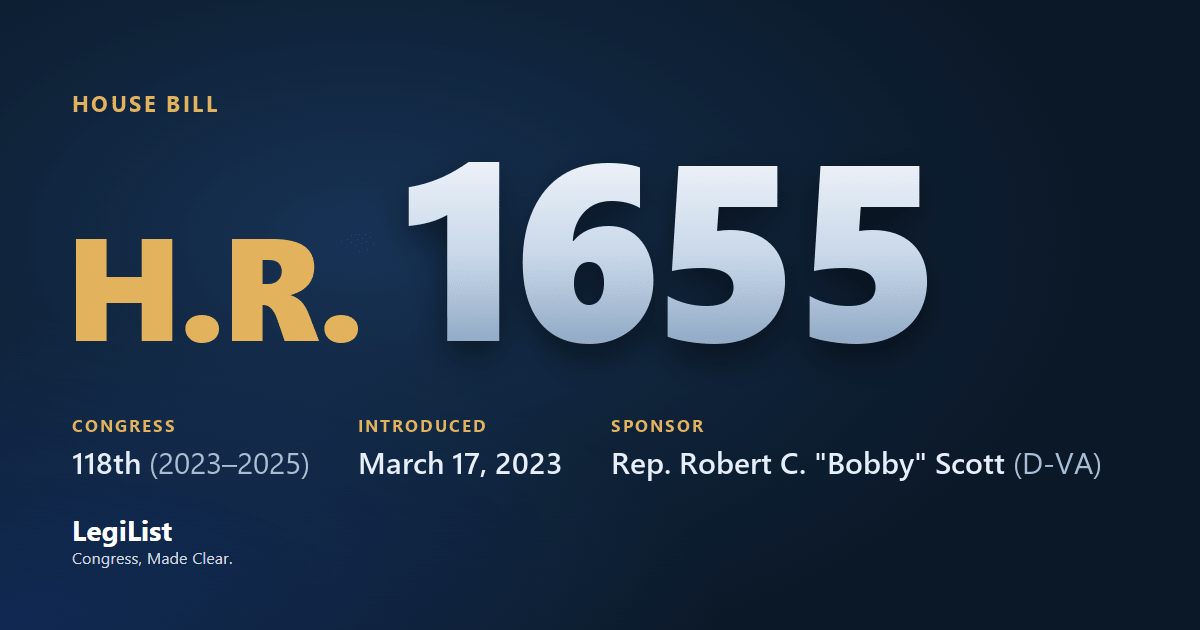
Jobs to Compete Act
Latest action · Mar 17, 2023 Referred to the House Committee on Education and the Workforce.
Progress
Where this bill reached, and when. A stage with no date was not reached; one that failed a vote and later carried shows the date it carried.
- IntroducedMar 17, 2023
- Passed HouseNot reached
- Passed SenateNot reached
- To the PresidentNot reached
- Became lawNot reached
Summary
Jobs to Compete Act
This bill expands student eligibility for Pell Grants by establishing the Workforce Pell Grants Program.
Specifically, the bill requires the Department of Education (ED) to award Workforce Pell Grants to students enrolled in eligible short-term programs.
The bill outlines eligibility requirements for programs seeking to offer their students these Workforce Pell Grants. An eligible program is one that
- provides at least 150 clock hours of instruction, but less than 600 clock hours of instruction, during a minimum of 8 weeks, but less than 15 weeks;
- provides an education aligned with the requirements of high-skill, high-wage, or in-demand industry sectors or occupations in the state or local area of the program (as determined by an accrediting agency or association recognized by ED);
- provides a student with a recognized postsecondary credential that is stackable and portable across multiple employers and geographical areas;
- has a verified completion rate of at least 70%;
- has a verified employment placement rate of at least 70%; and
- meets other eligibility criteria.
ED shall have the final determination of whether a program meets the bill's eligibility requirements.
Additionally, the bill requires ED and the Department of Labor to coordinate and collect data related to these workforce programs.
ED must annually collect and publish information on the College Scorecard regarding each eligible program, including job outcomes. The College Scorecard is a comparison tool for information on school sizes, settings, graduation rates, average costs, and salary ranges per field of study.
Cosponsors 4
Members who signed on, in the order they did. Signatures ran from Mar 17, 2023 to Apr 19, 2023; 2 are original cosponsors, there from the day it was introduced.
| Seat | Cosponsor | Signed on | |
|---|---|---|---|
| D-DC | Eleanor Holmes Norton | Original | Mar 17, 2023 |
| D-DE | Lisa Blunt Rochester | Original | Mar 17, 2023 |
| D-IN | André Carson | Mar 22, 2023 | |
| D-CA | Mark DeSaulnier | Apr 19, 2023 |
Committees 1
Where it was sent and what each committee and subcommittee did with it, in order.
| Chamber | Committee | What it did |
|---|---|---|
| House | Education and Workforce Committee | Referred Mar 17, 2023 |
Actions 2
Everything that happened, newest first.
- Mar 17, 2023Introduced in House
- Mar 17, 2023Referred to the House Committee on Education and the Workforce.
Research
What has been written about this bill: committee reports, cost estimates, the sponsor’s authority statement, printed hearings and the Congressional Research Service’s work.
Constitutional authority
The sponsor’s statement, as printed in the Congressional Record, vol. 169, no. 50, March 17, 2023, page H1296.
CRS reports 1
Congressional Research Service work that CRS links to this bill or the law it became, newest first.
Cite it 1
Products on other subjects that cite it, usually among other measures.
| Product | Title | Kind | Published |
|---|---|---|---|
| R47647 | Pell Grants for Short-Term Programs: Background and Legislation in the 118th Congress | Report | Aug 24, 2023 |
Titles 2
Every title it has carried, official and short, at each stage.
- Official Title as Introduced
- To amend the Higher Education Act of 1965 to extend Federal Pell Grant eligibility to certain short-term workforce programs.
- Short Title(s) as Introduced
- Jobs to Compete Act
Subjects
Assigned by the Library of Congress. Policy area: Education.
Text 1
Each version as it was printed, newest first.
- Mar 17, 2023Introduced in House
Everything here is as published by Congress: the summary is the Congressional Research Service's, the action wording is the clerks', and the subjects are the Library of Congress's. How far it got is read from the actions themselves, taking the most recent one of each kind, so a bill that failed a vote and later passed is shown as having passed. Records come from this bill on Congress.gov and govinfo.gov; cost estimates are the Congressional Budget Office's, and the hearings are the printed hearings GovInfo publishes, which can appear months after the hearing.