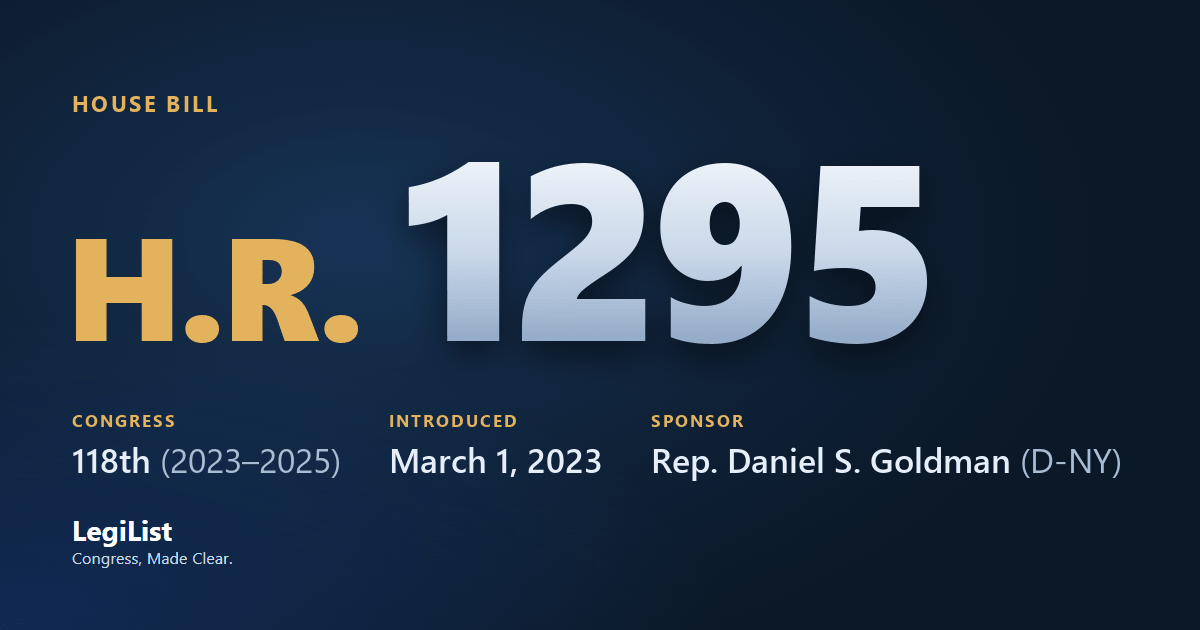
Early Voting Act
Latest action · Mar 1, 2023 Referred to the House Committee on House Administration.
Progress
Where this bill reached, and when. A stage with no date was not reached; one that failed a vote and later carried shows the date it carried.
- IntroducedMar 1, 2023
- Passed HouseNot reached
- Passed SenateNot reached
- To the PresidentNot reached
- Became lawNot reached
Summary
Early Voting Act
This bill expands early in-person voting.
The bill generally requires each state to allow individuals to vote in federal elections during an early voting period of at least 15 days. This requirement does not apply to jurisdictions that send a mail-in ballot to every registered voter.
Further, states and jurisdictions must ensure that polling places are accessible by public transportation, located in rural areas, and located on each branch campus of an institution of higher education.
The Election Assistance Commission must issue certain voluntary standards for early voting, including the nondiscriminatory geographic placement of polling places.
Finally, states and jurisdictions must begin processing and scanning ballots cast during the early voting period at least 14 days prior to election day. However, states and jurisdictions cannot tabulate ballots before the polls close on election day unless the tabulation is necessary and performed in accordance with existing state law.
Cosponsors 3
Members who signed on, in the order they did. Signatures ran from Aug 22, 2023 to Jan 29, 2024.
| Seat | Cosponsor | Signed on | |
|---|---|---|---|
| D-FL | Debbie Wasserman Schultz | Aug 22, 2023 | |
| D-CA | Adam B. Schiff | Sep 12, 2023 | |
| D-DC | Eleanor Holmes Norton | Jan 29, 2024 |
Committees 1
Where it was sent and what each committee and subcommittee did with it, in order.
| Chamber | Committee | What it did |
|---|---|---|
| House | Committee on House Administration | Referred Mar 1, 2023 |
Actions 2
Everything that happened, newest first.
- Mar 1, 2023Introduced in House
- Mar 1, 2023Referred to the House Committee on House Administration.
Research
What has been written about this bill: committee reports, cost estimates, the sponsor’s authority statement, printed hearings and the Congressional Research Service’s work.
Constitutional authority
The sponsor’s statement, as printed in the Congressional Record, vol. 169, no. 39, March 1, 2023, page H1051.
CRS reports 1
Congressional Research Service work that CRS links to this bill or the law it became, newest first.
Cite it 1
Products on other subjects that cite it, usually among other measures.
| Product | Title | Kind | Published |
|---|---|---|---|
| IF11477 | Early Voting and Mail Voting: Overview and Issues for Congress | Resource | Jul 10, 2026 |
Related bills 3
Companion bills and other measures the record links to this one.
| Bill | Title | Relationship | Latest action |
|---|---|---|---|
| S 1 | Freedom to Vote Act | Related bill | Jul 25, 2023 |
| HR 11 | Freedom to Vote Act | Related bill | Dec 17, 2024 |
| S 2344 | Freedom to Vote Act | Related bill | Jul 18, 2023 |
Titles 2
Every title it has carried, official and short, at each stage.
- Official Title as Introduced
- To amend the Help America Vote Act of 2002 to allow individuals to vote in an election for Federal office during an early voting period which occurs prior to the date of the election, and for other purposes.
- Short Title(s) as Introduced
- Early Voting Act
Subjects
Assigned by the Library of Congress. Policy area: Government Operations and Politics.
Text 1
Each version as it was printed, newest first.
- Mar 1, 2023Introduced in House
Support LegiList
This page is free, carries no paywall, and is built and maintained by one person. If the record here is useful to you, a few dollars keeps it going.
Everything here is as published by Congress: the summary is the Congressional Research Service's, the action wording is the clerks', and the subjects are the Library of Congress's. How far it got is read from the actions themselves, taking the most recent one of each kind, so a bill that failed a vote and later passed is shown as having passed. Records come from this bill on Congress.gov and govinfo.gov; cost estimates are the Congressional Budget Office's, and the hearings are the printed hearings GovInfo publishes, which can appear months after the hearing.