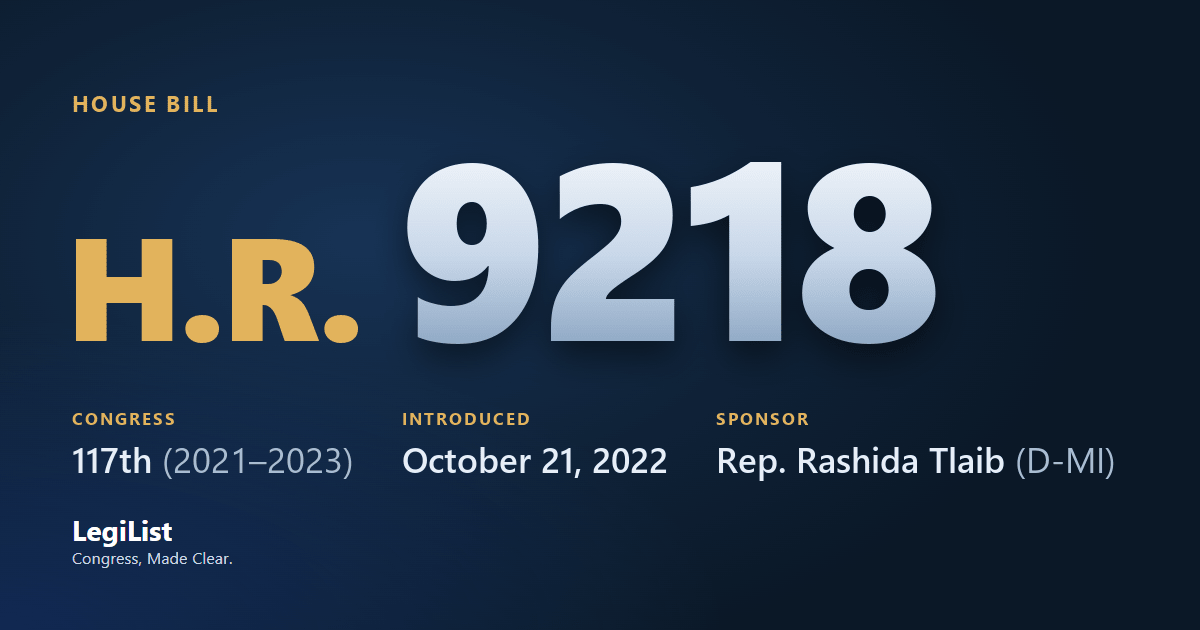
Cumulative Impacts Act of 2022
Latest action · Oct 24, 2022 Referred to the Subcommittee on Water Resources and Environment.
Progress
Where this bill reached, and when. A stage with no date was not reached; one that failed a vote and later carried shows the date it carried.
- IntroducedOct 21, 2022
- Passed HouseNot reached
- Passed SenateNot reached
- To the PresidentNot reached
- Became lawNot reached
Summary
Cumulative Impacts Act of 2022
This bill directs the Environmental Protection Agency (EPA) to determine whether issuing or renewing certain permits under the Clean Air Act and Clean Water Act will have cumulative impacts that will harm the health of the general population, or to any potentially exposed or susceptible subpopulation. If the EPA determines that, due to those potential cumulative impacts, there does not exist a reasonable certainty of no harm to the health to such populations, then the EPA must deny the permit application.
Cosponsors
Members who signed on, in the order they did.
Committees 2
Where it was sent and what each committee and subcommittee did with it, in order.
| Chamber | Committee | What it did |
|---|---|---|
| House | Energy and Commerce Committee | Referred Oct 21, 2022 |
| Environment Subcommittee | Referred Oct 24, 2022 | |
| House | Transportation and Infrastructure Committee | Referred Oct 21, 2022 |
| Water Resources and Environment Subcommittee | Referred Oct 24, 2022 |
Actions 4
Everything that happened, newest first.
- Oct 24, 2022Referred to the Subcommittee on Environment and Climate Change.
- Oct 24, 2022Referred to the Subcommittee on Water Resources and Environment.
- Oct 21, 2022Introduced in House
- Oct 21, 2022Referred to the Committee on Energy and Commerce, and in addition to the Committee on Transportation and Infrastructure, for a period to be subsequently determined by the Speaker, in each case for consideration of such provisions as fall within the jurisdiction of the committee concerned.
Research
What has been written about this bill: committee reports, cost estimates, the sponsor’s authority statement, printed hearings and the Congressional Research Service’s work.
Constitutional authority
The sponsor’s statement, as printed in the Congressional Record, vol. 168, no. 166, October 21, 2022, page H8409.
Related bills 3
Companion bills and other measures the record links to this one.
| Bill | Title | Relationship | Latest action |
|---|---|---|---|
| S 872 | Environmental Justice For All Act | Related bill | Mar 18, 2021 |
| HR 2021 | Environmental Justice For All Act | Related bill | Dec 30, 2022 |
| HR 4592 | Cumulative Impacts Act of 2023 | Reintroduced Bill | Jul 20, 2023 |
Titles 2
Every title it has carried, official and short, at each stage.
- Official Title as Introduced
- To establish a Federal program of cumulative impact assessments under the Clean Water Act and Clean Air Act, and for other purposes.
- Short Title(s) as Introduced
- Cumulative Impacts Act of 2022
Subjects
Assigned by the Library of Congress. Policy area: Environmental Protection.
Text 1
Each version as it was printed, newest first.
- Oct 21, 2022Introduced in House
Everything here is as published by Congress: the summary is the Congressional Research Service's, the action wording is the clerks', and the subjects are the Library of Congress's. How far it got is read from the actions themselves, taking the most recent one of each kind, so a bill that failed a vote and later passed is shown as having passed. Records come from this bill on Congress.gov and govinfo.gov; cost estimates are the Congressional Budget Office's, and the hearings are the printed hearings GovInfo publishes, which can appear months after the hearing.