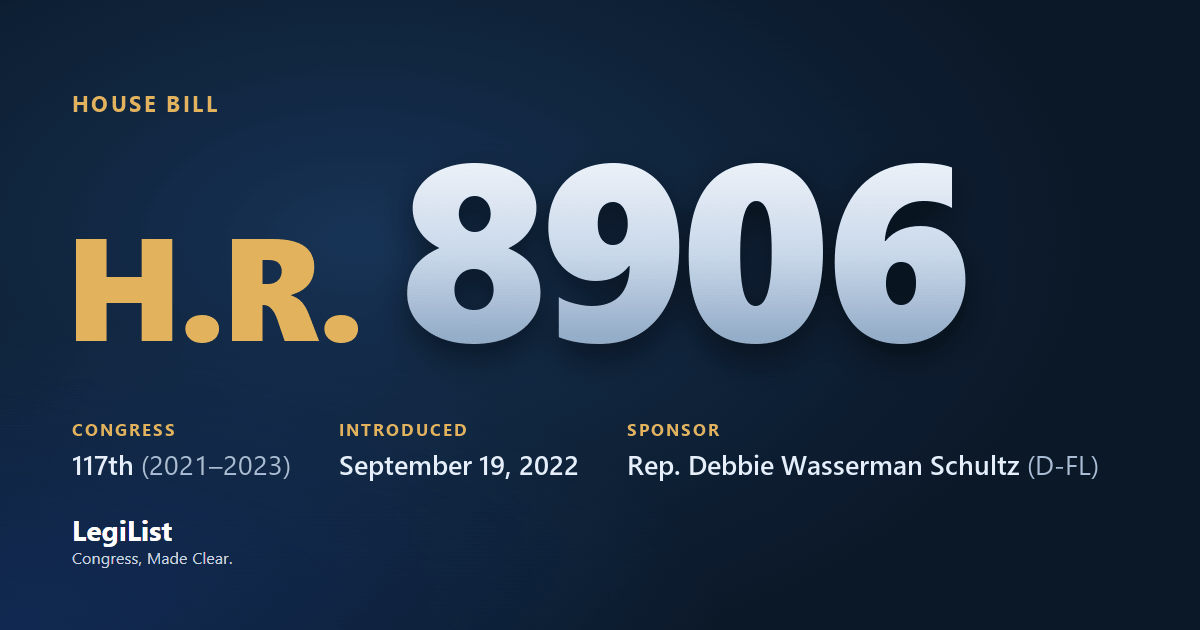
To provide for retroactive application of Generalized System of Preferences for the period after December 31, 2020, and before September 1, 2022.
Latest action · Sep 19, 2022 Referred to the House Committee on Ways and Means.
Progress
Where this bill reached, and when. A stage with no date was not reached; one that failed a vote and later carried shows the date it carried.
- IntroducedSep 19, 2022
- Passed HouseNot reached
- Passed SenateNot reached
- To the PresidentNot reached
- Became lawNot reached
Summary
This bill retroactively applies the Generalized System of Preferences (a U.S. trade preference program that provides duty-free access to imports on products from certain developing countries) for the period after December 31, 2020, and before September 1, 2022. These covered articles shall be liquidated or reliquidated as though entry occurred on December 31, 2020.
A request for liquidation or reliquidation must be filed with U.S. Customs and Border Protection (CBP) and such request must contain sufficient information for CBP to locate the entry or, if the entry cannot be located, reconstruct the entry.
Any amounts owed by the United States pursuant to liquidation or reliquidation of an entry of a covered article shall be paid without interest.
Cosponsors 20
Members who signed on, in the order they did. Signatures ran from Sep 19, 2022 to Dec 14, 2022; 2 are original cosponsors, there from the day it was introduced.
| Seat | Cosponsor | Signed on | |
|---|---|---|---|
| D-FL | Darren Soto | Original | Sep 19, 2022 |
| R-FL | Mario Diaz-Balart | Original | Sep 19, 2022 |
| R-FL | Maria Elvira Salazar | Sep 20, 2022 | |
| D-FL | Frederica S. Wilson | Sep 21, 2022 | |
| R-FL | John H. Rutherford | Sep 29, 2022 | |
| D-PA | Madeleine Dean | Oct 4, 2022 | |
| D-MA | Jake Auchincloss | Oct 7, 2022 | |
| D-CO | Diana DeGette | Oct 14, 2022 | |
| D-FL | Stephanie N. Murphy | Oct 14, 2022 | |
| D-MD | C. A. Dutch Ruppersberger | Nov 10, 2022 | |
| D-CA | Eric Swalwell | Nov 10, 2022 | |
| D-CA | Ted Lieu | Nov 10, 2022 | |
| D-NC | Deborah K. Ross | Nov 14, 2022 | |
| R-PA | Brian K. Fitzpatrick | Nov 29, 2022 | |
| R-KS | Jake LaTurner | Dec 1, 2022 | |
| D-FL | Sheila Cherfilus-McCormick | Dec 7, 2022 | |
| D-PA | Susan Wild | Dec 7, 2022 | |
| D-CA | Jimmy Panetta | Dec 13, 2022 | |
| D-NC | Kathy E. Manning | Dec 14, 2022 | |
| D-KS | Sharice Davids | Dec 14, 2022 |
Committees 1
Where it was sent and what each committee and subcommittee did with it, in order.
| Chamber | Committee | What it did |
|---|---|---|
| House | Ways and Means Committee | Referred Sep 19, 2022 |
Actions 2
Everything that happened, newest first.
- Sep 19, 2022Introduced in House
- Sep 19, 2022Referred to the House Committee on Ways and Means.
Research
What has been written about this bill: committee reports, cost estimates, the sponsor’s authority statement, printed hearings and the Congressional Research Service’s work.
Constitutional authority
The sponsor’s statement, as printed in the Congressional Record, vol. 168, no. 150, September 19, 2022, page H7967.
Titles 1
Every title it has carried, official and short, at each stage.
- Official Title as Introduced
- To provide for retroactive application of Generalized System of Preferences for the period after December 31, 2020, and before September 1, 2022.
Subjects
Assigned by the Library of Congress. Policy area: Foreign Trade and International Finance.
Text 1
Each version as it was printed, newest first.
- Sep 19, 2022Introduced in House
Everything here is as published by Congress: the summary is the Congressional Research Service's, the action wording is the clerks', and the subjects are the Library of Congress's. How far it got is read from the actions themselves, taking the most recent one of each kind, so a bill that failed a vote and later passed is shown as having passed. Records come from this bill on Congress.gov and govinfo.gov; cost estimates are the Congressional Budget Office's, and the hearings are the printed hearings GovInfo publishes, which can appear months after the hearing.