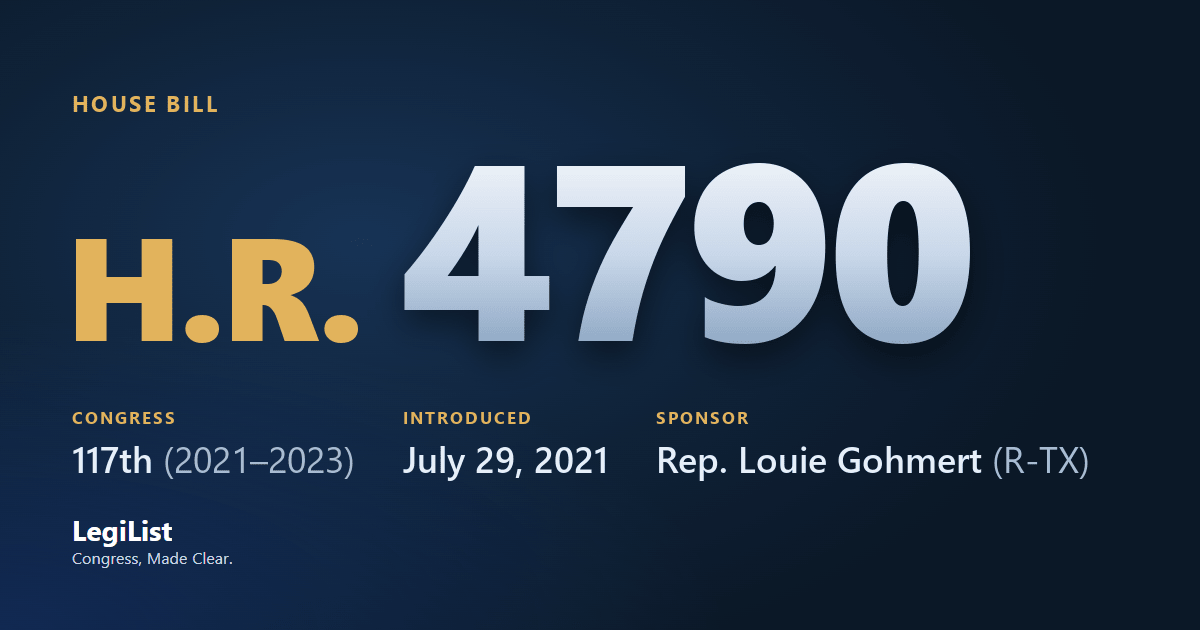
Service Member SCOTUS Act of 2021
Latest action · Nov 1, 2022 Referred to the Subcommittee on Courts, Intellectual Property, and the Internet.
Progress
Where this bill reached, and when. A stage with no date was not reached; one that failed a vote and later carried shows the date it carried.
- IntroducedJul 29, 2021
- Passed HouseNot reached
- Passed SenateNot reached
- To the PresidentNot reached
- Became lawNot reached
Summary
Service Member SCOTUS Act of 2021
This bill authorizes the Supreme Court to review by writ of certiorari certain cases in which the Court of Appeals for the Armed Forces has denied a petition for review or relief.
Cosponsors 5
Members who signed on, in the order they did. Signatures ran from Jul 29, 2021 to Aug 10, 2021; 1 is an original cosponsor, there from the day it was introduced.
| Seat | Cosponsor | Signed on | |
|---|---|---|---|
| R-AZ | Paul A. Gosar | Original | Jul 29, 2021 |
| R-VA | Bob Good | Jul 30, 2021 | |
| R-FL | Daniel Webster | Jul 30, 2021 | |
| R-FL | W. Gregory Steube | Aug 3, 2021 | |
| R-AL | Barry Moore | Aug 10, 2021 |
Committees 1
Where it was sent and what each committee and subcommittee did with it, in order.
| Chamber | Committee | What it did |
|---|---|---|
| House | Judiciary Committee | Referred Jul 29, 2021 |
| Courts, Intellectual Property, Artificial Intelligence, and the Internet Subcommittee | Referred Nov 1, 2022 |
Actions 3
Everything that happened, newest first.
- Nov 1, 2022Referred to the Subcommittee on Courts, Intellectual Property, and the Internet.
- Jul 29, 2021Introduced in House
- Jul 29, 2021Referred to the House Committee on the Judiciary.
Research
What has been written about this bill: committee reports, cost estimates, the sponsor’s authority statement, printed hearings and the Congressional Research Service’s work.
Constitutional authority
The sponsor’s statement, as printed in the Congressional Record, vol. 167, no. 133, July 29, 2021, page H4293.
Titles 2
Every title it has carried, official and short, at each stage.
- Official Title as Introduced
- To amend titles 10 and 28, United States Code, to allow for certiorari review of certain cases denied relief or review by the United States Court of Appeals for the Armed Forces.
- Short Title(s) as Introduced
- Service Member SCOTUS Act of 2021
Subjects
Assigned by the Library of Congress. Policy area: Armed Forces and National Security.
Text 1
Each version as it was printed, newest first.
- Jul 29, 2021Introduced in House
Support LegiList
This page is free, carries no paywall, and is built and maintained by one person. If the record here is useful to you, a few dollars keeps it going.
Everything here is as published by Congress: the summary is the Congressional Research Service's, the action wording is the clerks', and the subjects are the Library of Congress's. How far it got is read from the actions themselves, taking the most recent one of each kind, so a bill that failed a vote and later passed is shown as having passed. Records come from this bill on Congress.gov and govinfo.gov; cost estimates are the Congressional Budget Office's, and the hearings are the printed hearings GovInfo publishes, which can appear months after the hearing.