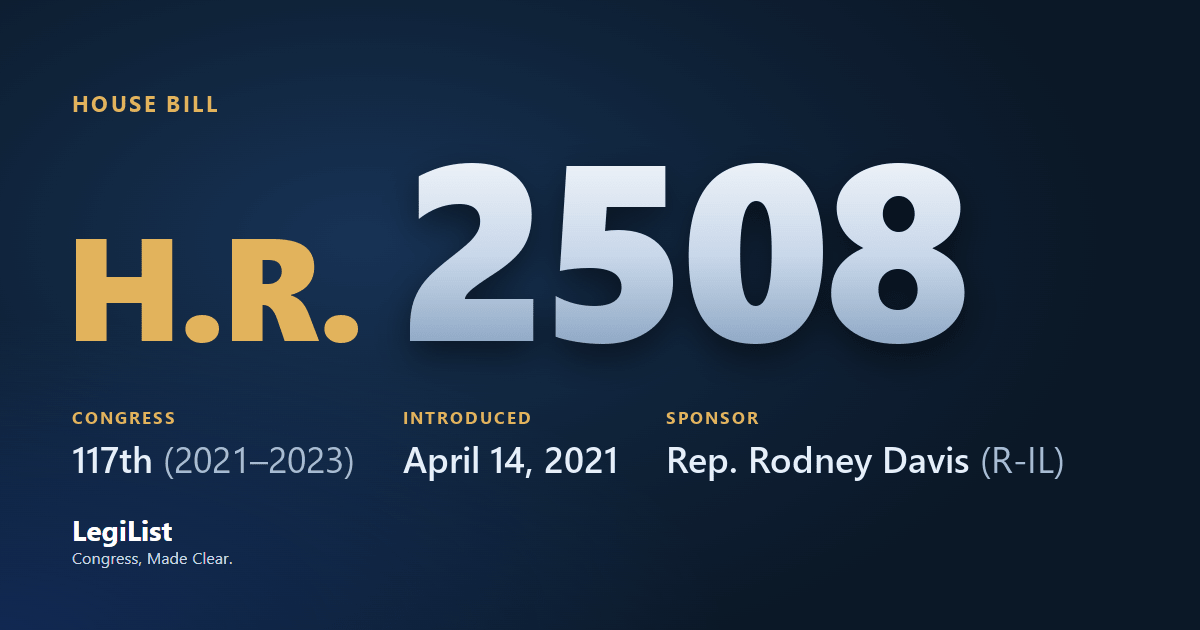
Naturally Offsetting Emissions by Managing and Implementing Tillage Strategies Act of 2021
Latest action · Apr 14, 2021 Referred to the House Committee on Agriculture.
Progress
Where this bill reached, and when. A stage with no date was not reached; one that failed a vote and later carried shows the date it carried.
- IntroducedApr 14, 2021
- Passed HouseNot reached
- Passed SenateNot reached
- To the PresidentNot reached
- Became lawNot reached
Summary
Naturally Offsetting Emissions by Managing and Implementing Tillage Strategies Act of 2021 or the NO EMITS Act
This bill directs the Department of Agriculture (USDA) to carry out activities to improve soil health, including to address climate change.
Specifically, USDA must
- establish a program that provides agricultural producers incentives (i.e., payments) for and technical assistance with adopting or maintaining practices or cropping systems to improve soil health,
- award grants to states and Indian tribes for implementing soil health programs, and
- use a portion of funds of the Commodity Credit Corporation to provide agricultural producers with technical assistance for mitigating and adapting to climate change.
The bill also (1) makes practices related to livestock production eligible for certain competitive grants under the On-Farm Conservation Innovation Trials program, and (2) increases funding for the program.
Cosponsors 2
Members who signed on, in the order they did. All signed on Apr 20, 2021.
| Seat | Cosponsor | Signed on | |
|---|---|---|---|
| R-NE | Don Bacon | Apr 20, 2021 | |
| R-AR | Eric A. "Rick" Crawford | Apr 20, 2021 |
Committees 1
Where it was sent and what each committee and subcommittee did with it, in order.
| Chamber | Committee | What it did |
|---|---|---|
| House | Agriculture Committee | Referred Apr 14, 2021 |
Actions 2
Everything that happened, newest first.
- Apr 14, 2021Introduced in House
- Apr 14, 2021Referred to the House Committee on Agriculture.
Research
What has been written about this bill: committee reports, cost estimates, the sponsor’s authority statement, printed hearings and the Congressional Research Service’s work.
Constitutional authority
The sponsor’s statement, as printed in the Congressional Record, vol. 167, no. 64, April 14, 2021, page H1790.
Printed hearings 1
Hearings whose printed record names this bill, newest first: hearings on it, and wider hearings where it came up.
| Number | Hearing | Committee | Held |
|---|---|---|---|
| Serial No. 117-16 | AMERICA'S NATURAL SOLUTIONS: THE CLIMATE BENEFITS OF INVESTING IN HEALTHY ECOSYSTEMS93 pages | Select Committee on the Climate Crisis | Apr 1, 2022 |
Titles 2
Every title it has carried, official and short, at each stage.
- Official Title as Introduced
- To amend the Food Security Act of 1985 to optimize the sequestration of carbon and the reduction of net emissions through agricultural practices, and for other purposes.
- Short Title(s) as Introduced
- Naturally Offsetting Emissions by Managing and Implementing Tillage Strategies Act of 2021
Subjects
Assigned by the Library of Congress. Policy area: Agriculture and Food.
- Accounting and auditing
- Agricultural conservation and pollution
- Agricultural practices and innovations
- Agriculture and Food
- Air quality
- Climate change and greenhouse gases
- Commodity Credit Corporation
- Farmland
- Government corporations and government-sponsored enterprises
- Livestock
- Public contracts and procurement
Text 1
Each version as it was printed, newest first.
- Apr 14, 2021Introduced in House
Support LegiList
This page is free, carries no paywall, and is built and maintained by one person. If the record here is useful to you, a few dollars keeps it going.
Everything here is as published by Congress: the summary is the Congressional Research Service's, the action wording is the clerks', and the subjects are the Library of Congress's. How far it got is read from the actions themselves, taking the most recent one of each kind, so a bill that failed a vote and later passed is shown as having passed. Records come from this bill on Congress.gov and govinfo.gov; cost estimates are the Congressional Budget Office's, and the hearings are the printed hearings GovInfo publishes, which can appear months after the hearing.