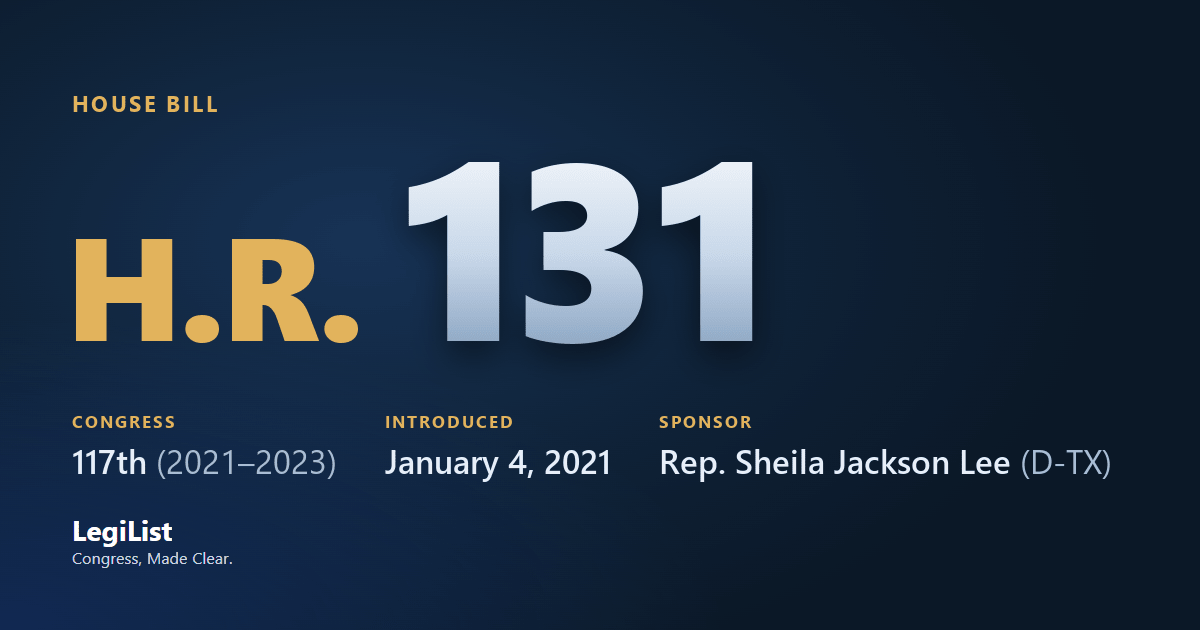
Kalief’s Law
Latest action · Mar 1, 2021 Referred to the Subcommittee on Crime, Terrorism, and Homeland Security.
Progress
Where this bill reached, and when. A stage with no date was not reached; one that failed a vote and later carried shows the date it carried.
- IntroducedJan 4, 2021
- Passed HouseNot reached
- Passed SenateNot reached
- To the PresidentNot reached
- Became lawNot reached
Summary
Effective and Humane Treatment of Youth Act of 2021 or Kalief's Law
This bill establishes requirements for the treatment of youth in the criminal justice system at the federal, state, and local levels. A youth is an individual who is 21 years of age or younger.
At the federal level, the bill
- requires federal law enforcement officers to record youth custodial interrogations,
- limits the use of solitary confinement for youth at federal facilities, and
- limits the use of restraints on youth during federal court proceedings.
At the state and local levels, the bill places conditions on existing grants and establishes a new grant to incentivize the implementation of similar policies with respect to youth.
First, the bill reauthorizes the Juvenile Accountability Block Grant program for FY2021-FY2025. To be eligible for grant funds, state and local governments must implement policies that, with respect to youth, provide a right to speedy trial, provide a right to timely bail consideration, and restrict the use of solitary confinement.
Second, a state or local government that receives funding under the Edward Byrne Memorial Justice Assistance Grant program or the Community Oriented Policing Services program must implement policies and training on police-youth interaction.
Third, the bill directs the Department of Justice to award grants to help state and local governments record youth custodial interrogations.
Cosponsors
Members who signed on, in the order they did.
Committees 1
Where it was sent and what each committee and subcommittee did with it, in order.
| Chamber | Committee | What it did |
|---|---|---|
| House | Judiciary Committee | Referred Jan 4, 2021 |
| Crime and Federal Government Surveillance Subcommittee | Referred Mar 1, 2021 |
Actions 3
Everything that happened, newest first.
- Mar 1, 2021Referred to the Subcommittee on Crime, Terrorism, and Homeland Security.
- Jan 4, 2021Introduced in House
- Jan 4, 2021Referred to the House Committee on the Judiciary.
Research
What has been written about this bill: committee reports, cost estimates, the sponsor’s authority statement, printed hearings and the Congressional Research Service’s work.
Constitutional authority
The sponsor’s statement, as printed in the Congressional Record, vol. 167, no. 2, January 4, 2021, page H54.
Related bills 1
Companion bills and other measures the record links to this one.
| Bill | Title | Relationship | Latest action |
|---|---|---|---|
| HR 44 | Kalief’s Law | Reintroduced Bill | Jan 9, 2023 |
Titles 3
Every title it has carried, official and short, at each stage.
- Official Title as Introduced
- To amend the Omnibus Crime Control and Safe Streets Act of 1968 to provide for the humane treatment of youths who are in police custody, and for other purposes.
- Short Title(s) as Introduced
- Kalief’s Law
- Effective and Humane Treatment of Youth Act of 2021
Subjects
Assigned by the Library of Congress. Policy area: Crime and Law Enforcement.
- Child health
- Child safety and welfare
- Community life and organization
- Congressional oversight
- Correctional facilities and imprisonment
- Crime and Law Enforcement
- Criminal investigation, prosecution, interrogation
- Criminal procedure and sentencing
- Detention of persons
- Due process and equal protection
- Evidence and witnesses
- Government studies and investigations
- Juvenile crime and gang violence
- Law enforcement administration and funding
- Law enforcement officers
- Lawyers and legal services
- Mental health
- Sound recording
- State and local government operations
Text 1
Each version as it was printed, newest first.
- Jan 4, 2021Introduced in House
Support LegiList
This page is free, carries no paywall, and is built and maintained by one person. If the record here is useful to you, a few dollars keeps it going.
Everything here is as published by Congress: the summary is the Congressional Research Service's, the action wording is the clerks', and the subjects are the Library of Congress's. How far it got is read from the actions themselves, taking the most recent one of each kind, so a bill that failed a vote and later passed is shown as having passed. Records come from this bill on Congress.gov and govinfo.gov; cost estimates are the Congressional Budget Office's, and the hearings are the printed hearings GovInfo publishes, which can appear months after the hearing.