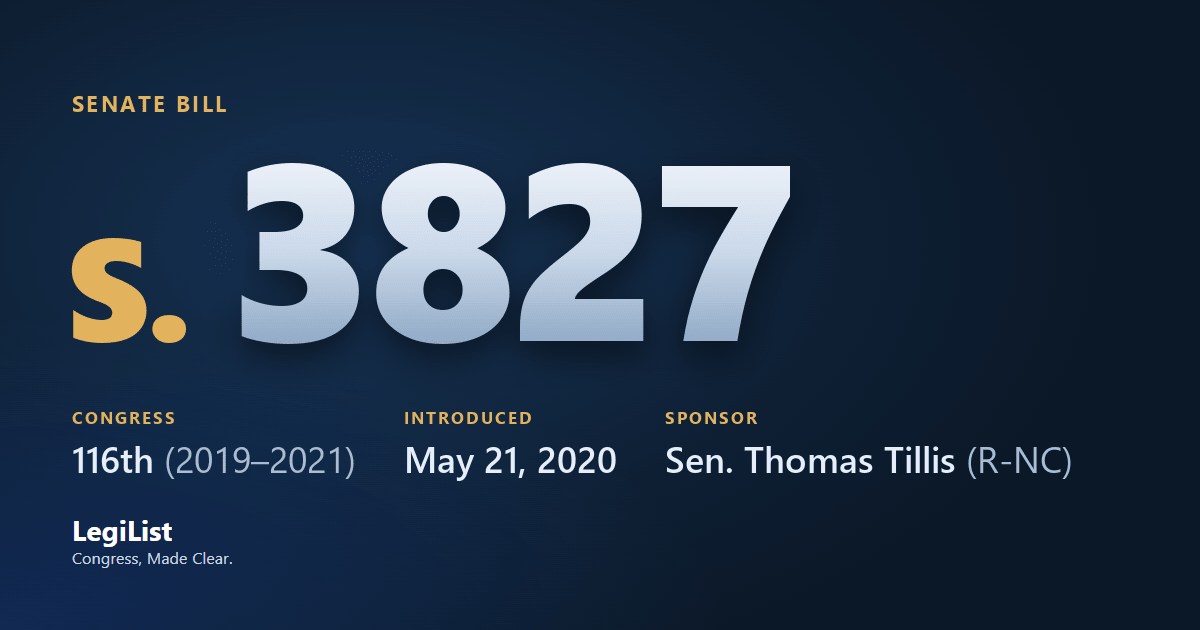
Medical Supplies for Pandemics Act of 2020
Latest action · May 21, 2020 Read twice and referred to the Committee on Health, Education, Labor, and Pensions.
Progress
Where this bill reached, and when. A stage with no date was not reached; one that failed a vote and later carried shows the date it carried.
- IntroducedMay 21, 2020
- Passed SenateNot reached
- Passed HouseNot reached
- To the PresidentNot reached
- Became lawNot reached
Summary
Medical Supplies for Pandemics Act of 2020
This bill requires the Department of Health and Human Services (HHS) to take specified actions, as part of its management of the Strategic National Stockpile, to establish and maintain domestic reserves of critical medical supplies. Specifically, HHS must (1) create incentives for manufacturers of medical supplies to increase emergency stocks and diversify geographic production; (2) purchase, lease, or enter into joint ventures with respect to facilities and equipment to produce medical supplies; and (3) work with distributors to refresh and replenish medical supplies. HHS must also submit a report to Congress concerning the details of any purchase, lease, or joint venture.
The department's authority under the bill to make purchases, leases, or joint ventures for medical supplies terminates on September 30, 2023.
Cosponsors 2
Members who signed on, in the order they did. All signed on May 21, 2020.
| Seat | Cosponsor | Signed on | |
|---|---|---|---|
| R-MS | Cindy Hyde-Smith | Original | May 21, 2020 |
| D-CO | Michael F. Bennet | Original | May 21, 2020 |
Committees 1
Where it was sent and what each committee and subcommittee did with it, in order.
| Chamber | Committee | What it did |
|---|---|---|
| Senate | Health, Education, Labor, and Pensions Committee | Referred May 21, 2020 |
Actions 2
Everything that happened, newest first.
- May 21, 2020Introduced in Senate
- May 21, 2020Read twice and referred to the Committee on Health, Education, Labor, and Pensions.
Research
What has been written about this bill: committee reports, cost estimates, the sponsor’s authority statement, printed hearings and the Congressional Research Service’s work.
CRS reports 1
Congressional Research Service work that CRS links to this bill or the law it became, newest first.
Cite it 1
Products on other subjects that cite it, usually among other measures.
| Product | Title | Kind | Published |
|---|---|---|---|
| R46628 | COVID-19 and Domestic PPE Production and Distribution: Issues and Policy Options Archived | Report | Dec 7, 2020 |
Related bills 4
Companion bills and other measures the record links to this one.
| Bill | Title | Relationship | Latest action |
|---|---|---|---|
| HR 14 | Commitment to Defeat the Virus and Keep America Healthy Act | Related bill | Nov 2, 2020 |
| HR 6531 | Medical Supplies for Pandemics Act of 2020 | Identical bill | Apr 17, 2020 |
| HR 6800 | The Heroes Act | Related bill | Jul 23, 2020 |
| HR 7574 | Strengthening America’s Strategic National Stockpile Act of 2020 | Related bill | Sep 22, 2020 |
Titles 2
Every title it has carried, official and short, at each stage.
- Official Title as Introduced
- A bill to amend the Public Health Service Act to authorize the use of the Strategic National Stockpile to enhance medical supply chain elasticity and establish and maintain domestic reserves of critical medical supplies, and for other purposes.
- Short Title(s) as Introduced
- Medical Supplies for Pandemics Act of 2020
Subjects
Assigned by the Library of Congress. Policy area: Health.
- Congressional oversight
- Emergency medical services and trauma care
- Health
- Health programs administration and funding
- Health technology, devices, supplies
- Immunology and vaccination
- Manufacturing
- Medical tests and diagnostic methods
- Prescription drugs
- Public contracts and procurement
- Strategic materials and reserves
Text 1
Each version as it was printed, newest first.
- May 21, 2020Introduced in Senate
Everything here is as published by Congress: the summary is the Congressional Research Service's, the action wording is the clerks', and the subjects are the Library of Congress's. How far it got is read from the actions themselves, taking the most recent one of each kind, so a bill that failed a vote and later passed is shown as having passed. Records come from this bill on Congress.gov and govinfo.gov; cost estimates are the Congressional Budget Office's, and the hearings are the printed hearings GovInfo publishes, which can appear months after the hearing.