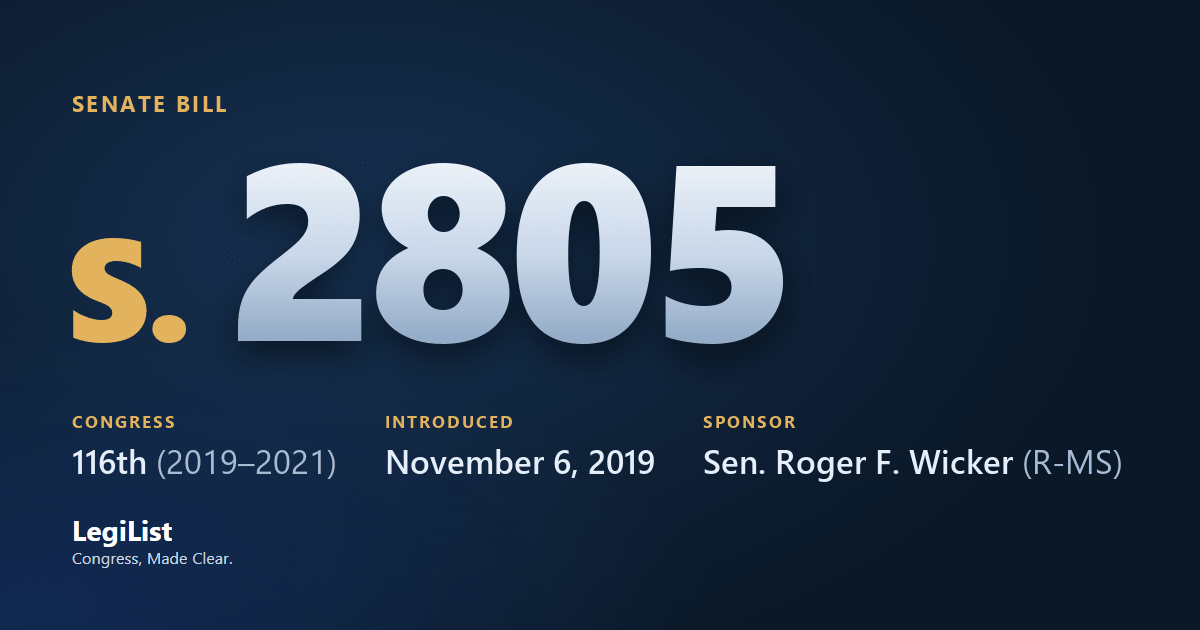
TOD Advancement Act of 2019
Latest action · Aug 12, 2020 Placed on Senate Legislative Calendar under General Orders. Calendar No. 516.
Progress
Where this bill reached, and when. A stage with no date was not reached; one that failed a vote and later carried shows the date it carried.
- IntroducedNov 6, 2019
- Passed SenateNot reached
- Passed HouseNot reached
- To the PresidentNot reached
- Became lawNot reached
Summary
TOD Advancement Act of 2019
This bill revises and extends until December 4, 2021, the Railroad Rehabilitation Improvement and Financing program.
Specifically, the bill revises program purposes to include financing economic development and infrastructure that (1) incorporates private investment of greater than 20% of total project costs; (2) is physically connected to, or within one half mile walking distance from, a passenger rail station or minimodal station that includes rail services; (3) will commerce construction within 90 days after the loan or loan guarantee is obligated for the project; and (4) demonstrates the ability to generate new financial assistance for the relevant passenger rail station or service.
The bill requires the Department of Transportation to periodically report to Congress on the number of applications for loans and loan guarantees under the program.
Cosponsors 6
Members who signed on, in the order they did. Signatures ran from Nov 6, 2019 to Nov 19, 2019; 2 are original cosponsors, there from the day it was introduced.
| Seat | Cosponsor | Signed on | |
|---|---|---|---|
| R-LA | Bill Cassidy | Original | Nov 6, 2019 |
| D-IL | Tammy Duckworth | Original | Nov 6, 2019 |
| R-ME | Susan M. Collins | Nov 7, 2019 | |
| D-MA | Edward J. Markey | Nov 14, 2019 | |
| D-RI | Jack Reed | Nov 14, 2019 | |
| I-ME | Angus S. King Jr. | Nov 19, 2019 |
Committees 1
Where it was sent and what each committee and subcommittee did with it, in order.
| Chamber | Committee | What it did |
|---|---|---|
| Senate | Commerce, Science, and Transportation Committee | Referred Nov 6, 2019Markup Nov 13, 2019Reported Aug 12, 2020 |
Actions 5
Everything that happened, newest first.
- Aug 12, 2020Committee on Commerce, Science, and Transportation. Reported by Senator Wicker with amendments. With written report No. 116-255.
- Aug 12, 2020Placed on Senate Legislative Calendar under General Orders. Calendar No. 516.
- Nov 13, 2019Committee on Commerce, Science, and Transportation. Ordered to be reported with an amendment favorably.
- Nov 6, 2019Introduced in Senate
- Nov 6, 2019Read twice and referred to the Committee on Commerce, Science, and Transportation.
Research
What has been written about this bill: committee reports, cost estimates, the sponsor’s authority statement, printed hearings and the Congressional Research Service’s work.
Committee report
Congressional Budget Office cost estimate
- Dec 5, 2019S. 2805, TOD Advancement Act of 2019As ordered reported by the Senate Committee on Commerce, Science, and Transportation on November 13, 2019
Titles 3
Every title it has carried, official and short, at each stage.
- Official Title as Introduced
- A bill to improve transit-oriented development financing, and for other purposes.
- Short Title(s) as Introduced
- TOD Advancement Act of 2019
- Short Title(s) as Reported to Senate
- TOD Advancement Act of 2019
Subjects
Assigned by the Library of Congress. Policy area: Transportation and Public Works.
Text 2
Each version as it was printed, newest first.
- Aug 12, 2020Reported to Senate
- Nov 6, 2019Introduced in Senate
Support LegiList
This page is free, carries no paywall, and is built and maintained by one person. If the record here is useful to you, a few dollars keeps it going.
Everything here is as published by Congress: the summary is the Congressional Research Service's, the action wording is the clerks', and the subjects are the Library of Congress's. How far it got is read from the actions themselves, taking the most recent one of each kind, so a bill that failed a vote and later passed is shown as having passed. Records come from this bill on Congress.gov and govinfo.gov; cost estimates are the Congressional Budget Office's, and the hearings are the printed hearings GovInfo publishes, which can appear months after the hearing.