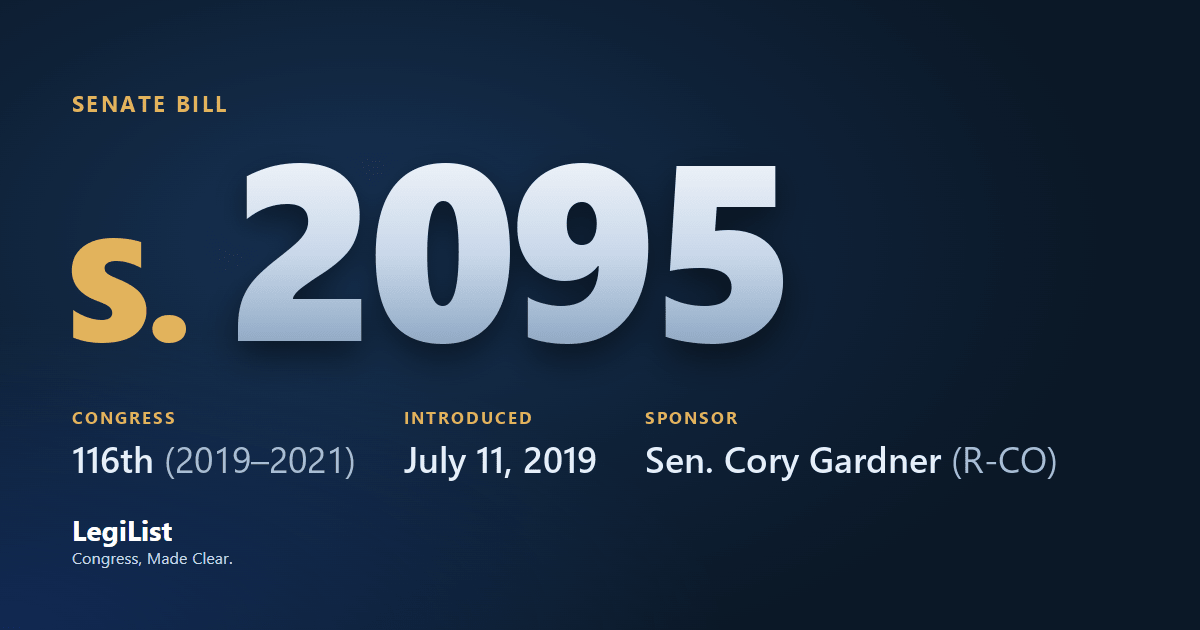
Enhancing Grid Security through Public-Private Partnerships Act
Latest action · Oct 24, 2019 Placed on Senate Legislative Calendar under General Orders. Calendar No. 267.
Progress
Where this bill reached, and when. A stage with no date was not reached; one that failed a vote and later carried shows the date it carried.
- IntroducedJul 11, 2019
- Passed SenateNot reached
- Passed HouseNot reached
- To the PresidentNot reached
- Became lawNot reached
Summary
Enhancing Grid Security through Public-Private Partnerships Act
This bill directs the Department of Energy to facilitate and encourage public-private partnerships in order to address and mitigate the physical security and cybersecurity risks of electric utilities.
Cosponsors 1
Members who signed on, in the order they did. All signed on Jul 11, 2019.
| Seat | Cosponsor | Signed on | |
|---|---|---|---|
| D-CO | Michael F. Bennet | Original | Jul 11, 2019 |
Committees 1
Where it was sent and what each committee and subcommittee did with it, in order.
| Chamber | Committee | What it did |
|---|---|---|
| Senate | Energy and Natural Resources Committee | Referred Jul 11, 2019Markup Sep 25, 2019Reported Oct 24, 2019 |
| Energy Subcommittee | Hearings Sep 11, 2019 |
Actions 6
Everything that happened, newest first.
- Oct 24, 2019Committee on Energy and Natural Resources. Reported by Senator Murkowski without amendment. With written report No. 116-147.
- Oct 24, 2019Placed on Senate Legislative Calendar under General Orders. Calendar No. 267.
- Sep 25, 2019Committee on Energy and Natural Resources. Ordered to be reported without amendment favorably.
- Sep 11, 2019Committee on Energy and Natural Resources Subcommittee on Energy. Hearings held. With printed Hearing: S.Hrg. 116-335.
- Jul 11, 2019Introduced in Senate
Research
What has been written about this bill: committee reports, cost estimates, the sponsor’s authority statement, printed hearings and the Congressional Research Service’s work.
Committee report
Congressional Budget Office cost estimate
- Oct 30, 2019S. 2095, Enhancing Grid Security through Public-Private Partnerships ActAs ordered reported by the Senate Committee on Energy and Natural Resources on September 25, 2019
Printed hearings 1
Hearings whose printed record names this bill, newest first: hearings on it, and wider hearings where it came up.
| Number | Hearing | Committee | Held |
|---|---|---|---|
| S. Hrg. 116-335 | PENDING LEGISLATION102 pages | Energy and Natural Resources Committee | Sep 11, 2019 |
CRS reports 1
Congressional Research Service work that CRS links to this bill or the law it became, newest first.
Cite it 1
Products on other subjects that cite it, usually among other measures.
| Product | Title | Kind | Published |
|---|---|---|---|
| R46372 | Summary and Analysis of S. 2657, the American Energy Innovation Act Archived | Report | May 27, 2020 |
Related bills 1
Companion bills and other measures the record links to this one.
| Bill | Title | Relationship | Latest action |
|---|---|---|---|
| HR 359 | Enhancing Grid Security through Public-Private Partnerships Act | Related bill | Sep 30, 2020 |
Titles 3
Every title it has carried, official and short, at each stage.
- Official Title as Introduced
- A bill to provide for certain programs and developments in the Department of Energy concerning the cybersecurity and vulnerabilities of, and physical threat to, the electric grid, and for other purposes.
- Short Title(s) as Introduced
- Enhancing Grid Security through Public-Private Partnerships Act
- Short Title(s) as Reported to Senate
- Enhancing Grid Security through Public-Private Partnerships Act
Subjects
Assigned by the Library of Congress. Policy area: Energy.
Text 2
Each version as it was printed, newest first.
- Oct 24, 2019Reported to Senate
- Jul 11, 2019Introduced in Senate
Everything here is as published by Congress: the summary is the Congressional Research Service's, the action wording is the clerks', and the subjects are the Library of Congress's. How far it got is read from the actions themselves, taking the most recent one of each kind, so a bill that failed a vote and later passed is shown as having passed. Records come from this bill on Congress.gov and govinfo.gov; cost estimates are the Congressional Budget Office's, and the hearings are the printed hearings GovInfo publishes, which can appear months after the hearing.