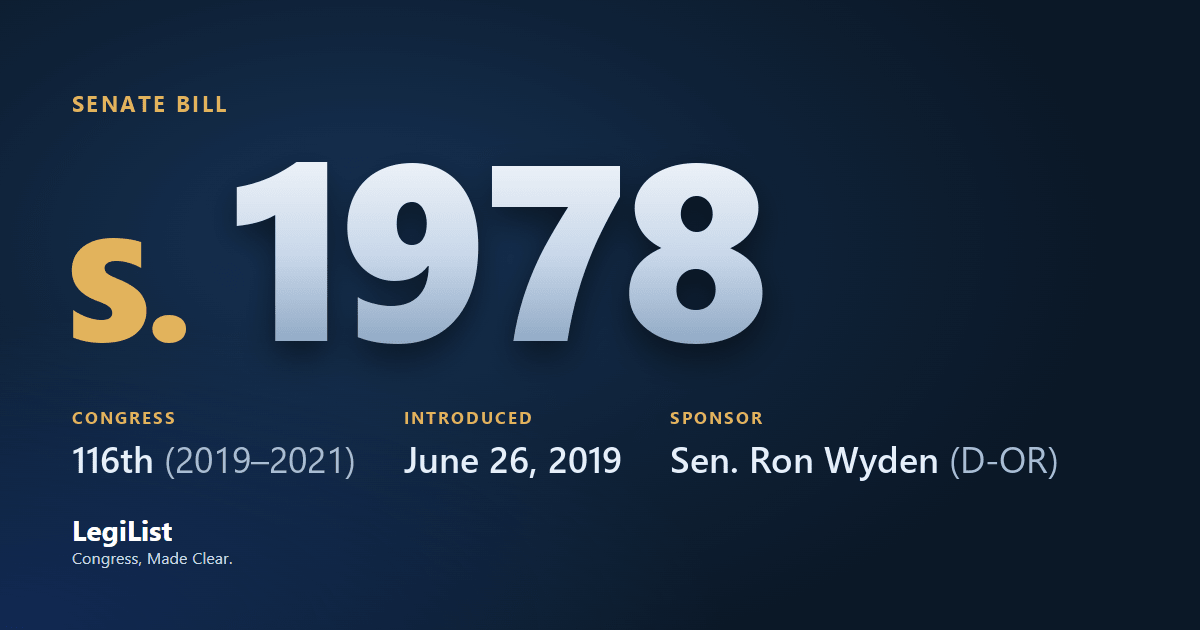
Corporate Transparency Act of 2019
Latest action · Jun 26, 2019 Read twice and referred to the Committee on Banking, Housing, and Urban Affairs.
Progress
Where this bill reached, and when. A stage with no date was not reached; one that failed a vote and later carried shows the date it carried.
- IntroducedJun 26, 2019
- Passed SenateNot reached
- Passed HouseNot reached
- To the PresidentNot reached
- Became lawNot reached
Summary
Corporate Transparency Act of 2019
This bill requires certain new and existing small corporations and limited liability companies to disclose information about their beneficial owners. A beneficial owner is an individual who (1) exercises substantial control over a corporation or limited liability company, (2) owns 25% or more of the interest in a corporation or limited liability company, or (3) receives substantial economic benefits from the assets of a corporation or limited liability company.
Specifically, if certain entities apply to form a corporation or limited liability company, they must file beneficial ownership information with the Financial Crimes Enforcement Network (FinCEN). Furthermore, certain existing corporations and limited liability companies must file this information with FinCEN two years after the implementation of final regulations required under this bill.
The bill imposes a civil penalty and authorizes criminal penalties—a fine, a prison term for up to three years, or both—for providing false or fraudulent beneficial ownership information or for willfully failing to provide complete or updated beneficial ownership information.
The Government Accountability Office must study and report on: (1) the availability of beneficial ownership information for other legal entities (e.g., partnerships), and (2) the effectiveness of incorporation practices implemented under this bill.
Cosponsors 2
Members who signed on, in the order they did. All signed on Jun 26, 2019.
| Seat | Cosponsor | Signed on | |
|---|---|---|---|
| R-FL | Marco Rubio | Original | Jun 26, 2019 |
| D-RI | Sheldon Whitehouse | Original | Jun 26, 2019 |
Committees 1
Where it was sent and what each committee and subcommittee did with it, in order.
| Chamber | Committee | What it did |
|---|---|---|
| Senate | Banking, Housing, and Urban Affairs Committee | Referred Jun 26, 2019 |
Actions 2
Everything that happened, newest first.
- Jun 26, 2019Introduced in Senate
- Jun 26, 2019Read twice and referred to the Committee on Banking, Housing, and Urban Affairs.
Research
What has been written about this bill: committee reports, cost estimates, the sponsor’s authority statement, printed hearings and the Congressional Research Service’s work.
CRS reports 2
Congressional Research Service work that CRS links to this bill or the law it became, newest first.
Cite it 2
Products on other subjects that cite it, usually among other measures.
| Product | Title | Kind | Published |
|---|---|---|---|
| R47255 | The Financial Crimes Enforcement Network (FinCEN): Anti-Money Laundering Act of 2020 Implementation and Beyond | Report | Mar 20, 2026 |
| IF11341 | Could the Global Legal Entity Identifier Be Useful for Financial Transparency Legislation in the 116th Congress? Archived | Resource | Oct 22, 2019 |
Related bills 1
Companion bills and other measures the record links to this one.
| Bill | Title | Relationship | Latest action |
|---|---|---|---|
| HR 2513 | Corporate Transparency Act of 2019 | Related bill | Oct 23, 2019 |
Titles 2
Every title it has carried, official and short, at each stage.
- Official Title as Introduced
- A bill to ensure that persons who form corporations or limited liability companies in the United States disclose the beneficial owners of those corporations or limited liability companies, in order to prevent wrongdoers from exploiting United States corporations and limited liability companies for criminal gain, to assist law enforcement in detecting, preventing, and punishing terrorism, money laundering, and other misconduct involving United States corporations and limited liability companies, and for other purposes.
- Short Title(s) as Introduced
- Corporate Transparency Act of 2019
Subjects
Assigned by the Library of Congress. Policy area: Finance and Financial Sector.
- Business ethics
- Business records
- Civil actions and liability
- Corporate finance and management
- Criminal investigation, prosecution, interrogation
- Criminal procedure and sentencing
- Finance and Financial Sector
- Fraud offenses and financial crimes
- Government information and archives
- Law enforcement administration and funding
- Terrorism
- Trade secrets and economic espionage
- U.S. and foreign investments
Text 1
Each version as it was printed, newest first.
- Jun 26, 2019Introduced in Senate
Support LegiList
This page is free, carries no paywall, and is built and maintained by one person. If the record here is useful to you, a few dollars keeps it going.
Everything here is as published by Congress: the summary is the Congressional Research Service's, the action wording is the clerks', and the subjects are the Library of Congress's. How far it got is read from the actions themselves, taking the most recent one of each kind, so a bill that failed a vote and later passed is shown as having passed. Records come from this bill on Congress.gov and govinfo.gov; cost estimates are the Congressional Budget Office's, and the hearings are the printed hearings GovInfo publishes, which can appear months after the hearing.