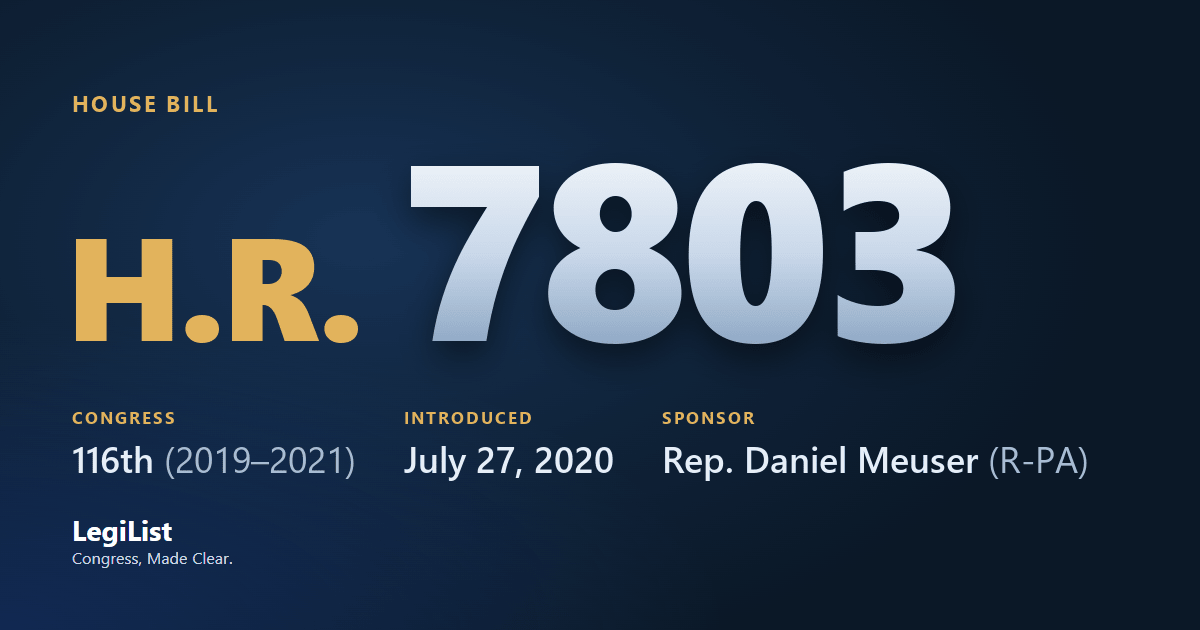
Stop Mail-In Voter Fraud Act
Latest action · Jul 27, 2020 Referred to the Committee on the Judiciary, and in addition to the Committee on House Administration, for a period to be subsequently determined by the Speaker, in each case for consideration of such provisions as fall within the jurisdiction of the committee concerned.
Progress
Where this bill reached, and when. A stage with no date was not reached; one that failed a vote and later carried shows the date it carried.
- IntroducedJul 27, 2020
- Passed HouseNot reached
- Passed SenateNot reached
- To the PresidentNot reached
- Became lawNot reached
Summary
Stop Mail-In Voter Fraud Act
This bill provides for enhanced penalties for certain crimes related to federal elections and contains other related provisions.
More specifically, the bill increases the maximum terms of imprisonment for various criminal acts if the act involves multiple ballots related to a federal election. For example, current law allows for a prison term of up to 20 years for certain fraudulent schemes involving the mail. Under this bill, the maximum prison term shall be 30 years if such a mail fraud scheme involves multiple ballots for a federal election.
The bill also requires the Department of Justice (DOJ) to establish a system, including a toll-free hotline and confidential website, for an individual to report instances of fraudulent transmission of ballots by mail in a federal election.
In addition, the bill requires courts to notify state election offices and DOJ when an individual has been recused from serving on a jury on the grounds that the individual is not a U.S. citizen. Each state's election office shall, as part of regular maintenance of its list of eligible voters, remove the name of such an individual from the voter list.
Cosponsors 2
Members who signed on, in the order they did. Signatures ran from Jul 30, 2020 to Aug 7, 2020.
| Seat | Cosponsor | Signed on | |
|---|---|---|---|
| R-IL | Rodney Davis | Jul 30, 2020 | |
| R-PA | Fred Keller | Aug 7, 2020 |
Committees 2
Where it was sent and what each committee and subcommittee did with it, in order.
| Chamber | Committee | What it did |
|---|---|---|
| House | Judiciary Committee | Referred Jul 27, 2020 |
| House | Committee on House Administration | Referred Jul 27, 2020 |
Actions 2
Everything that happened, newest first.
- Jul 27, 2020Introduced in House
- Jul 27, 2020Referred to the Committee on the Judiciary, and in addition to the Committee on House Administration, for a period to be subsequently determined by the Speaker, in each case for consideration of such provisions as fall within the jurisdiction of the committee concerned.
Research
What has been written about this bill: committee reports, cost estimates, the sponsor’s authority statement, printed hearings and the Congressional Research Service’s work.
Constitutional authority
The sponsor’s statement, as printed in the Congressional Record, vol. 166, no. 135, July 30, 2020.
Titles 2
Every title it has carried, official and short, at each stage.
- Official Title as Introduced
- To amend title 18, United States Code, and the National Voter Registration Act of 1993 to provide for enhanced penalties for the fraudulent transmission of ballots by mail in elections for Federal office, to direct the Attorney General to establish a system for receiving reports of incidents of the fraudulent transmission of such ballots by mail, and for other purposes.
- Short Title(s) as Introduced
- Stop Mail-In Voter Fraud Act
Subjects
Assigned by the Library of Congress. Policy area: Crime and Law Enforcement.
- Crime and Law Enforcement
- Criminal justice information and records
- Criminal procedure and sentencing
- Elections, voting, political campaign regulation
- Federal district courts
- Fraud offenses and financial crimes
- Government information and archives
- Intergovernmental relations
- Judicial procedure and administration
- State and local courts
- State and local government operations
Text 1
Each version as it was printed, newest first.
- Jul 27, 2020Introduced in House
Support LegiList
This page is free, carries no paywall, and is built and maintained by one person. If the record here is useful to you, a few dollars keeps it going.
Everything here is as published by Congress: the summary is the Congressional Research Service's, the action wording is the clerks', and the subjects are the Library of Congress's. How far it got is read from the actions themselves, taking the most recent one of each kind, so a bill that failed a vote and later passed is shown as having passed. Records come from this bill on Congress.gov and govinfo.gov; cost estimates are the Congressional Budget Office's, and the hearings are the printed hearings GovInfo publishes, which can appear months after the hearing.