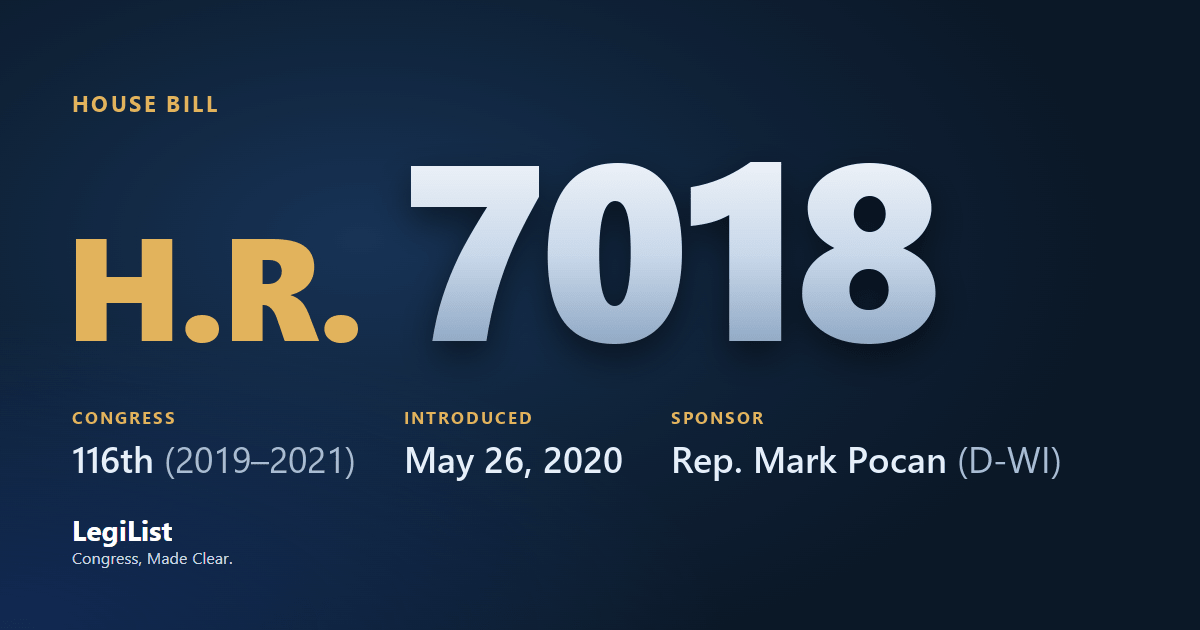
COVID–19 Emergency Production Act
Latest action · May 26, 2020 Referred to the House Committee on Financial Services.
Progress
Where this bill reached, and when. A stage with no date was not reached; one that failed a vote and later carried shows the date it carried.
- IntroducedMay 26, 2020
- Passed HouseNot reached
- Passed SenateNot reached
- To the PresidentNot reached
- Became lawNot reached
Summary
COVID-19 Emergency Production Act
This bill directs the President to use existing authorities under the Defense Production Act of 1950 with respect to the production of COVID-19 (i.e., coronavirus disease 2019) supplies, such as personal protective equipment, diagnostic tests, and vaccines. That act confers upon the President a broad set of authorities to influence domestic industry in order to provide essential materials and goods needed for the national defense.
Specifically, the President must (1) make a determination that such supplies are essential for the national defense, (2) identify private-sector capacity to produce these supplies, and (3) exercise authorities under the act to require emergency production of them at a reasonable price. In addition, the President shall coordinate the allocation of these supplies based on requests from governors and the needs of the states as determined by the population of each state.
The bill's directive to produce COVID-19 supplies terminates when there are no remaining requests for them from states, and supplies that have been produced but are unused at that time shall be deposited into the Strategic National Stockpile.
Cosponsors 4
Members who signed on, in the order they did. Signatures ran from May 26, 2020 to Jun 24, 2020; 2 are original cosponsors, there from the day it was introduced.
| Seat | Cosponsor | Signed on | |
|---|---|---|---|
| D-FL | Charlie Crist | Original | May 26, 2020 |
| D-DE | Lisa Blunt Rochester | Original | May 26, 2020 |
| D-RI | David N. Cicilline | May 27, 2020 | |
| D-WA | Pramila Jayapal | Jun 24, 2020 |
Committees 1
Where it was sent and what each committee and subcommittee did with it, in order.
| Chamber | Committee | What it did |
|---|---|---|
| House | Financial Services Committee | Referred May 26, 2020 |
Actions 2
Everything that happened, newest first.
- May 26, 2020Introduced in House
- May 26, 2020Referred to the House Committee on Financial Services.
Research
What has been written about this bill: committee reports, cost estimates, the sponsor’s authority statement, printed hearings and the Congressional Research Service’s work.
Constitutional authority
The sponsor’s statement, as printed in the Congressional Record, vol. 166, no. 98, May 26, 2020, page H2282.
Related bills 1
Companion bills and other measures the record links to this one.
| Bill | Title | Relationship | Latest action |
|---|---|---|---|
| HR 8508 | COVID–19 Vaccine Distribution and Production Act | Related bill | Oct 2, 2020 |
Titles 2
Every title it has carried, official and short, at each stage.
- Official Title as Introduced
- To require the President to use authorities under the Defense Production Act of 1950 to require emergency production of COVID-19 supplies to address the COVID-19 pandemic, and for other purposes.
- Short Title(s) as Introduced
- COVID–19 Emergency Production Act
Subjects
Assigned by the Library of Congress. Policy area: Government Operations and Politics.
- Cardiovascular and respiratory health
- Emergency medical services and trauma care
- Government Operations and Politics
- Health technology, devices, supplies
- Immunology and vaccination
- Infectious and parasitic diseases
- Manufacturing
- Medical tests and diagnostic methods
- Military procurement, research, weapons development
- Public contracts and procurement
- State and local government operations
- Strategic materials and reserves
- Worker safety and health
Text 1
Each version as it was printed, newest first.
- May 26, 2020Introduced in House
Support LegiList
This page is free, carries no paywall, and is built and maintained by one person. If the record here is useful to you, a few dollars keeps it going.
Everything here is as published by Congress: the summary is the Congressional Research Service's, the action wording is the clerks', and the subjects are the Library of Congress's. How far it got is read from the actions themselves, taking the most recent one of each kind, so a bill that failed a vote and later passed is shown as having passed. Records come from this bill on Congress.gov and govinfo.gov; cost estimates are the Congressional Budget Office's, and the hearings are the printed hearings GovInfo publishes, which can appear months after the hearing.