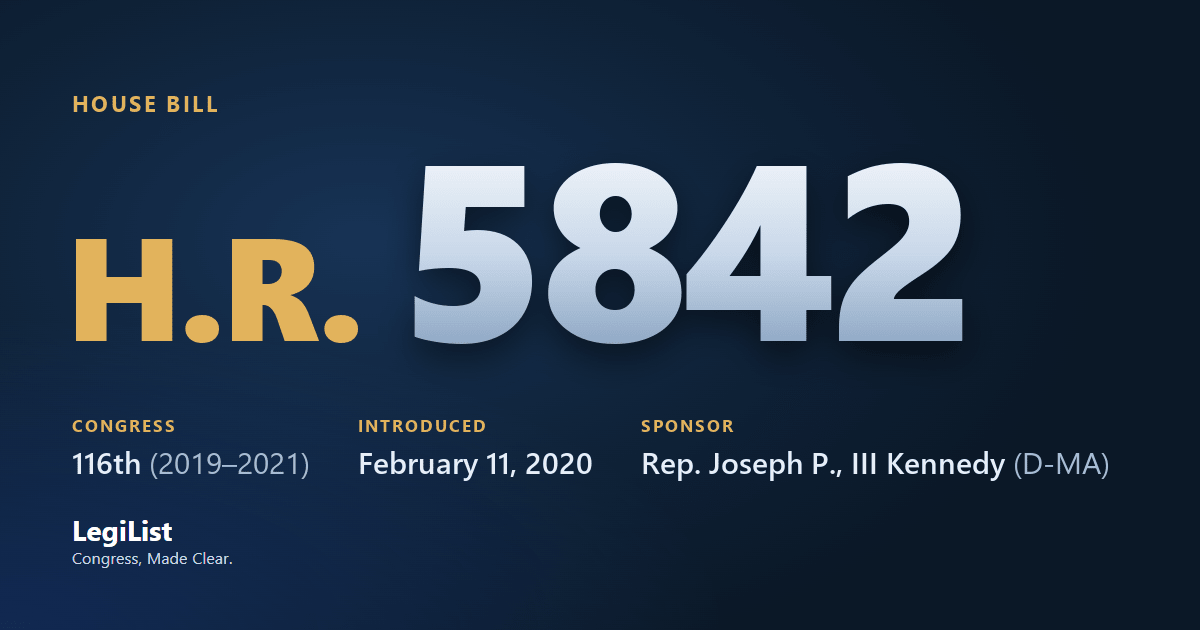
Voices for Environmental Justice Act
Latest action · Feb 11, 2020 Referred to the House Committee on Energy and Commerce.
Progress
Where this bill reached, and when. A stage with no date was not reached; one that failed a vote and later carried shows the date it carried.
- IntroducedFeb 11, 2020
- Passed HouseNot reached
- Passed SenateNot reached
- To the PresidentNot reached
- Became lawNot reached
Summary
Voices for Environmental Justice Act
This bill authorizes the Environmental Protection Agency (EPA) to award grants to eligible entities to participate in decisions impacting the health and safety of their communities in connection with an actual or potential release of a covered hazardous air pollutant. Additionally, the bill authorizes the EPA to award grants to eligible entities to participate in decisions impacting the health and safety of their communities relating to the permitting or permit renewal of a solid waste disposal facility or hazardous waste facility.
An eligible entity must be a group of individuals who reside in a community that (1) is a population or community of color, an indigenous community, or a low-income community; and (2) is in close proximity to the site of an actual or potential release of a covered hazardous air pollutant.
Covered hazardous air pollutants include those listed on the Toxics Release Inventory or those identified as carcinogenic by an assessment under the Integrated Risk Information System of the EPA.
Cosponsors 3
Members who signed on, in the order they did. Signatures ran from Feb 11, 2020 to Feb 21, 2020; 2 are original cosponsors, there from the day it was introduced.
| Seat | Cosponsor | Signed on | |
|---|---|---|---|
| D-CA | Nanette Diaz Barragán | Original | Feb 11, 2020 |
| D-CA | Raul Ruiz | Original | Feb 11, 2020 |
| D-NY | Paul Tonko | Feb 21, 2020 |
Committees 1
Where it was sent and what each committee and subcommittee did with it, in order.
| Chamber | Committee | What it did |
|---|---|---|
| House | Energy and Commerce Committee | Referred Feb 11, 2020 |
Actions 2
Everything that happened, newest first.
- Feb 11, 2020Introduced in House
- Feb 11, 2020Referred to the House Committee on Energy and Commerce.
Research
What has been written about this bill: committee reports, cost estimates, the sponsor’s authority statement, printed hearings and the Congressional Research Service’s work.
Constitutional authority
The sponsor’s statement, as printed in the Congressional Record, vol. 166, no. 28, February 11, 2020, page H1046.
CRS reports 1
Congressional Research Service work that CRS links to this bill or the law it became, newest first.
Cite it 1
Products on other subjects that cite it, usually among other measures.
| Product | Title | Kind | Published |
|---|---|---|---|
| R47920 | U.S. Environmental Protection Agency (EPA) Environmental Justice Activities and Programs | Report | Feb 13, 2024 |
Titles 2
Every title it has carried, official and short, at each stage.
- Official Title as Introduced
- To authorize the Administrator of the Environmental Protection Agency to award grants to entities to enable such entities to participate in decisions impacting the health and safety of their communities in connection with the release of certain hazardous air pollutants and the permitting of solid waste disposal facilities and hazardous waste facilities, and for other purposes.
- Short Title(s) as Introduced
- Voices for Environmental Justice Act
Subjects
Assigned by the Library of Congress. Policy area: Environmental Protection.
- Air quality
- Community life and organization
- Due process and equal protection
- Environmental assessment, monitoring, research
- Environmental health
- Environmental Protection
- Environmental regulatory procedures
- Government information and archives
- Hazardous wastes and toxic substances
- Indian social and development programs
- Licensing and registrations
- Minority health
- Poverty and welfare assistance
- Racial and ethnic relations
- Solid waste and recycling
Text 1
Each version as it was printed, newest first.
- Feb 11, 2020Introduced in House
Support LegiList
This page is free, carries no paywall, and is built and maintained by one person. If the record here is useful to you, a few dollars keeps it going.
Everything here is as published by Congress: the summary is the Congressional Research Service's, the action wording is the clerks', and the subjects are the Library of Congress's. How far it got is read from the actions themselves, taking the most recent one of each kind, so a bill that failed a vote and later passed is shown as having passed. Records come from this bill on Congress.gov and govinfo.gov; cost estimates are the Congressional Budget Office's, and the hearings are the printed hearings GovInfo publishes, which can appear months after the hearing.