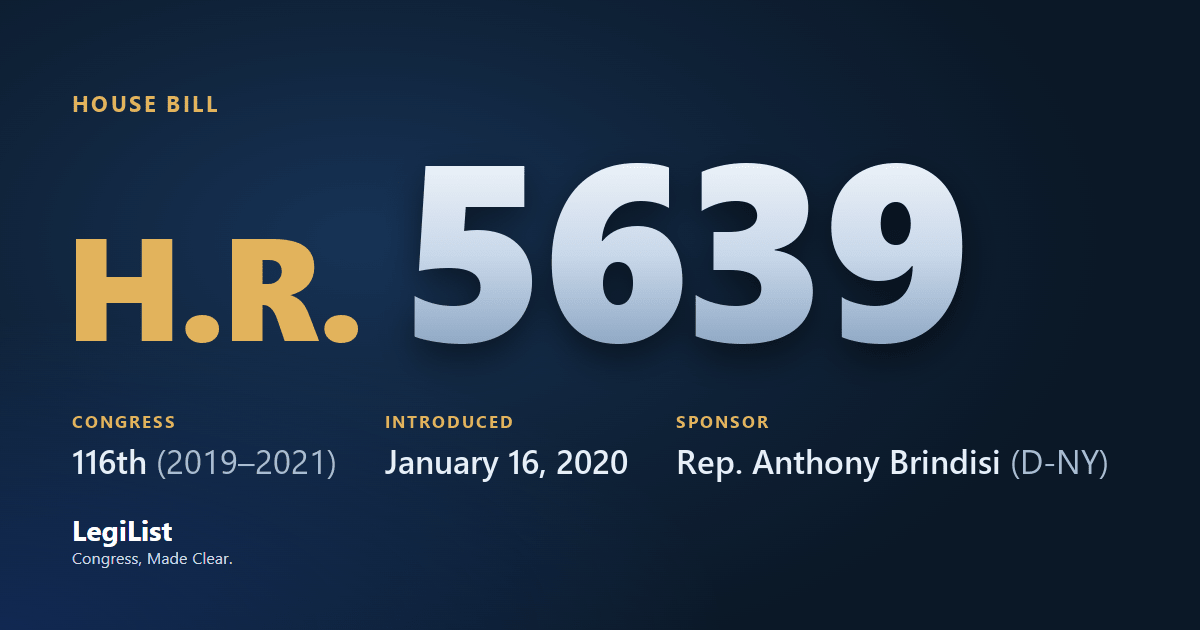
Chuck Osier Burial Benefits Act
Latest action · Jul 30, 2020 Ordered to be Reported (Amended) by Voice Vote.
Progress
Where this bill reached, and when. A stage with no date was not reached; one that failed a vote and later carried shows the date it carried.
- IntroducedJan 16, 2020
- Passed HouseNot reached
- Passed SenateNot reached
- To the PresidentNot reached
- Became lawNot reached
Summary
Chuck Osier Burial Benefits Act
This bill requires the Department of Veterans Affairs to furnish an urn or commemorative plaque in lieu of a headstone or marker to eligible deceased individuals if requested. Specifically, the United States must pay for an urn (in which the remains of such individual may be placed at private expense) or a commemorative plaque signifying the individual's status as a veteran.
Eligible deceased individuals are those who
- served in the Armed Forces on or after April 6, 1917;
- are buried in a private cemetery but eligible for burial in a national cemetery;
- are buried in a private cemetery and were entitled to a headstone, marker or medallion (or would have been but for their age); and
- were cremated and not interred in a national cemetery, a state veterans' cemetery, a tribal cemetery, or a private cemetery.
Cosponsors 2
Members who signed on, in the order they did. Signatures ran from Jan 16, 2020 to Jan 24, 2020; 1 is an original cosponsor, there from the day it was introduced.
| Seat | Cosponsor | Signed on | |
|---|---|---|---|
| R-FL | Michael Waltz | Original | Jan 16, 2020 |
| R-PA | Brian K. Fitzpatrick | Jan 24, 2020 |
Committees 1
Where it was sent and what each committee and subcommittee did with it, in order.
| Chamber | Committee | What it did |
|---|---|---|
| House | Veterans' Affairs Committee | Referred Jan 16, 2020Markup Jul 30, 2020 |
| Disability Assistance and Memorial Affairs Subcommittee | Referred Feb 7, 2020Discharged Jul 30, 2020 |
Actions 6
Everything that happened, newest first.
- Jul 30, 2020Subcommittee on Disability Assistance and Memorial Affairs Discharged.
- Jul 30, 2020Committee Consideration and Mark-up Session Held.
- Jul 30, 2020Ordered to be Reported (Amended) by Voice Vote.
- Feb 7, 2020Referred to the Subcommittee on Disability Assistance and Memorial Affairs.
- Jan 16, 2020Introduced in House
Research
What has been written about this bill: committee reports, cost estimates, the sponsor’s authority statement, printed hearings and the Congressional Research Service’s work.
Congressional Budget Office cost estimate
- Aug 28, 2020H.R. 5639, Chuck Osier Burial Benefits ActAs ordered reported by the House Committee on Veterans’ Affairs on July 30, 2020
Constitutional authority
The sponsor’s statement, as printed in the Congressional Record, vol. 166, no. 10, January 16, 2020, page H326.
Titles 2
Every title it has carried, official and short, at each stage.
- Official Title as Introduced
- To amend title 38, United States Code, to authorize the Secretary of Veterans Affairs to furnish urns for the remains of certain veterans whose cremated remains are not interred in certain cemeteries.
- Short Title(s) as Introduced
- Chuck Osier Burial Benefits Act
Subjects
Assigned by the Library of Congress. Policy area: Armed Forces and National Security.
Text 1
Each version as it was printed, newest first.
- Jan 16, 2020Introduced in House
Support LegiList
This page is free, carries no paywall, and is built and maintained by one person. If the record here is useful to you, a few dollars keeps it going.
Everything here is as published by Congress: the summary is the Congressional Research Service's, the action wording is the clerks', and the subjects are the Library of Congress's. How far it got is read from the actions themselves, taking the most recent one of each kind, so a bill that failed a vote and later passed is shown as having passed. Records come from this bill on Congress.gov and govinfo.gov; cost estimates are the Congressional Budget Office's, and the hearings are the printed hearings GovInfo publishes, which can appear months after the hearing.