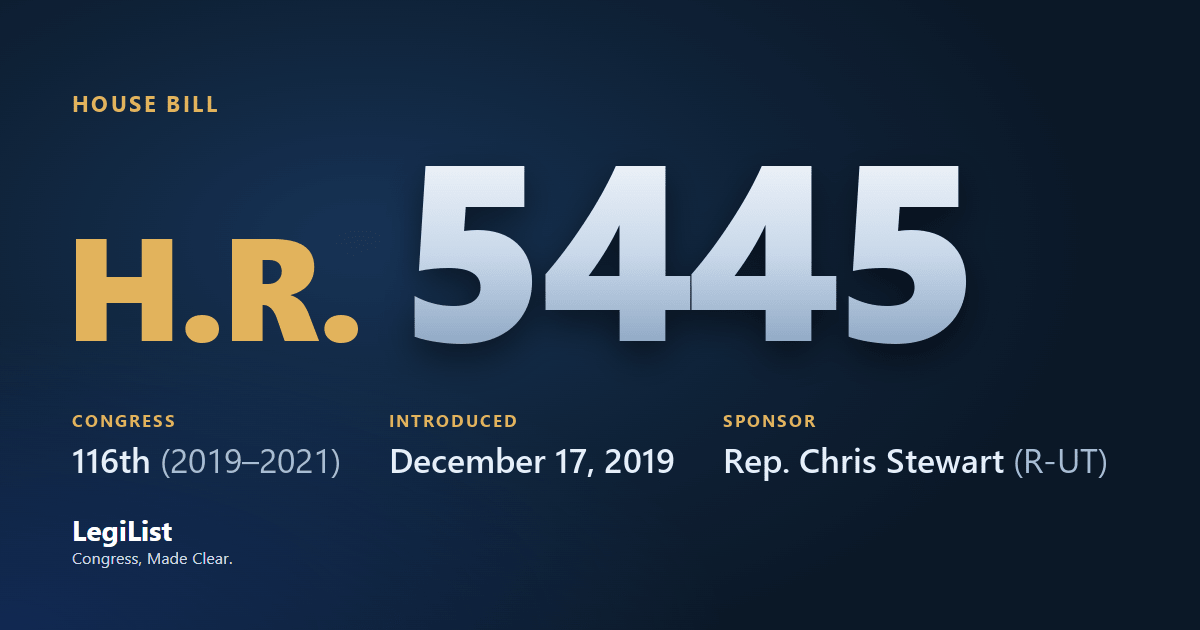
Critical Infrastructure Act of 2019
Latest action · Jan 8, 2020 Referred to the Subcommittee on Water, Oceans, and Wildlife.
Progress
Where this bill reached, and when. A stage with no date was not reached; one that failed a vote and later carried shows the date it carried.
- IntroducedDec 17, 2019
- Passed HouseNot reached
- Passed SenateNot reached
- To the PresidentNot reached
- Became lawNot reached
Summary
Critical Infrastructure Act of 2019
This bill (1) requires specified power administrations to disclose all estimated costs and factors affecting total power costs, such as costs for complying with environmental laws impacting the conservation of fish and wildlife, (2) prohibits the Department of the Interior from designating critical habitat in certain water infrastructure areas, and (3) provides exemptions from environmental review requirements for certain electrical power projects or construction projects that may affect prairie dogs.
Specifically, the bill requires the Bonneville Power Administration, the Western Area Power Administration, the Southwestern Power Administration, and the Southeastern Power Administration to include in monthly billing statements sent to each customer estimates of all costs and factors affecting total power costs. The estimates must include the customer's share of such administration's costs for compliance with any relevant federal environmental laws impacting the conservation of fish and wildlife.
Each administration must report each year on (1) all estimated costs and factors affecting total power costs, including estimates of its total compliance costs; and (2) sources of replacement power.
The bill prohibits Interior from designating critical habitat for endangered or threatened species in certain water storage, diversion, or delivery facilities.
In addition, the bill exempts projects to install or maintain electrical transmission poles or power lines from environmental review requirements. The bill also exempts from such review construction projects that include buffer areas if the projects would otherwise only require an environmental assessment because of the presence of prairie dogs in such buffer areas.
Cosponsors 8
Members who signed on, in the order they did. Signatures ran from Dec 18, 2019 to Feb 4, 2020.
| Seat | Cosponsor | Signed on | |
|---|---|---|---|
| R-AR | Eric A. "Rick" Crawford | Dec 18, 2019 | |
| R-WA | Dan Newhouse | Dec 19, 2019 | |
| R-MT | Greg Gianforte | Dec 19, 2019 | |
| R-AZ | Paul A. Gosar | Jan 9, 2020 | |
| R-CA | Tom McClintock | Jan 9, 2020 | |
| R-WY | Liz Cheney | Jan 13, 2020 | |
| R-AZ | Debbie Lesko | Feb 4, 2020 | |
| R-ND | Kelly Armstrong | Feb 4, 2020 |
Committees 1
Where it was sent and what each committee and subcommittee did with it, in order.
| Chamber | Committee | What it did |
|---|---|---|
| House | Natural Resources Committee | Referred Dec 17, 2019 |
| Water, Wildlife and Fisheries Subcommittee | Referred Jan 8, 2020 |
Actions 3
Everything that happened, newest first.
- Jan 8, 2020Referred to the Subcommittee on Water, Oceans, and Wildlife.
- Dec 17, 2019Introduced in House
- Dec 17, 2019Referred to the House Committee on Natural Resources.
Research
What has been written about this bill: committee reports, cost estimates, the sponsor’s authority statement, printed hearings and the Congressional Research Service’s work.
Constitutional authority
The sponsor’s statement, as printed in the Congressional Record, vol. 165, no. 204, December 17, 2019, page H10609.
Titles 2
Every title it has carried, official and short, at each stage.
- Official Title as Introduced
- To amend the Endangered Species Act of 1973 to encourage the construction of critical infrastructure, and for other purposes.
- Short Title(s) as Introduced
- Critical Infrastructure Act of 2019
Subjects
Assigned by the Library of Congress. Policy area: Environmental Protection.
Text 1
Each version as it was printed, newest first.
- Dec 17, 2019Introduced in House
Support LegiList
This page is free, carries no paywall, and is built and maintained by one person. If the record here is useful to you, a few dollars keeps it going.
Everything here is as published by Congress: the summary is the Congressional Research Service's, the action wording is the clerks', and the subjects are the Library of Congress's. How far it got is read from the actions themselves, taking the most recent one of each kind, so a bill that failed a vote and later passed is shown as having passed. Records come from this bill on Congress.gov and govinfo.gov; cost estimates are the Congressional Budget Office's, and the hearings are the printed hearings GovInfo publishes, which can appear months after the hearing.