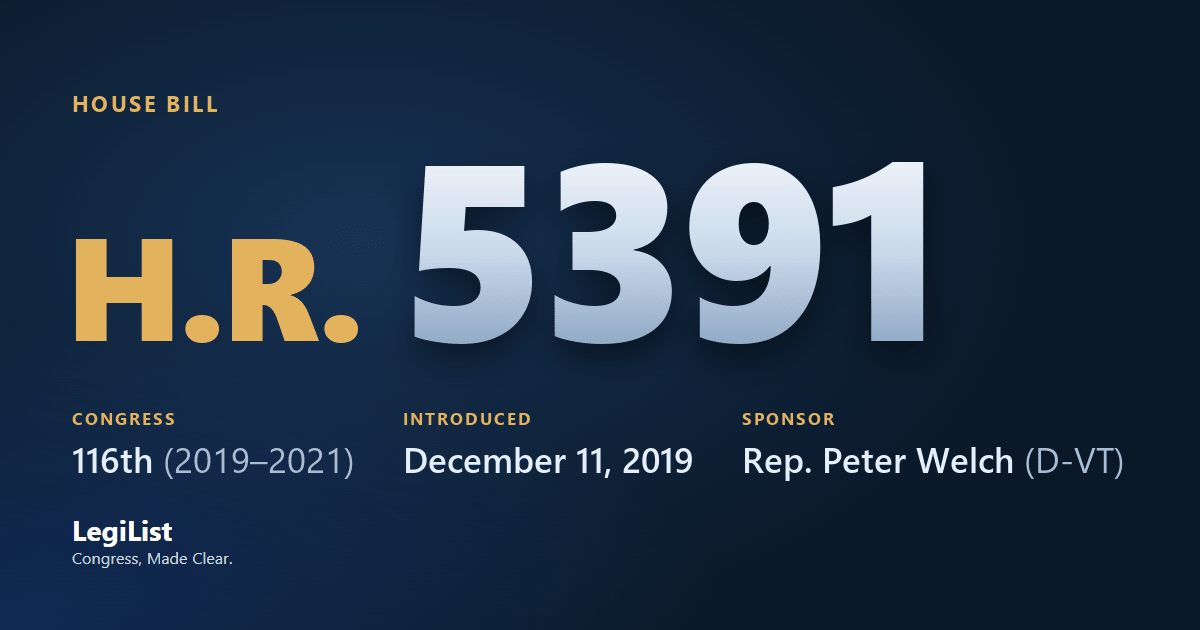
WHERA Act
Latest action · Dec 12, 2019 Referred to the Subcommittee on Environment and Climate Change.
Progress
Where this bill reached, and when. A stage with no date was not reached; one that failed a vote and later carried shows the date it carried.
- IntroducedDec 11, 2019
- Passed HouseNot reached
- Passed SenateNot reached
- To the PresidentNot reached
- Became lawNot reached
Summary
Wood Heaters Emissions Reduction Act of 2019 or the WHERA Act
This bill requires the Environmental Protection Agency (EPA) to implement programs and authorize policy to reduce emissions from wood heaters.
Specifically, the bill requires the EPA to establish a grant program to provide funding for programs designed to (1) incentivize homeowners to replace old wood heaters with more efficient, cleaner-burning heaters; (2) achieve significant reductions in emissions from wood heaters; (3) help homeowners transition to safer and more efficient heating sources; and (4) support retailers, installers, and manufacturers that sell and make more efficient certified clean heaters.
The EPA must also establish a program to (1) inform stakeholders of the benefits of replacing wood heaters that do not meet specified emission reductions standards, (2) develop nonfinancial incentives to promote the proper installation and use of certified clean heaters, and (3) consult with Indian tribes to implement programs and actions to reduce wood heater emissions.
Finally, the bill authorizes the EPA to accept wood heater emissions reductions Supplemental Environmental Projects.
Cosponsors 1
Members who signed on, in the order they did. All signed on Dec 11, 2019.
| Seat | Cosponsor | Signed on | |
|---|---|---|---|
| R-WA | Cathy McMorris Rodgers | Original | Dec 11, 2019 |
Committees 1
Where it was sent and what each committee and subcommittee did with it, in order.
| Chamber | Committee | What it did |
|---|---|---|
| House | Energy and Commerce Committee | Referred Dec 11, 2019 |
| Environment Subcommittee | Referred Dec 12, 2019 |
Actions 3
Everything that happened, newest first.
- Dec 12, 2019Referred to the Subcommittee on Environment and Climate Change.
- Dec 11, 2019Introduced in House
- Dec 11, 2019Referred to the House Committee on Energy and Commerce.
Research
What has been written about this bill: committee reports, cost estimates, the sponsor’s authority statement, printed hearings and the Congressional Research Service’s work.
Constitutional authority
The sponsor’s statement, as printed in the Congressional Record, vol. 165, no. 198, December 11, 2019, page H10123.
Related bills 2
Companion bills and other measures the record links to this one.
| Bill | Title | Relationship | Latest action |
|---|---|---|---|
| S 2274 | WHERA Act | Identical bill | Jul 25, 2019 |
| S 5065 | Economic Justice Act | Related bill | Dec 18, 2020 |
Titles 3
Every title it has carried, official and short, at each stage.
- Official Title as Introduced
- To establish a voluntary program that strengthens the economy, public health, and environment of the United States by reducing emissions from wood heaters, and for other purposes.
- Short Title(s) as Introduced
- WHERA Act
- Wood Heaters Emissions Reduction Act of 2019
Subjects
Assigned by the Library of Congress. Policy area: Environmental Protection.
- Air quality
- Congressional oversight
- Energy assistance for the poor and aged
- Energy efficiency and conservation
- Environmental health
- Environmental Protection
- Government information and archives
- Indian social and development programs
- Lighting, heating, cooling
- Residential rehabilitation and home repair
- Solid waste and recycling
Text 1
Each version as it was printed, newest first.
- Dec 11, 2019Introduced in House
Support LegiList
This page is free, carries no paywall, and is built and maintained by one person. If the record here is useful to you, a few dollars keeps it going.
Everything here is as published by Congress: the summary is the Congressional Research Service's, the action wording is the clerks', and the subjects are the Library of Congress's. How far it got is read from the actions themselves, taking the most recent one of each kind, so a bill that failed a vote and later passed is shown as having passed. Records come from this bill on Congress.gov and govinfo.gov; cost estimates are the Congressional Budget Office's, and the hearings are the printed hearings GovInfo publishes, which can appear months after the hearing.