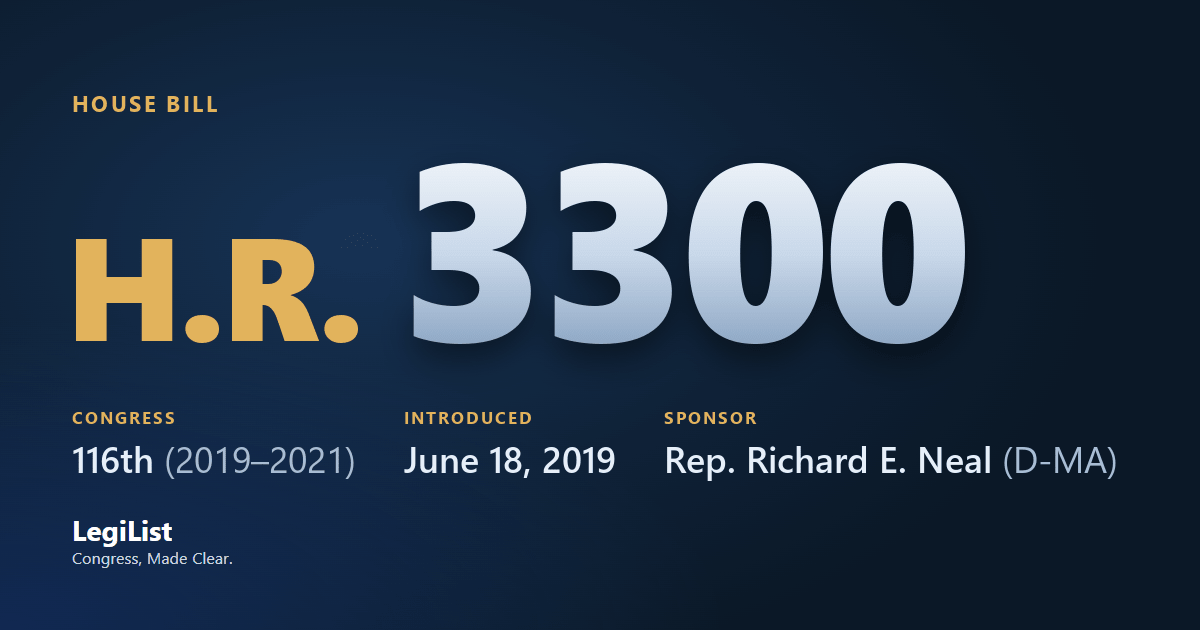
Economic Mobility Act of 2019
Latest action · Feb 4, 2020 Placed on the Union Calendar, Calendar No. 307.
Progress
Where this bill reached, and when. A stage with no date was not reached; one that failed a vote and later carried shows the date it carried.
- IntroducedJun 18, 2019
- Passed HouseNot reached
- Passed SenateNot reached
- To the PresidentNot reached
- Became lawNot reached
Summary
Economic Mobility Act of 2019
This bill modifies provisions relating to the earned income tax credit, the child tax credit, and the child and dependent care tax credit. Among other things, it increases the earned income tax credit in 2019 and 2020 for individuals with no qualifying children, makes the child and dependent care tax credits fully refundable during the same period, increases the child tax credit for children under the age of 4, increases the exclusion from employee gross income for employer-provided dependent care assistance, and provides for payments to U.S. possessions related to such credits.
The bill also eliminates the increase in unrelated business taxable income by expenses for certain fringe benefits for which a tax deduction is not allowed, including transportation and parking benefits or an on-premises athletic facility.
Cosponsors 2
Members who signed on, in the order they did. Signatures ran from Jun 19, 2019 to Jun 26, 2019.
| Seat | Cosponsor | Signed on | |
|---|---|---|---|
| D-GU | Michael F. Q. San Nicolas | Jun 19, 2019 | |
| D-NJ | Donald Norcross | Jun 26, 2019 |
Committees 1
Where it was sent and what each committee and subcommittee did with it, in order.
| Chamber | Committee | What it did |
|---|---|---|
| House | Ways and Means Committee | Referred Jun 18, 2019Markup Jun 20, 2019Reported Feb 4, 2020 |
Actions 6
Everything that happened, newest first.
- Feb 4, 2020Reported (Amended) by the Committee on Ways and Means. H. Rept. 116-384.
- Feb 4, 2020Placed on the Union Calendar, Calendar No. 307.
- Jun 20, 2019Committee Consideration and Mark-up Session Held.
- Jun 20, 2019Ordered to be Reported (Amended) by the Yeas and Nays: 22 - 19.
- Jun 18, 2019Introduced in House
- Jun 18, 2019Referred to the House Committee on Ways and Means.
Research
What has been written about this bill: committee reports, cost estimates, the sponsor’s authority statement, printed hearings and the Congressional Research Service’s work.
Committee report
Congressional Budget Office cost estimate
- Jul 9, 2019H.R. 3300, Economic Mobility Act of 2019As ordered reported by the House Committee on Ways and Means on June 20, 2019
Constitutional authority
The sponsor’s statement, as printed in the Congressional Record, vol. 165, no. 102, June 18, 2019, page H4771.
Printed hearings 1
Hearings whose printed record names this bill, newest first: hearings on it, and wider hearings where it came up.
| Number | Hearing | Committee | Held |
|---|---|---|---|
| Serial No. 116-30 | OVERSIGHT HEARING ON FISCAL YEAR 2021 BUDGET REQUEST FOR DEPARTMENT OF THE INTERIOR'S OFFICE OF INSULAR AFFAIRS54 pages | Natural Resources Committee | Feb 11, 2020 |
CRS reports 6
Congressional Research Service work that CRS links to this bill or the law it became, newest first.
Cite it 6
Products on other subjects that cite it, usually among other measures.
| Product | Title | Kind | Published |
|---|---|---|---|
| IN11610 | The “Childless” EITC: Temporary Expansion for 2021 Under the American Rescue Plan Act of 2021 (ARPA; P.L. 117-2) Archived | Insight | May 3, 2021 |
| IN11522 | Tax Policy on the Horizon: Potential Tax Policy Issues in the 117th Congress Archived | Insight | Oct 23, 2020 |
| R45971 | The Impact of the Federal Income Tax Code on Poverty | Report | Oct 19, 2020 |
| R46502 | The Child Tax Credit: Selected Legislative Proposals in the 116th Congress Archived | Report | Aug 28, 2020 |
| R46212 | Wage Inequality and the Stagnation of Earnings of Low-Wage Workers: Contributing Factors and Policy Options Archived | Report | Feb 5, 2020 |
Related bills 6
Companion bills and other measures the record links to this one.
| Bill | Title | Relationship | Latest action |
|---|---|---|---|
| S 632 | LIFT for Charities Act | Related bill | Feb 28, 2019 |
| HR 1545 | To amend the Internal Revenue Code of 1986 to repeal the inclusion of certain fringe benefit expenses for which a deduction is disallowed in unrelated business taxable income. | Related bill | Mar 5, 2019 |
| HR 1985 | Family Savings for Kids and Seniors Act | Related bill | Mar 28, 2019 |
| HR 3307 | To amend the Internal Revenue Code of 1986 to provide for payments to possessions of the United States related to the application of the earned income tax credit in such possessions. | Related bill | Jun 18, 2019 |
| S 3883 | A bill to amend the Internal Revenue Code of 1986 to make the earned income tax credit available to residents of possessions of the United States. | Related bill | Jun 3, 2020 |
Titles 3
Every title it has carried, official and short, at each stage.
- Official Title as Introduced
- To amend the Internal Revenue Code of 1986 to provide tax relief for workers and families, and for other purposes.
- Short Title(s) as Introduced
- Economic Mobility Act of 2019
- Short Title(s) as Reported to House
- Economic Mobility Act of 2019
Subjects
Assigned by the Library of Congress. Policy area: Taxation.
- Adult day care
- Business expenses
- Caribbean area
- Child care and development
- Corporate finance and management
- Employee benefits and pensions
- Guam
- Income tax credits
- Income tax exclusion
- Income tax rates
- Inflation and prices
- Northern Mariana Islands
- Poverty and welfare assistance
- Puerto Rico
- Sports and recreation facilities
- Student aid and college costs
- Tax treatment of families
- Tax-exempt organizations
- Taxation
- Transportation costs
- U.S. territories and protectorates
- Virgin Islands
- Wages and earnings
Text 2
Each version as it was printed, newest first.
- Feb 4, 2020Reported in House
- Jun 18, 2019Introduced in House
Everything here is as published by Congress: the summary is the Congressional Research Service's, the action wording is the clerks', and the subjects are the Library of Congress's. How far it got is read from the actions themselves, taking the most recent one of each kind, so a bill that failed a vote and later passed is shown as having passed. Records come from this bill on Congress.gov and govinfo.gov; cost estimates are the Congressional Budget Office's, and the hearings are the printed hearings GovInfo publishes, which can appear months after the hearing.