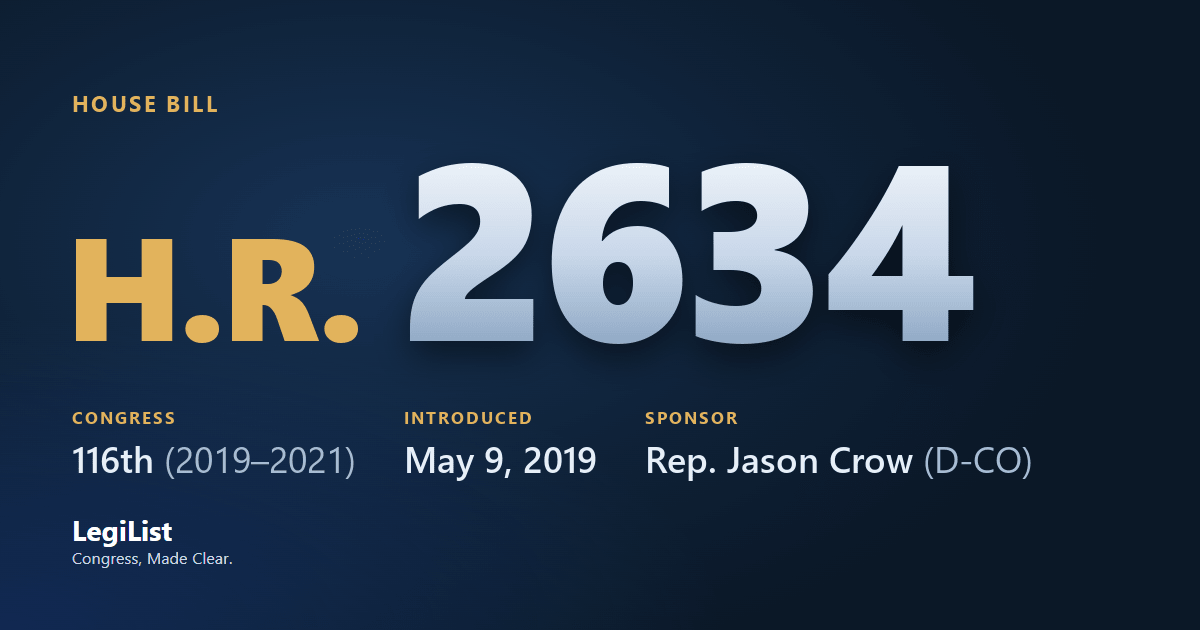
Closing the Loophole on Interstate Firearm Sales Act
Latest action · Jun 26, 2019 Referred to the Subcommittee on Crime, Terrorism, and Homeland Security.
Progress
Where this bill reached, and when. A stage with no date was not reached; one that failed a vote and later carried shows the date it carried.
- IntroducedMay 9, 2019
- Passed HouseNot reached
- Passed SenateNot reached
- To the PresidentNot reached
- Became lawNot reached
Summary
Closing the Loophole on Interstate Firearm Sales Act
This bill generally prohibits a licensed importer, manufacturer, dealer, or collector (transferor) from selling or delivering a rifle or shotgun to an out-of-state resident (transferee). Specifically, the bill removes an exception under current law that allows a transferee to obtain a rifle or shotgun from a transferor in another state, provided that (1) the transferee and transferor meet in person to accomplish the transfer; and (2) the sale, delivery, and receipt of the firearm comply with the laws of both states.
Cosponsors 11
Members who signed on, in the order they did. Signatures ran from May 9, 2019 to Jan 15, 2020; 6 are original cosponsors, there from the day it was introduced.
| Seat | Cosponsor | Signed on | |
|---|---|---|---|
| D-FL | Alcee L. Hastings | Original | May 9, 2019 |
| D-FL | Donna E. Shalala | Original | May 9, 2019 |
| D-CO | Ed Perlmutter | Original | May 9, 2019 |
| D-DC | Eleanor Holmes Norton | Original | May 9, 2019 |
| D-CO | Joe Neguse | Original | May 9, 2019 |
| D-FL | Theodore E. Deutch | Original | May 9, 2019 |
| D-MD | Jamie Raskin | May 15, 2019 | |
| D-CA | Grace F. Napolitano | May 17, 2019 | |
| D-CA | Ro Khanna | Aug 16, 2019 | |
| D-CA | Jerry McNerney | Dec 18, 2019 | |
| D-CO | Diana DeGette | Jan 15, 2020 |
Committees 1
Where it was sent and what each committee and subcommittee did with it, in order.
| Chamber | Committee | What it did |
|---|---|---|
| House | Judiciary Committee | Referred May 9, 2019 |
| Crime and Federal Government Surveillance Subcommittee | Referred Jun 26, 2019 |
Actions 3
Everything that happened, newest first.
- Jun 26, 2019Referred to the Subcommittee on Crime, Terrorism, and Homeland Security.
- May 9, 2019Introduced in House
- May 9, 2019Referred to the House Committee on the Judiciary.
Research
What has been written about this bill: committee reports, cost estimates, the sponsor’s authority statement, printed hearings and the Congressional Research Service’s work.
Constitutional authority
The sponsor’s statement, as printed in the Congressional Record, vol. 165, no. 77, May 9, 2019, page H3681.
Related bills 1
Companion bills and other measures the record links to this one.
| Bill | Title | Relationship | Latest action |
|---|---|---|---|
| HR 647 | Closing the Loophole on Interstate Firearm Sales Act | Reintroduced Bill | Mar 22, 2021 |
Titles 2
Every title it has carried, official and short, at each stage.
- Official Title as Introduced
- To prohibit a Federal firearms licensee from transferring a long gun to a person who the licensee knows or has reasonable cause to believe does not reside in (or if the person is a corporation or other business entity, does not maintain a place of business in) the State in which the licensee's place of business is located.
- Short Title(s) as Introduced
- Closing the Loophole on Interstate Firearm Sales Act
Subjects
Assigned by the Library of Congress. Policy area: Crime and Law Enforcement.
Text 1
Each version as it was printed, newest first.
- May 9, 2019Introduced in House
Everything here is as published by Congress: the summary is the Congressional Research Service's, the action wording is the clerks', and the subjects are the Library of Congress's. How far it got is read from the actions themselves, taking the most recent one of each kind, so a bill that failed a vote and later passed is shown as having passed. Records come from this bill on Congress.gov and govinfo.gov; cost estimates are the Congressional Budget Office's, and the hearings are the printed hearings GovInfo publishes, which can appear months after the hearing.