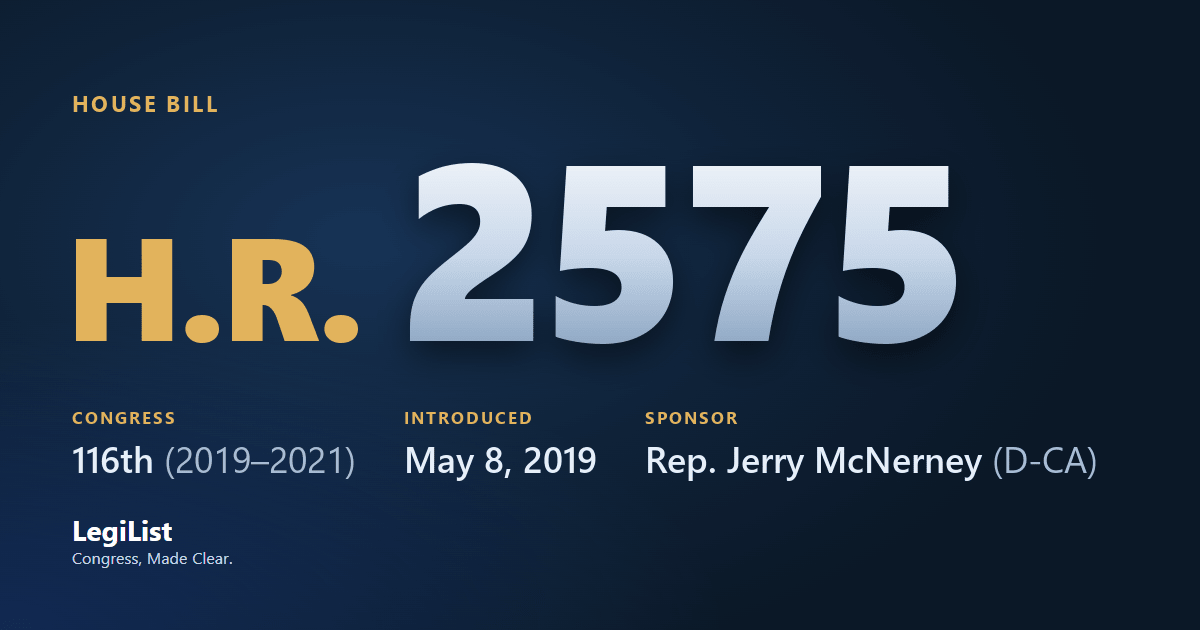
AI in Government Act of 2020
Latest action · Sep 15, 2020 Received in the Senate. Read twice. Placed on Senate Legislative Calendar under General Orders. Calendar No. 531.
Progress
Where this bill reached, and when. A stage with no date was not reached; one that failed a vote and later carried shows the date it carried.
- IntroducedMay 8, 2019
- Passed HouseSep 14, 2020
- Passed SenateNot reached
- To the PresidentNot reached
- Became lawNot reached
Summary
AI in Government Act of 2020
This bill creates the AI Center of Excellence within the General Services Administration.
The center shall
- facilitate the adoption of artificial intelligence (AI) technologies in the federal government,
- improve cohesion and competency in the adoption and use of AI within the federal government, and
- carry out such activities for the purposes of benefitting the public and enhancing the productivity and efficiency of federal government operations.
The Office of Management and Budget (OMB) must issue a memorandum to federal agencies that shall
- inform the development of policies regarding federal acquisition and use by agencies regarding technologies that are empowered or enabled by AI;
- recommend approaches to remove barriers for use by agencies of AI technologies in order to promote the innovative application of those technologies while protecting civil liberties, civil rights, and economic and national security;
- identify best practices for identifying, assessing, and mitigating any discriminatory impact or bias on the basis of any classification protected under federal nondiscrimination laws, or any unintended consequence of the use of AI; and
- provide a template of the required contents of the agency plans.
The OMB shall issue a draft version of the memorandum for public comment and updates.
In addition, the Office of Personnel Management (OPM) must
- identify key skills and competencies needed for positions related to AI;
- establish an occupational series, or revise an existing job series, to include positions the primary duties of which relate to AI;
- establish an estimate of the number of federal employees in positions related to AI by each agency; and
- using the estimate, prepare a two-year and five-year forecast of the number of federal employees in positions related to AI that each agency will need to employ.
The OPM shall submit a comprehensive plan with a time line to complete such requirements.
Cosponsors 1
Members who signed on, in the order they did. All signed on May 8, 2019.
| Seat | Cosponsor | Signed on | |
|---|---|---|---|
| R-NC | Mark Meadows | Original | May 8, 2019 |
Committees 1
Where it was sent and what each committee and subcommittee did with it, in order.
| Chamber | Committee | What it did |
|---|---|---|
| House | Oversight and Government Reform Committee | Referred May 8, 2019Markup Dec 19, 2019 |
Actions 9
Everything that happened, newest first.
- Sep 15, 2020Received in the Senate. Read twice. Placed on Senate Legislative Calendar under General Orders. Calendar No. 531.
- Sep 14, 2020Mrs. Maloney, Carolyn B. moved to suspend the rules and pass the bill, as amended.
- Sep 14, 2020Considered under suspension of the rules. (consideration: CR H4354-4356)
- Sep 14, 2020DEBATE - The House proceeded with forty minutes of debate on H.R. 2575.
- Sep 14, 2020Passed/agreed to in House: On motion to suspend the rules and pass the bill, as amended Agreed to by voice vote. (text: CR H4354-4355)
- Sep 14, 2020Motion to reconsider laid on the table Agreed to without objection.
- Dec 19, 2019Committee Consideration and Mark-up Session Held.
- May 8, 2019Introduced in House
- May 8, 2019Referred to the House Committee on Oversight and Reform.
In the Congressional Record 2
Days the Record’s own index lists this bill, newest first, with the pages and the members it names. Pages starting H are the House, S the Senate, E Extensions of Remarks.
| Where | In the Record | Members | Date |
|---|---|---|---|
| House | Debate and remarks H4990 | Jerry McNerney D-CA | Sep 29, 2020 |
| House | Debate and remarks H4354–H4356Text printed H4354 | Carolyn B. Maloney D-NY, Jerry McNerney D-CA, Michael Cloud R-TX | Sep 14, 2020 |
Research
What has been written about this bill: committee reports, cost estimates, the sponsor’s authority statement, printed hearings and the Congressional Research Service’s work.
Congressional Budget Office cost estimate
- Jan 22, 2020H.R. 2575, AI in Government Act of 2019As ordered reported by the House Committee on Oversight and Government Reform on December 19, 2019
Constitutional authority
The sponsor’s statement, as printed in the Congressional Record, vol. 165, no. 76, May 8, 2019, page H3501.
Related bills 1
Companion bills and other measures the record links to this one.
| Bill | Title | Relationship | Latest action |
|---|---|---|---|
| S 1363 | AI in Government Act of 2019 | Identical bill | Jun 1, 2020 |
Titles 4
Every title it has carried, official and short, at each stage.
- Official Title as Introduced
- To authorize an AI Center of Excellence within the General Services Administration, and for other purposes.
- Short Title(s) as Introduced
- AI in Government Act of 2019
- Short Title(s) as Passed House
- AI in Government Act of 2020
- Short Title(s) from PCS (Placed on Senate Calendar) bill text
- AI in Government Act of 2020
Subjects
Assigned by the Library of Congress. Policy area: Government Operations and Politics.
- Administrative law and regulatory procedures
- Advanced technology and technological innovations
- Advisory bodies
- Computers and information technology
- Congressional oversight
- Employment and training programs
- Executive agency funding and structure
- General Services Administration
- Government employee pay, benefits, personnel management
- Government information and archives
- Government Operations and Politics
- Public-private cooperation
Text 3
Each version as it was printed, newest first.
- Sep 15, 2020Placed on Calendar Senate
- Sep 14, 2020Engrossed in House
- May 8, 2019Introduced in House
Everything here is as published by Congress: the summary is the Congressional Research Service's, the action wording is the clerks', and the subjects are the Library of Congress's. How far it got is read from the actions themselves, taking the most recent one of each kind, so a bill that failed a vote and later passed is shown as having passed. Records come from this bill on Congress.gov and govinfo.gov; cost estimates are the Congressional Budget Office's, and the hearings are the printed hearings GovInfo publishes, which can appear months after the hearing.