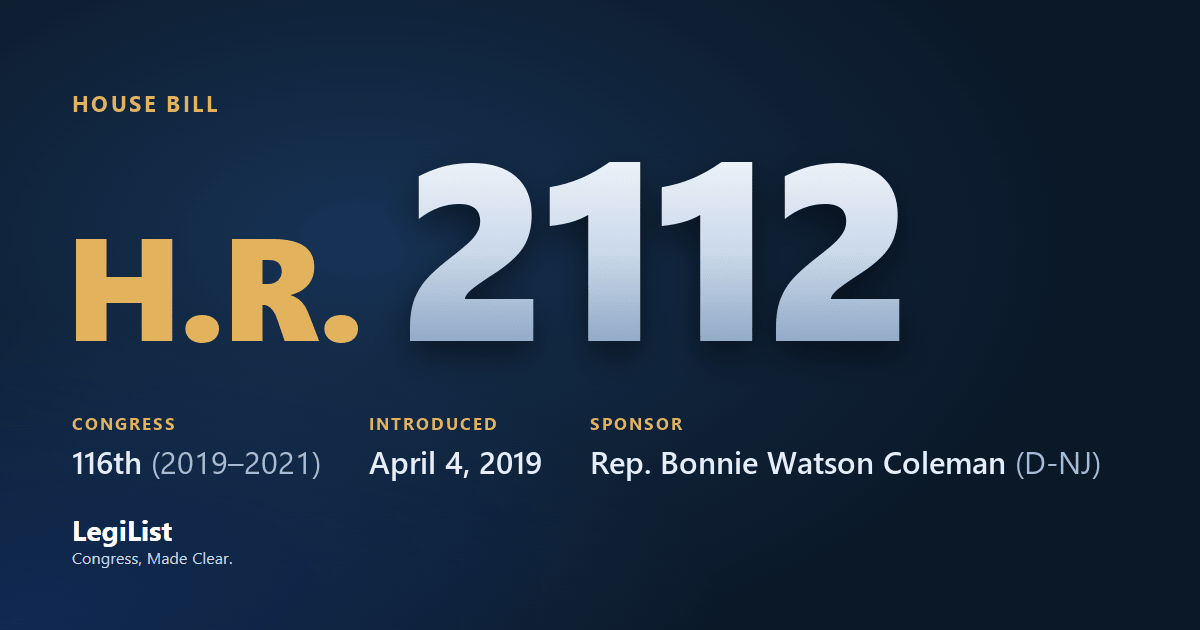
Refund to Rainy Day Savings Act
Latest action · Apr 4, 2019 Referred to the House Committee on Ways and Means.
Progress
Where this bill reached, and when. A stage with no date was not reached; one that failed a vote and later carried shows the date it carried.
- IntroducedApr 4, 2019
- Passed HouseNot reached
- Passed SenateNot reached
- To the PresidentNot reached
- Became lawNot reached
Summary
Refund to Rainy Day Savings Act
This bill requires the Department of the Treasury to establish and implement a Refund to Rainy Day Savings Program to permit a taxpayer to defer payment on 20% of a tax refund to be deposited into a Treasury account, accumulate interest, and disbursed to the taxpayer in six months.
The bill also reauthorizes the Assets for Independence (AFI) federal matched savings program through FY2024 and requires appropriations for the program to be reserved for
- general research and evaluation,
- grants for AFI innovation projects to expand the availability of matched savings accounts to low-income individuals, and
- a three-year matched savings account pilot program established by the Department of Health and Human Services (HHS) to encourage savings by low-income taxpayers.
Under the pilot program, HHS may provide grants to qualified entities to match funds saved by low-income taxpayers under the Refund to Rainy Day Savings Program.
Qualified entities for the pilot program include
- nonprofit organizations,
- state or local government agencies or tribal governments applying with a nonprofit organization,
- sites that offer free tax assistance under certain Internal Revenue Service programs, and
- certain low-income credit unions and community development financial institutions.
HHS must (1) contract with an independent research organization to evaluate the pilot program, and (2) report annually to Congress on the progress and outcomes of the pilot program.
Cosponsors 5
Members who signed on, in the order they did. Signatures ran from Apr 4, 2019 to Jun 4, 2020; 1 is an original cosponsor, there from the day it was introduced.
| Seat | Cosponsor | Signed on | |
|---|---|---|---|
| R-AR | J. French Hill | Original | Apr 4, 2019 |
| D-PA | Susan Wild | May 21, 2019 | |
| D-GA | David Scott | Jul 23, 2019 | |
| D-CA | Josh Harder | Jun 4, 2020 | |
| D-GU | Michael F. Q. San Nicolas | Jun 4, 2020 |
Committees 1
Where it was sent and what each committee and subcommittee did with it, in order.
| Chamber | Committee | What it did |
|---|---|---|
| House | Ways and Means Committee | Referred Apr 4, 2019 |
Actions 2
Everything that happened, newest first.
- Apr 4, 2019Introduced in House
- Apr 4, 2019Referred to the House Committee on Ways and Means.
Research
What has been written about this bill: committee reports, cost estimates, the sponsor’s authority statement, printed hearings and the Congressional Research Service’s work.
Constitutional authority
The sponsor’s statement, as printed in the Congressional Record, vol. 165, no. 59, April 4, 2019, page H3101.
CRS reports 1
Congressional Research Service work that CRS links to this bill or the law it became, newest first.
Cite it 1
Products on other subjects that cite it, usually among other measures.
| Product | Title | Kind | Published |
|---|---|---|---|
| R45979 | Financial Inclusion and Credit Access Policy Issues Archived | Report | Oct 24, 2019 |
Related bills 2
Companion bills and other measures the record links to this one.
| Bill | Title | Relationship | Latest action |
|---|---|---|---|
| S 1018 | Refund to Rainy Day Savings Act | Identical bill | Apr 3, 2019 |
| HR 4986 | Refund to Rainy Day Savings Act | Reintroduced Bill | Aug 6, 2021 |
Titles 2
Every title it has carried, official and short, at each stage.
- Official Title as Introduced
- To establish the Refund to Rainy Day Savings Program.
- Short Title(s) as Introduced
- Refund to Rainy Day Savings Act
Subjects
Assigned by the Library of Congress. Policy area: Taxation.
Text 1
Each version as it was printed, newest first.
- Apr 4, 2019Introduced in House
Everything here is as published by Congress: the summary is the Congressional Research Service's, the action wording is the clerks', and the subjects are the Library of Congress's. How far it got is read from the actions themselves, taking the most recent one of each kind, so a bill that failed a vote and later passed is shown as having passed. Records come from this bill on Congress.gov and govinfo.gov; cost estimates are the Congressional Budget Office's, and the hearings are the printed hearings GovInfo publishes, which can appear months after the hearing.