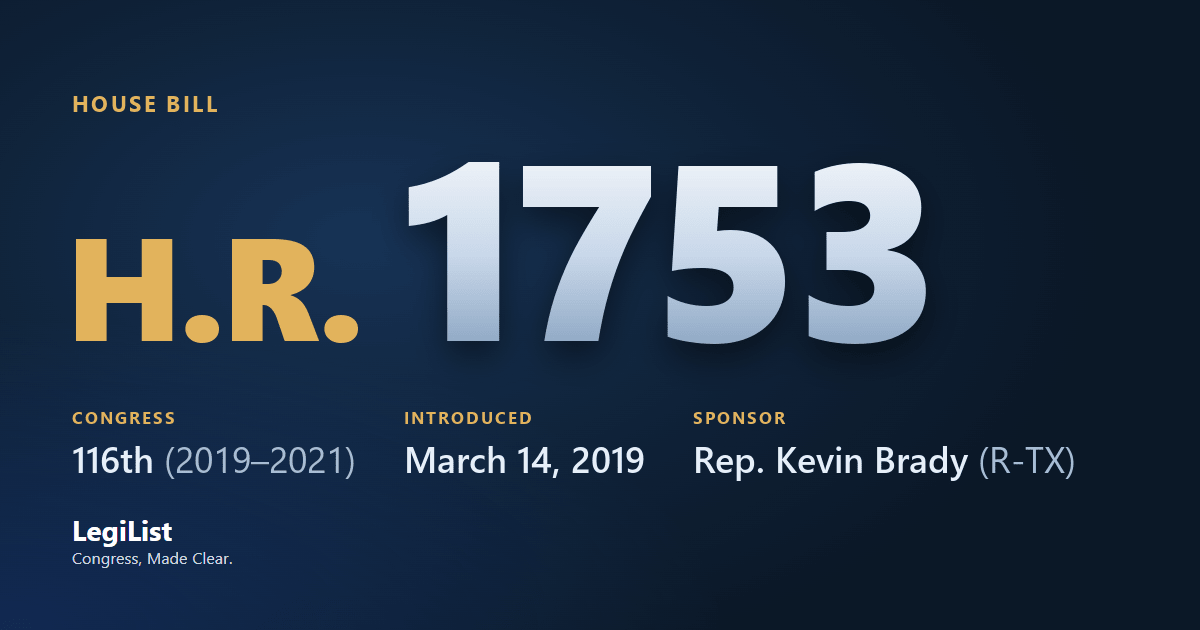
Jobs and Opportunity with Benefits and Services for Success Act
Latest action · Mar 14, 2019 Referred to the Subcommittee on Worker and Family Support.
Progress
Where this bill reached, and when. A stage with no date was not reached; one that failed a vote and later carried shows the date it carried.
- IntroducedMar 14, 2019
- Passed HouseNot reached
- Passed SenateNot reached
- To the PresidentNot reached
- Became lawNot reached
Summary
Jobs and Opportunity with Benefits and Services for Success Act
This bill renames the Temporary Assistance for Needy Families (TANF) program as the Jobs and Opportunity with Benefits and Services (JOBS) program, reauthorizes the program through FY2024, and makes changes relating to work requirements for beneficiaries.
States providing aid under the program shall create an individual opportunity plan for each beneficiary. States shall impose work requirements on all work-eligible beneficiaries, and shall reduce benefits for noncompliance. (Currently, individual plans are optional under TANF, and states have discretion as to whether to reduce benefits for noncompliant individuals.)
States providing aid shall meet annual performance targets related to the number of beneficiaries who exit the program and find unsubsidized employment. The Department of Health and Human Services (HHS) shall reduce grants to states that fail to meet such targets. States shall provide data related to beneficiary employment and wages to HHS, which shall be publicly available.
The bill modifies various limitations on the use of funds for various purposes, and establishes that at least 25% of funds from various grants shall be spent on core activities.
Certain existing laws relating to monitoring and recovering improper benefits payments shall apply to the JOBS program.
The bill eliminates programs providing (1) supplemental grants for population increases, (2) bonuses for high performance states, (3) welfare-to-work grants, and (4) contingency funds for state welfare programs.
Cosponsors 95
Members who signed on, in the order they did. Signatures ran from Mar 14, 2019 to Oct 20, 2020, with 20 there on the day it was introduced.
| Seat | Cosponsor | Signed on | |
|---|---|---|---|
| R-GA | A. Drew Ferguson IV | Original | Mar 14, 2019 |
| R-NE | Adrian Smith | Original | Mar 14, 2019 |
| R-OH | Brad R. Wenstrup | Original | Mar 14, 2019 |
| R-WV | Carol D. Miller | Original | Mar 14, 2019 |
| R-PA | Daniel Meuser | Original | Mar 14, 2019 |
| R-IL | Darin LaHood | Original | Mar 14, 2019 |
| R-CA | Devin Nunes | Original | Mar 14, 2019 |
| R-MT | Greg Gianforte | Original | Mar 14, 2019 |
| R-IN | Jackie Walorski | Original | Mar 14, 2019 |
| R-IN | Jim Banks | Original | Mar 14, 2019 |
| R-TX | Jodey C. Arrington | Original | Mar 14, 2019 |
| R-TX | Kenny Marchant | Original | Mar 14, 2019 |
| R-PA | Lloyd Smucker | Original | Mar 14, 2019 |
| R-LA | Mike Johnson | Original | Mar 14, 2019 |
| R-PA | Mike Kelly | Original | Mar 14, 2019 |
Actions 3
Everything that happened, newest first.
- Mar 14, 2019Introduced in House
- Mar 14, 2019Referred to the House Committee on Ways and Means.
- Mar 14, 2019Referred to the Subcommittee on Worker and Family Support.
Related bills 9
Companion bills and other measures the record links to this one.
| Bill | Title | Relationship | Latest action |
|---|---|---|---|
| S 802 | Jobs and Opportunity with Benefits and Services for Success Act | Identical bill | Mar 14, 2019 |
| HR 1245 | Improving Access to Child Care Act | Related bill | Feb 14, 2019 |
| HR 1246 | Improving Access to Work Act | Related bill | Feb 14, 2019 |
| HR 1413 | WORK Act | Related bill | Feb 27, 2019 |
| HR 1469 | Improving Transparency in TANF through Data Act | Related bill | Feb 28, 2019 |
Subjects
Assigned by the Library of Congress. Policy area: Social Welfare.
- Appropriations
- Child care and development
- Child safety and welfare
- Economic performance and conditions
- Employment and training programs
- Family relationships
- Government information and archives
- Indian social and development programs
- Marriage and family status
- Performance measurement
- Poverty and welfare assistance
- Social Welfare
- State and local finance
- State and local government operations
- U.S. territories and protectorates
Text 1
Each version as it was printed, newest first.
- Mar 14, 2019Introduced in House
Everything here is as published by Congress: the summary is the Congressional Research Service's, the action wording is the clerks', and the subjects are the Library of Congress's. How far it got is read from the actions themselves, taking the most recent one of each kind, so a bill that failed a vote and later passed is shown as having passed. Records come from this bill on Congress.gov and govinfo.gov.