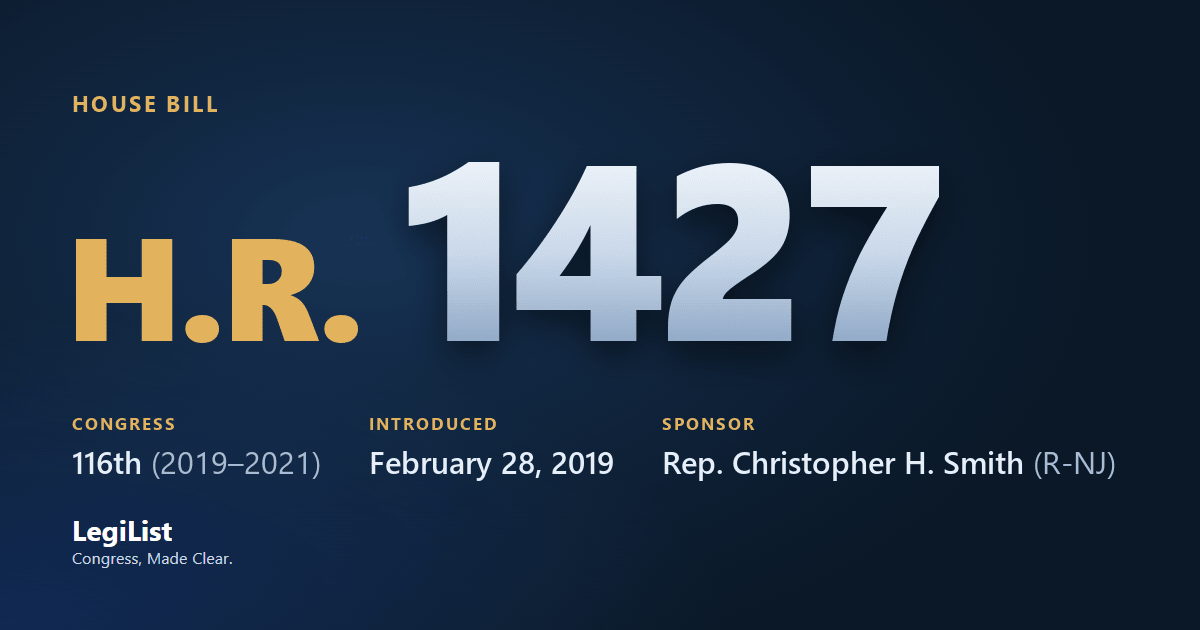
To amend title 5, United States Code, to provide for priority for making payments for lodging expenses for Federal employees that are booked in places with policies to protect individuals from severe forms of human trafficking, and for other purposes.
Latest action · Feb 28, 2019 Referred to the House Committee on Oversight and Reform.
Progress
Where this bill reached, and when. A stage with no date was not reached; one that failed a vote and later carried shows the date it carried.
- IntroducedFeb 28, 2019
- Passed HouseNot reached
- Passed SenateNot reached
- To the PresidentNot reached
- Became lawNot reached
Summary
This bill requires each federal agency, for the purposes of booking and making payments for traveling employees' lodging expenses, to give priority to preferred places of accommodation.
To be considered a preferred place of accommodation, a hotel, motel, or other place of public accommodation must have certain measures in place, including (1) a zero-tolerance policy regarding severe forms of trafficking in persons, (2) procedures for employees to identify and report such exploitation to appropriate law enforcement authorities and to hotel management, and (3) certain mandatory training for employees who are located at the place of accommodation and who are likely to interact with guests.
The General Services Administration shall (1) develop and make available a model zero-tolerance policy for places of accommodation, (2) develop and publish a list of training programs that address the identification of human trafficking and reporting to authorities, and (3) maintain a list of each preferred place of accommodation.
Compliance with these requirements shall be assessed and enforced separately for each individual place of accommodation, and a lack of compliance by one shall not impact the eligibility of an affiliated establishment.
Cosponsors 3
Members who signed on, in the order they did. Signatures ran from Feb 28, 2019 to Sep 24, 2019; 1 is an original cosponsor, there from the day it was introduced.
| Seat | Cosponsor | Signed on | |
|---|---|---|---|
| D-NY | Carolyn B. Maloney | Original | Feb 28, 2019 |
| D-CA | Karen Bass | Mar 5, 2019 | |
| R-FL | Michael Waltz | Sep 24, 2019 |
Committees 1
Where it was sent and what each committee and subcommittee did with it, in order.
| Chamber | Committee | What it did |
|---|---|---|
| House | Oversight and Government Reform Committee | Referred Feb 28, 2019 |
Actions 2
Everything that happened, newest first.
- Feb 28, 2019Introduced in House
- Feb 28, 2019Referred to the House Committee on Oversight and Reform.
Research
What has been written about this bill: committee reports, cost estimates, the sponsor’s authority statement, printed hearings and the Congressional Research Service’s work.
Constitutional authority
The sponsor’s statement, as printed in the Congressional Record, vol. 165, no. 37, February 28, 2019, page H2315.
Titles 1
Every title it has carried, official and short, at each stage.
- Official Title as Introduced
- To amend title 5, United States Code, to provide for priority for making payments for lodging expenses for Federal employees that are booked in places with policies to protect individuals from severe forms of human trafficking, and for other purposes.
Subjects
Assigned by the Library of Congress. Policy area: Government Operations and Politics.
Text 1
Each version as it was printed, newest first.
- Feb 28, 2019Introduced in House
Support LegiList
This page is free, carries no paywall, and is built and maintained by one person. If the record here is useful to you, a few dollars keeps it going.
Everything here is as published by Congress: the summary is the Congressional Research Service's, the action wording is the clerks', and the subjects are the Library of Congress's. How far it got is read from the actions themselves, taking the most recent one of each kind, so a bill that failed a vote and later passed is shown as having passed. Records come from this bill on Congress.gov and govinfo.gov; cost estimates are the Congressional Budget Office's, and the hearings are the printed hearings GovInfo publishes, which can appear months after the hearing.