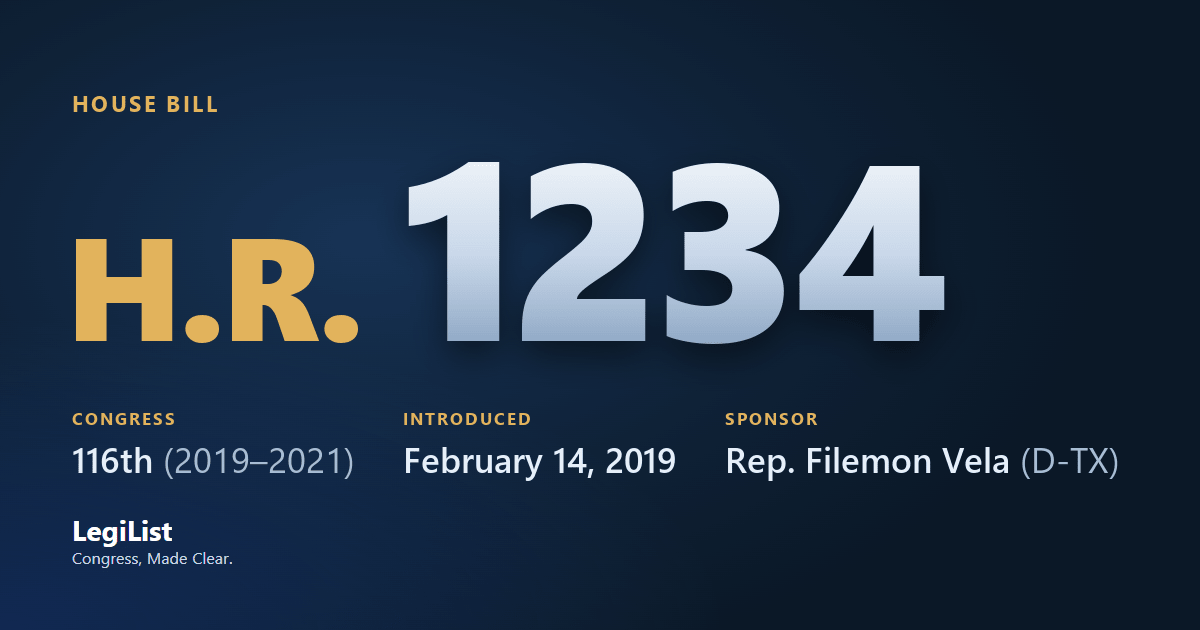
Preventing the Taking of Americans’ Land to Build Trump’s Wall Act
Latest action · Mar 25, 2019 Referred to the Subcommittee on the Constitution, Civil Rights, and Civil Liberties.
Progress
Where this bill reached, and when. A stage with no date was not reached; one that failed a vote and later carried shows the date it carried.
- IntroducedFeb 14, 2019
- Passed HouseNot reached
- Passed SenateNot reached
- To the PresidentNot reached
- Became lawNot reached
Summary
Preventing the Taking of Americans' Land to Build Trump's Wall Act
This bill restricts the government's ability to seize private land rights for physical barriers, or roads between ports of entry, along the U.S.-Mexico border. Before taking possession of or altering such private land, the Department of Homeland Security shall certify to Congress that each property owner has received just compensation as established in a judicial condemnation proceeding.
Cosponsors 7
Members who signed on, in the order they did. Signatures ran from Feb 14, 2019 to Mar 11, 2019; 1 is an original cosponsor, there from the day it was introduced.
| Seat | Cosponsor | Signed on | |
|---|---|---|---|
| D-MS | Bennie G. Thompson | Original | Feb 14, 2019 |
| D-TX | Veronica Escobar | Feb 25, 2019 | |
| D-NJ | Bonnie Watson Coleman | Feb 26, 2019 | |
| D-TX | Sheila Jackson Lee | Feb 28, 2019 | |
| D-IL | Janice D. Schakowsky | Mar 5, 2019 | |
| D-DC | Eleanor Holmes Norton | Mar 11, 2019 | |
| D-TX | Vicente Gonzalez | Mar 11, 2019 |
Committees 2
Where it was sent and what each committee and subcommittee did with it, in order.
| Chamber | Committee | What it did |
|---|---|---|
| House | Judiciary Committee | Referred Feb 14, 2019 |
| Constitution and Limited Government Subcommittee | Referred Mar 25, 2019 | |
| House | Homeland Security Committee | Referred Feb 14, 2019 |
| Border Security and Enforcement Subcommittee | Referred Mar 6, 2019 |
Actions 4
Everything that happened, newest first.
- Mar 25, 2019Referred to the Subcommittee on the Constitution, Civil Rights, and Civil Liberties.
- Mar 6, 2019Referred to the Subcommittee on Border Security, Facilitation, and Operations.
- Feb 14, 2019Introduced in House
- Feb 14, 2019Referred to the Committee on the Judiciary, and in addition to the Committee on Homeland Security, for a period to be subsequently determined by the Speaker, in each case for consideration of such provisions as fall within the jurisdiction of the committee concerned.
Research
What has been written about this bill: committee reports, cost estimates, the sponsor’s authority statement, printed hearings and the Congressional Research Service’s work.
Constitutional authority
The sponsor’s statement, as printed in the page H2033.
Printed hearings 1
Hearings whose printed record names this bill, newest first: hearings on it, and wider hearings where it came up.
| Number | Hearing | Committee | Held |
|---|---|---|---|
| Serial No. 116-62 | EXAMINING THE EFFECT OF THE BORDER WALL ON PRIVATE AND TRIBAL LANDOWNERS56 pages | Homeland Security Committee | Feb 27, 2020 |
Titles 2
Every title it has carried, official and short, at each stage.
- Official Title as Introduced
- To amend the Homeland Security Act of 2002 to prohibit seizing private land for a border wall, and for other purposes.
- Short Title(s) as Introduced
- Preventing the Taking of Americans’ Land to Build Trump’s Wall Act
Subjects
Assigned by the Library of Congress. Policy area: Immigration.
Text 1
Each version as it was printed, newest first.
- Feb 14, 2019Introduced in House
Support LegiList
This page is free, carries no paywall, and is built and maintained by one person. If the record here is useful to you, a few dollars keeps it going.
Everything here is as published by Congress: the summary is the Congressional Research Service's, the action wording is the clerks', and the subjects are the Library of Congress's. How far it got is read from the actions themselves, taking the most recent one of each kind, so a bill that failed a vote and later passed is shown as having passed. Records come from this bill on Congress.gov and govinfo.gov; cost estimates are the Congressional Budget Office's, and the hearings are the printed hearings GovInfo publishes, which can appear months after the hearing.