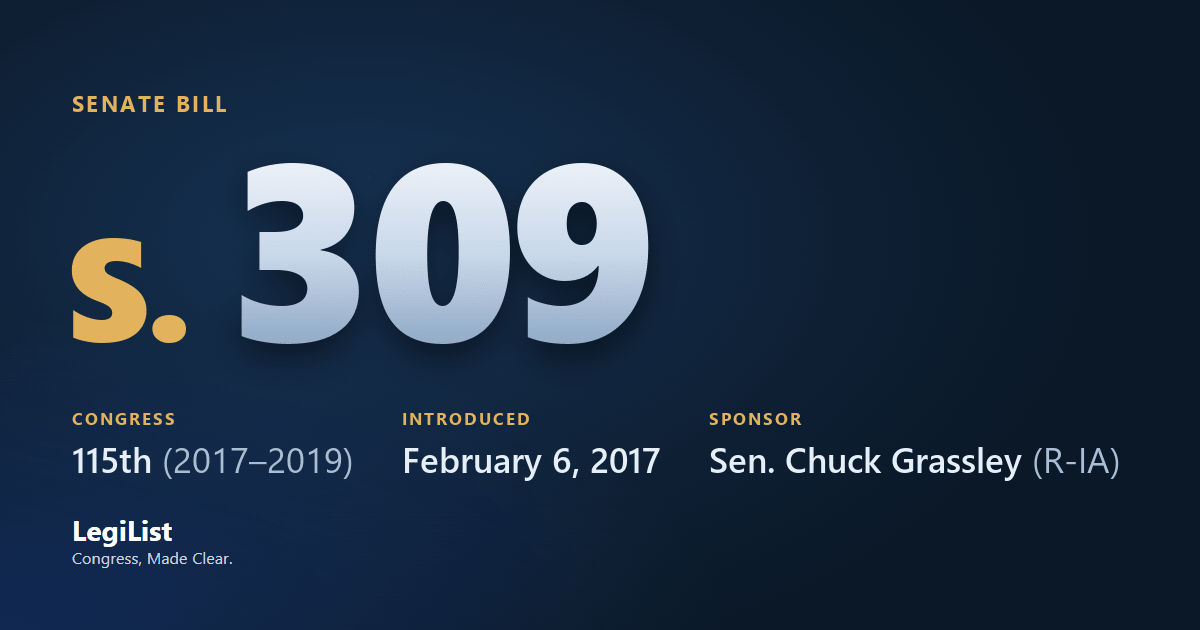
Community-Based Independence for Seniors Act
Latest action · Feb 6, 2017 Read twice and referred to the Committee on Finance.
Progress
Where this bill reached, and when. A stage with no date was not reached; one that failed a vote and later carried shows the date it carried.
- IntroducedFeb 6, 2017
- Passed SenateNot reached
- Passed HouseNot reached
- To the PresidentNot reached
- Became lawNot reached
Summary
Community-Based Independence for Seniors Act
This bill establishes a Community-Based Institutional Special Needs Plan demonstration program, through which the Centers for Medicare & Medicaid Services (CMS) shall target home- and community-based services to low-income seniors who are unable to perform two or more activities of daily living and are eligible for Medicare Advantage (MA) but not for Medicaid.
An MA plan that is selected to participate in the program must use certain payments from CMS to provide those beneficiaries with services and supports such as homemaker services, home-delivered meals, transportation services, respite care, adult daycare, and certain equipment.
The bill establishes a special election period during which an eligible beneficiary may switch to an MA plan that participates in the program.
Cosponsors 2
Members who signed on, in the order they did. Signatures ran from Feb 6, 2017 to Feb 15, 2018, with 1 there on the day it was introduced.
| Seat | Cosponsor | Signed on | |
|---|---|---|---|
| D-MD | Benjamin L. Cardin | Original | Feb 6, 2017 |
| D-RI | Sheldon Whitehouse | Feb 15, 2018 |
Actions 2
Everything that happened, newest first.
- Feb 6, 2017Introduced in Senate
- Feb 6, 2017Read twice and referred to the Committee on Finance.
Subjects
Assigned by the Library of Congress. Policy area: Health.
Text 1
Each version as it was printed, newest first.
- Feb 6, 2017Introduced in Senate
Everything here is as published by Congress: the summary is the Congressional Research Service's, the action wording is the clerks', and the subjects are the Library of Congress's. How far it got is read from the actions themselves, taking the most recent one of each kind, so a bill that failed a vote and later passed is shown as having passed. Records come from this bill on Congress.gov and govinfo.gov.