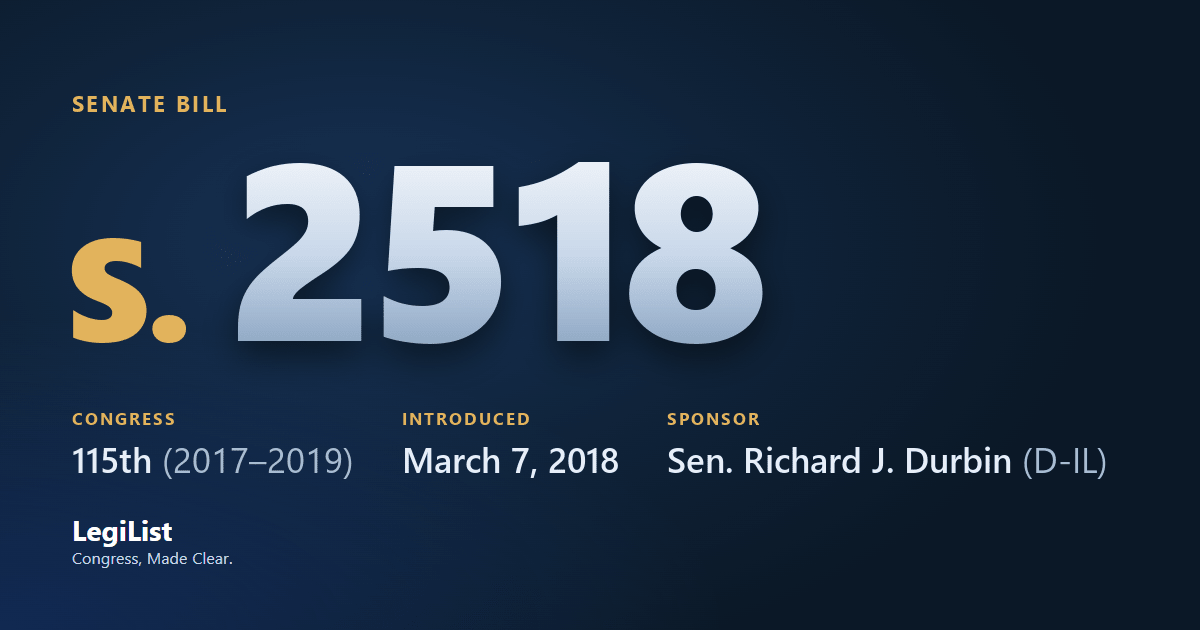
Protecting Employees and Retirees in Business Bankruptcies Act of 2018
Latest action · Mar 7, 2018 Read twice and referred to the Committee on the Judiciary. (text of measure as introduced: CR S1456-1460)
Progress
Where this bill reached, and when. A stage with no date was not reached; one that failed a vote and later carried shows the date it carried.
- IntroducedMar 7, 2018
- Passed SenateNot reached
- Passed HouseNot reached
- To the PresidentNot reached
- Became lawNot reached
Summary
Protecting Employees and Retirees in Business Bankruptcies Act of 2018
This bill amends federal bankruptcy law to modify provisions related to Chapter 11 bankruptcy, which typically involves the reorganization of a debtor company's assets and debts. Specifically, the bill modifies provisions governing: (1) employee and retiree recoveries and losses, and (2) executive compensation programs.
With respect to employee and retiree recoveries and losses, the bill does the following:
- increases the maximum value and age of specified wage and benefit claims entitled to priority payment;
- allows certain claims for losses related to defined contribution plans, if the employer or plan sponsor has committed fraud or otherwise breached its fiduciary duty;
- allows, as an administrative expense of the estate, severance pay owed to employees;
- establishes certain restrictions regarding the rejection or amendment of a collective bargaining agreement;
- revises specified procedures related to the reduction or denial of retiree benefits;
- requires a court, in approving a sale of business assets, to consider the extent to which a bidder has offered to maintain existing jobs and assume benefit obligations; and
- modifies other provisions.
With respect to executive compensation, the bill does the following:
- establishes specified limitations related to executive compensation enhancements,
- prohibits executives from receiving certain retiree benefits if such benefits were reduced or eliminated for other employees or retirees, and
revises other requirements related to court approval of such compensation.
In addition, the bill grants creditor status to labor organizations for purposes of filing a proof of claim.
Cosponsors 2
Members who signed on, in the order they did. All signed on Mar 7, 2018.
| Seat | Cosponsor | Signed on | |
|---|---|---|---|
| D-RI | Sheldon Whitehouse | Original | Mar 7, 2018 |
| D-OH | Sherrod Brown | Original | Mar 7, 2018 |
Committees 1
Where it was sent and what each committee and subcommittee did with it, in order.
| Chamber | Committee | What it did |
|---|---|---|
| Senate | Judiciary Committee | Referred Mar 7, 2018 |
Actions 2
Everything that happened, newest first.
- Mar 7, 2018Introduced in Senate
- Mar 7, 2018Read twice and referred to the Committee on the Judiciary. (text of measure as introduced: CR S1456-1460)
In the Congressional Record 1
Days the Record’s own index lists this bill, newest first, with the pages and the members it names. Pages starting H are the House, S the Senate, E Extensions of Remarks.
| Where | In the Record | Members | Date |
|---|---|---|---|
| Senate | Text printed S1456–S1460 | Richard J. Durbin D-IL (text) | Mar 7, 2018 |
Related bills 2
Companion bills and other measures the record links to this one.
| Bill | Title | Relationship | Latest action |
|---|---|---|---|
| HR 138 | Protecting Employees and Retirees in Business Bankruptcies Act of 2017 | Related bill | Mar 15, 2018 |
| S 1156 | Protecting Employees and Retirees in Business Bankruptcies Act of 2015 | Reintroduction of | Apr 30, 2015 |
Titles 2
Every title it has carried, official and short, at each stage.
- Official Title as Introduced
- A bill to amend title 11, United States Code, to improve protections for employees and retirees in business bankruptcies.
- Short Titles as Introduced
- Protecting Employees and Retirees in Business Bankruptcies Act of 2018
Subjects
Assigned by the Library of Congress. Policy area: Finance and Financial Sector.
Text 1
Each version as it was printed, newest first.
- Mar 7, 2018Introduced in Senate
Support LegiList
This page is free, carries no paywall, and is built and maintained by one person. If the record here is useful to you, a few dollars keeps it going.
Everything here is as published by Congress: the summary is the Congressional Research Service's, the action wording is the clerks', and the subjects are the Library of Congress's. How far it got is read from the actions themselves, taking the most recent one of each kind, so a bill that failed a vote and later passed is shown as having passed. Records come from this bill on Congress.gov and govinfo.gov; cost estimates are the Congressional Budget Office's, and the hearings are the printed hearings GovInfo publishes, which can appear months after the hearing.