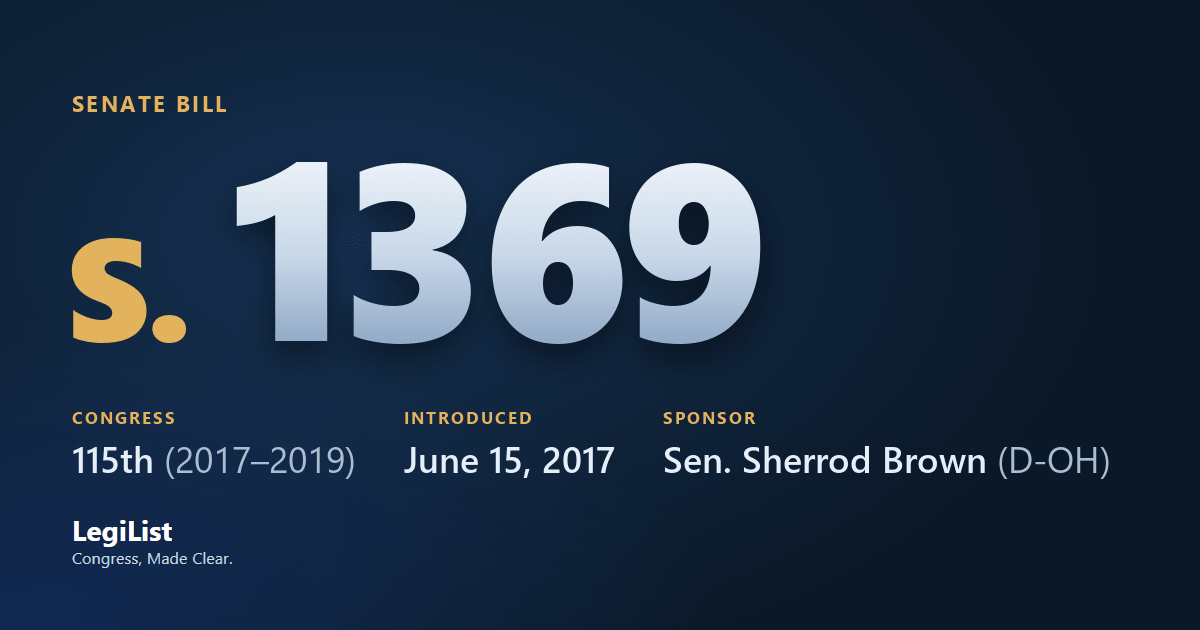
Stop Price Gouging Act
Latest action · Jun 15, 2017 Read twice and referred to the Committee on Finance.
Progress
Where this bill reached, and when. A stage with no date was not reached; one that failed a vote and later carried shows the date it carried.
- IntroducedJun 15, 2017
- Passed SenateNot reached
- Passed HouseNot reached
- To the PresidentNot reached
- Became lawNot reached
Summary
Stop Price Gouging Act
This bill amends the Internal Revenue Code to impose an excise tax on pharmaceutical companies that sell prescription drugs that are subject to price spikes that exceed the annual percentage increase in the medical care consumer price index detailed expenditure category for all urban consumers (U.S. city average).
For each taxable prescription drug, the excise tax ranges from 50% to 100% of price spike revenue received by the company, depending on the size of the price spike and including an adjustment for revenue that is due solely to an increase in the cost of the inputs necessary to manufacture the drug.
Pharmaceutical companies must submit specified data regarding drug prices and revenue to the Inspector General (IG) of the Department of Health and Human Services (HHS), and the IG must submit an assessment of the data to the Internal Revenue Service.
HHS, upon the recommendation of the IG, may exempt certain drugs from the excise tax if: (1) a for-cause price increase exemption should apply, or (2) the drug has an average manufacturer price of not greater than $10 for a 30-day supply and is marketed by at least 3 other holders of applications approved under the Federal Food, Drug, and Cosmetic Act.
The Government Accountability Office must examine: (1) how drug manufacturers and health plans establish initial launch prices for newly approved drugs, and (2) alternative methods that have been proposed for setting the price of new drugs.
Cosponsors 8
Members who signed on, in the order they did. Signatures ran from Jun 15, 2017 to Aug 3, 2017; 5 are original cosponsors, there from the day it was introduced.
| Seat | Cosponsor | Signed on | |
|---|---|---|---|
| D-MN | Al Franken | Original | Jun 15, 2017 |
| D-RI | Jack Reed | Original | Jun 15, 2017 |
| D-NY | Kirsten E. Gillibrand | Original | Jun 15, 2017 |
| D-NH | Margaret Wood Hassan | Original | Jun 15, 2017 |
| D-NM | Tom Udall | Original | Jun 15, 2017 |
| D-IL | Richard J. Durbin | Jun 19, 2017 | |
| I-VT | Bernard Sanders | Jun 22, 2017 | |
| D-CT | Richard Blumenthal | Aug 3, 2017 |
Committees 1
Where it was sent and what each committee and subcommittee did with it, in order.
| Chamber | Committee | What it did |
|---|---|---|
| Senate | Finance Committee | Referred Jun 15, 2017 |
Actions 2
Everything that happened, newest first.
- Jun 15, 2017Introduced in Senate
- Jun 15, 2017Read twice and referred to the Committee on Finance.
Research
What has been written about this bill: committee reports, cost estimates, the sponsor’s authority statement, printed hearings and the Congressional Research Service’s work.
Printed hearings 1
Hearings whose printed record names this bill, newest first: hearings on it, and wider hearings where it came up.
| Number | Hearing | Committee | Held |
|---|---|---|---|
| S. Hrg. 115-438 | NOMINATION OF ALEX MICHAEL AZAR II202 pages | Finance Committee | Jan 9, 2018 |
Related bills 2
Companion bills and other measures the record links to this one.
| Bill | Title | Relationship | Latest action |
|---|---|---|---|
| S 378 | Stop Price Gouging Act | Reintroduced Bill | Feb 7, 2019 |
| HR 2974 | Stop Price Gouging Act | Identical bill | Jun 23, 2017 |
Titles 2
Every title it has carried, official and short, at each stage.
- Official Title as Introduced
- A bill to amend the Internal Revenue Code of 1986 to establish an excise tax on certain prescription drugs which have been subject to a price spike, and for other purposes.
- Short Titles as Introduced
- Stop Price Gouging Act
Subjects
Assigned by the Library of Congress. Policy area: Taxation.
Text 1
Each version as it was printed, newest first.
- Jun 15, 2017Introduced in Senate
Everything here is as published by Congress: the summary is the Congressional Research Service's, the action wording is the clerks', and the subjects are the Library of Congress's. How far it got is read from the actions themselves, taking the most recent one of each kind, so a bill that failed a vote and later passed is shown as having passed. Records come from this bill on Congress.gov and govinfo.gov; cost estimates are the Congressional Budget Office's, and the hearings are the printed hearings GovInfo publishes, which can appear months after the hearing.