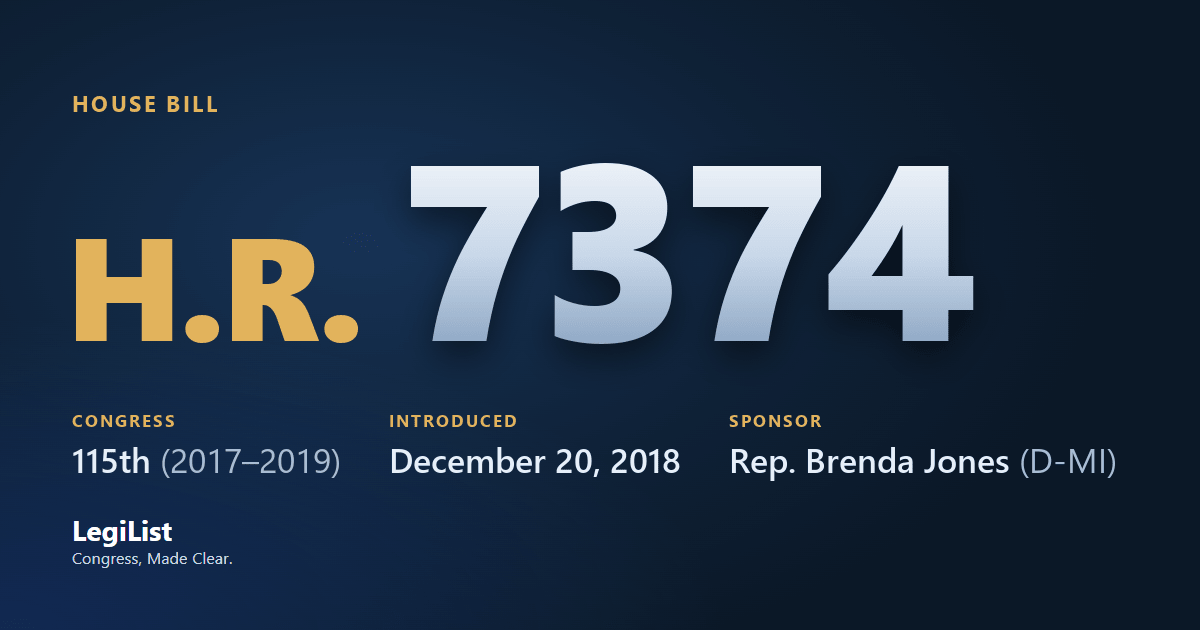
Minimum Wage Fairness Act of 2018
Latest action · Dec 20, 2018 Referred to the Committee on Education and the Workforce, and in addition to the Committees on Oversight and Government Reform, and Financial Services, for a period to be subsequently determined by the Speaker, in each case for consideration of such provisions as fall within the jurisdiction of the committee concerned.
Progress
Where this bill reached, and when. A stage with no date was not reached; one that failed a vote and later carried shows the date it carried.
- IntroducedDec 20, 2018
- Passed HouseNot reached
- Passed SenateNot reached
- To the PresidentNot reached
- Became lawNot reached
Summary
Minimum Wage Fairness Act of 2018
This bill requires the Department of Labor to identify each fiscal year any states that have reduced their minimum wage or that have reduced a minimum wage increase that would otherwise become effective. Labor must then notify federal agencies that administer programs in such states and such agencies must reduce the funding for the administrative costs of such programs by a percentage equivalent to the reduction in the minimum wage in such states.
Cosponsors 1
Members who signed on, in the order they did. All signed on Dec 20, 2018.
| Seat | Cosponsor | Signed on | |
|---|---|---|---|
| D-MI | Brenda L. Lawrence | Original | Dec 20, 2018 |
Actions 2
Everything that happened, newest first.
- Dec 20, 2018Introduced in House
- Dec 20, 2018Referred to the Committee on Education and the Workforce, and in addition to the Committees on Oversight and Government Reform, and Financial Services, for a period to be subsequently determined by the Speaker, in each case for consideration of such provisions as fall within the jurisdiction of the committee concerned.
Subjects
Assigned by the Library of Congress. Policy area: Labor and Employment.
Text 1
Each version as it was printed, newest first.
- Dec 20, 2018Introduced in House
Everything here is as published by Congress: the summary is the Congressional Research Service's, the action wording is the clerks', and the subjects are the Library of Congress's. How far it got is read from the actions themselves, taking the most recent one of each kind, so a bill that failed a vote and later passed is shown as having passed. Records come from this bill on Congress.gov and govinfo.gov.