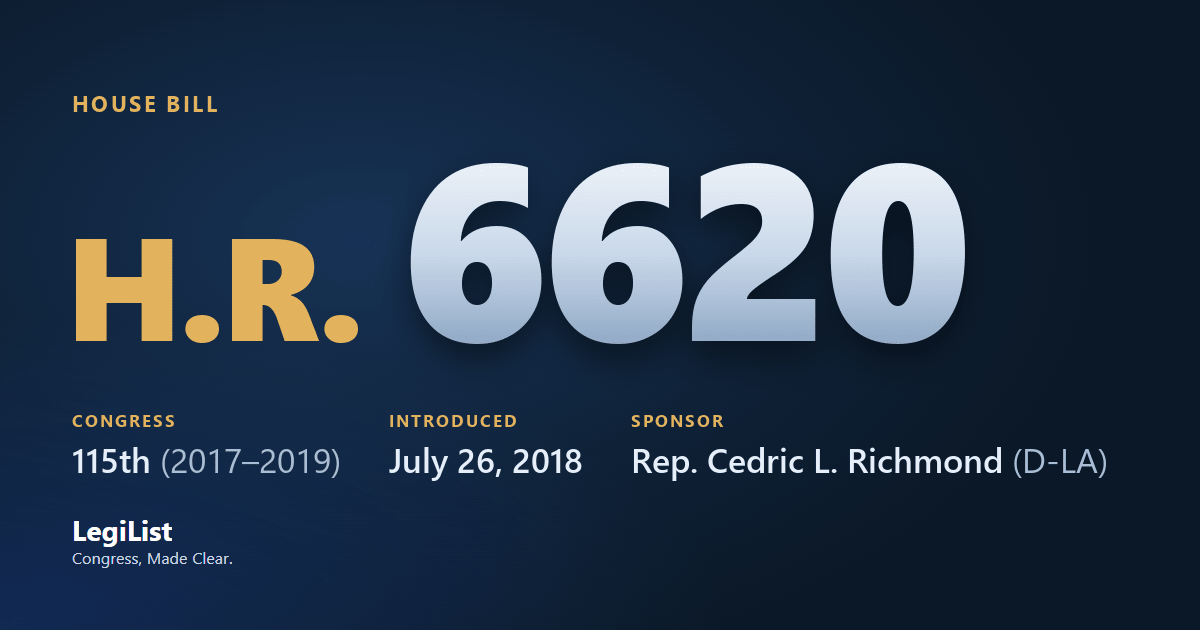
Protecting Critical Infrastructure Against Drones and Emerging Threats Act
Latest action · Sep 26, 2018 Received in the Senate and Read twice and referred to the Committee on Homeland Security and Governmental Affairs.
Progress
Where this bill reached, and when. A stage with no date was not reached; one that failed a vote and later carried shows the date it carried.
- IntroducedJul 26, 2018
- Passed HouseSep 25, 2018
- Passed SenateNot reached
- To the PresidentNot reached
- Became lawNot reached
Summary
Protecting Critical Infrastructure Against Drones and Emerging Threats Act
This bill requires the Department of Homeland Security to:
- request additional information from other agencies of the federal government, state and local government agencies, and the private sector relating to threats of unmanned aircraft systems (drones) and other emerging threats associated with such new technologies;
- develop and disseminate a security threat assessment regarding drones and other emerging threats associated with such new technologies; and
- establish and utilize a secure communications and information technology infrastructure, including data-mining and other advanced analytical tools.
Cosponsors 1
Members who signed on, in the order they did. All signed on Jul 26, 2018.
| Seat | Cosponsor | Signed on | |
|---|---|---|---|
| R-TX | John Ratcliffe | Original | Jul 26, 2018 |
Committees 3
Where it was sent and what each committee and subcommittee did with it, in order.
| Chamber | Committee | What it did |
|---|---|---|
| House | Homeland Security Committee | Referred Jul 26, 2018Markup Sep 13, 2018Reported Sep 25, 2018 |
| Counterterrorism and Intelligence Subcommittee | Referred Aug 20, 2018Discharged Sep 13, 2018 | |
| Oversight, Investigations, and Accountability Subcommittee | Referred Aug 20, 2018Discharged Sep 13, 2018 | |
| House | Transportation and Infrastructure Committee | Referred Jul 26, 2018Discharged Sep 25, 2018 |
| Aviation Subcommittee | Referred Jul 27, 2018 | |
| Senate | Homeland Security and Governmental Affairs Committee | Referred Sep 26, 2018 |
Actions 18
Everything that happened, newest first.
- Sep 26, 2018Received in the Senate and Read twice and referred to the Committee on Homeland Security and Governmental Affairs.
- Sep 25, 2018Reported by the Committee on Homeland Security. H. Rept. 115-960, Part I.
- Sep 25, 2018Committee on Transportation discharged.
- Sep 25, 2018Placed on the Union Calendar, Calendar No. 748.
- Sep 25, 2018Mr. McCaul moved to suspend the rules and pass the bill.
- Sep 25, 2018Considered under suspension of the rules. (consideration: CR H8750-8752)
- Sep 25, 2018DEBATE - The House proceeded with forty minutes of debate on H.R. 6620.
- Sep 25, 2018Passed/agreed to in House: On motion to suspend the rules and pass the bill Agreed to by voice vote. (text: CR H8750)
- Sep 25, 2018Motion to reconsider laid on the table Agreed to without objection.
- Sep 13, 2018Subcommittee on Counterterrorism and Intelligence Discharged.
- Sep 13, 2018Subcommittee on Oversight and Management Efficiency Discharged.
- Sep 13, 2018Committee Consideration and Mark-up Session Held.
- Sep 13, 2018Ordered to be Reported by Unanimous Consent.
- Aug 20, 2018Referred to the Subcommittee on Counterterrorism and Intelligence.
- Aug 20, 2018Referred to the Subcommittee on Oversight and Management Efficiency.
- Jul 27, 2018Referred to the Subcommittee on Aviation.
- Jul 26, 2018Introduced in House
- Jul 26, 2018Referred to the Committee on Homeland Security, and in addition to the Committee on Transportation and Infrastructure, for a period to be subsequently determined by the Speaker, in each case for consideration of such provisions as fall within the jurisdiction of the committee concerned.
In the Congressional Record 2
Days the Record’s own index lists this bill, newest first, with the pages and the members it names. Pages starting H are the House, S the Senate, E Extensions of Remarks.
| Where | In the Record | Members | Date |
|---|---|---|---|
| Extensions | Cost estimates E1340 | Michael T. McCaul R-TX | Sep 28, 2018 |
| House | Debate and remarks H8750–H8752Text printed H8750 | Cedric L. Richmond D-LA, Michael T. McCaul R-TX, Sheila Jackson Lee D-TX | Sep 25, 2018 |
Research
What has been written about this bill: committee reports, cost estimates, the sponsor’s authority statement, printed hearings and the Congressional Research Service’s work.
Committee report
Congressional Budget Office cost estimate
- Sep 28, 2018H.R. 6620, Protecting Critical Infrastructure Against Drones and Emerging Threats ActAs passed by the House of Representatives on September 25, 2018
Constitutional authority
The sponsor’s statement, as printed in the Congressional Record, vol. 164, no. 126, July 26, 2018, page H7727.
Titles 4
Every title it has carried, official and short, at each stage.
- Official Title as Introduced
- To require the Department of Homeland Security to prepare a threat assessment relating to unmanned aircraft systems, and for other purposes.
- Short Titles as Introduced
- Protecting Critical Infrastructure Against Drones and Emerging Threats Act
- Short Titles as Reported to House
- Protecting Critical Infrastructure Against Drones and Emerging Threats Act
- Short Titles as Passed House
- Protecting Critical Infrastructure Against Drones and Emerging Threats Act
Subjects
Assigned by the Library of Congress. Policy area: Emergency Management.
- Advanced technology and technological innovations
- Aviation and airports
- Computer security and identity theft
- Computers and information technology
- Congressional oversight
- Emergency Management
- Government information and archives
- Government studies and investigations
- Homeland security
- Transportation safety and security
Text 4
Each version as it was printed, newest first.
- Sep 26, 2018Referred in Senate
- Sep 25, 2018Engrossed in House
- Sep 25, 2018Reported in House
- Jul 26, 2018Introduced in House
Support LegiList
This page is free, carries no paywall, and is built and maintained by one person. If the record here is useful to you, a few dollars keeps it going.
Everything here is as published by Congress: the summary is the Congressional Research Service's, the action wording is the clerks', and the subjects are the Library of Congress's. How far it got is read from the actions themselves, taking the most recent one of each kind, so a bill that failed a vote and later passed is shown as having passed. Records come from this bill on Congress.gov and govinfo.gov; cost estimates are the Congressional Budget Office's, and the hearings are the printed hearings GovInfo publishes, which can appear months after the hearing.