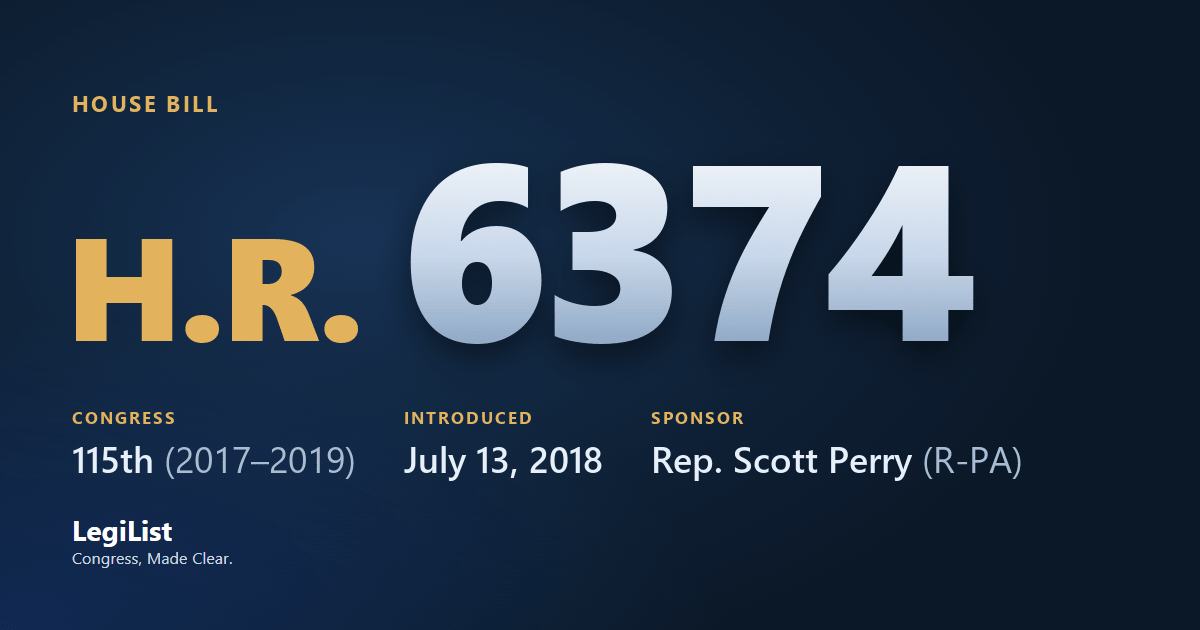
FIT Act
Latest action · Sep 5, 2018 Received in the Senate and Read twice and referred to the Committee on Homeland Security and Governmental Affairs.
Progress
Where this bill reached, and when. A stage with no date was not reached; one that failed a vote and later carried shows the date it carried.
- IntroducedJul 13, 2018
- Passed HouseSep 4, 2018
- Passed SenateNot reached
- To the PresidentNot reached
- Became lawNot reached
Summary
Fitness Information Transparency Act of 2018 or the FIT Act
This bill directs the Department of Homeland Security to adopt contractor fitness standards that reflect public trust concerns at each position risk level.
Cosponsors 1
Members who signed on, in the order they did. All signed on Jul 13, 2018.
| Seat | Cosponsor | Signed on | |
|---|---|---|---|
| R-TX | Michael T. McCaul | Original | Jul 13, 2018 |
Actions 15
Everything that happened, newest first.
- Sep 5, 2018Received in the Senate and Read twice and referred to the Committee on Homeland Security and Governmental Affairs.
- Sep 4, 2018Considered under suspension of the rules. (consideration: CR S7799-7801)
- Sep 4, 2018DEBATE - The House proceeded with forty minutes of debate on H.R. 6374.
- Sep 4, 2018Motion to reconsider laid on the table Agreed to without objection.
- Sep 4, 2018Mr. Katko moved to suspend the rules and pass the bill, as amended.
Subjects
Assigned by the Library of Congress. Policy area: Government Operations and Politics.
Text 4
Each version as it was printed, newest first.
- Sep 5, 2018Referred in Senate
- Sep 4, 2018Reported in House
- Sep 4, 2018Engrossed in House
- Jul 13, 2018Introduced in House
Everything here is as published by Congress: the summary is the Congressional Research Service's, the action wording is the clerks', and the subjects are the Library of Congress's. How far it got is read from the actions themselves, taking the most recent one of each kind, so a bill that failed a vote and later passed is shown as having passed. Records come from this bill on Congress.gov and govinfo.gov.