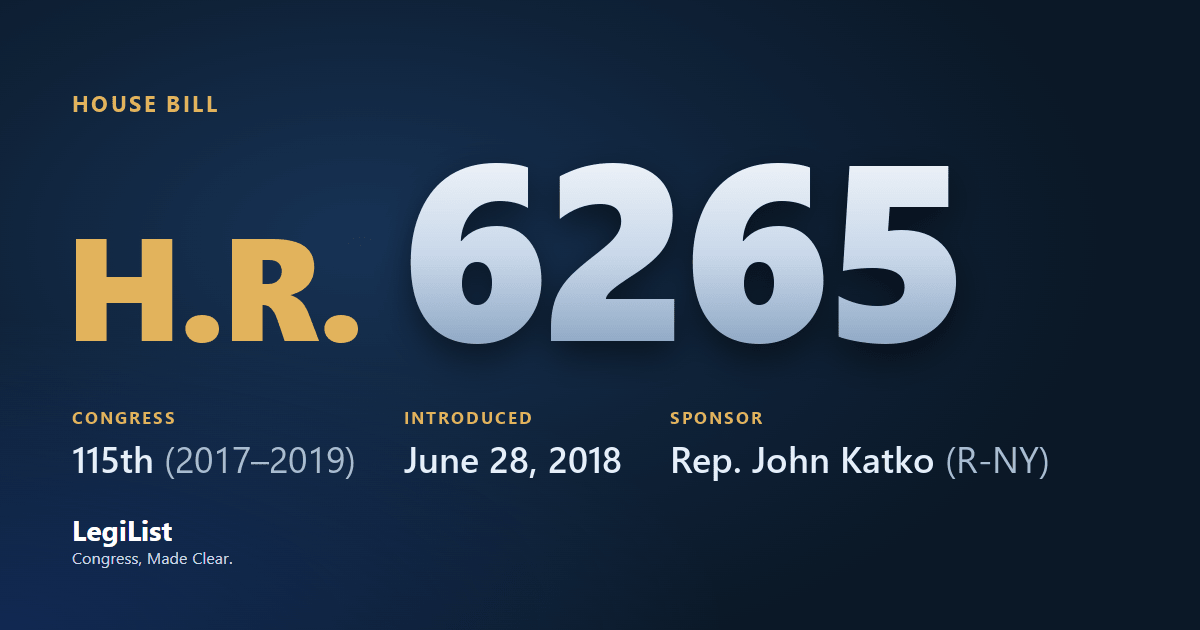
PreCheck is PreCheck Act of 2018
Latest action · Sep 5, 2018 Received in the Senate and Read twice and referred to the Committee on Commerce, Science, and Transportation.
Progress
Where this bill reached, and when. A stage with no date was not reached; one that failed a vote and later carried shows the date it carried.
- IntroducedJun 28, 2018
- Passed HouseSep 4, 2018
- Passed SenateNot reached
- To the PresidentNot reached
- Became lawNot reached
Summary
PreCheck is PreCheck Act of 2018
This bill directs the Transportation Security Administration (TSA) to ensure that only travelers who are members of a trusted traveler program are permitted to use TSA PreCheck security screening lanes at TSA checkpoints.
Any traveler under the age of 12 or over the age of 75 who is not a member of a trusted traveler program shall be permitted to utilize PreCheck security screening lanes at TSA checkpoints when traveling on the same reservation as a member of a trusted traveler program.
The TSA shall implement a risk modified screening protocol for lanes other than designated TSA PreCheck security screening lanes at TSA checkpoints to further segment passengers based on risk. Only low-risk passengers shall be eligible to undergo risk modified screening at TSA checkpoints.
The Inspector General of the Department of Homeland Security must assess whether there has been a systematic pattern of violations of the use of TSA PreCheck security screening lanes at TSA checkpoints during the previous calendar year.
The TSA shall complete the implementation of a long-term strategy to increase enrollment in the TSA PreCheck Program and expand the total population of members of trusted traveler programs.
Cosponsors 3
Members who signed on, in the order they did. Signatures ran from Jun 28, 2018 to Jul 25, 2018; 2 are original cosponsors, there from the day it was introduced.
| Seat | Cosponsor | Signed on | |
|---|---|---|---|
| R-TX | Michael T. McCaul | Original | Jun 28, 2018 |
| D-MA | William R. Keating | Original | Jun 28, 2018 |
| D-NJ | Bonnie Watson Coleman | Jul 25, 2018 |
Committees 2
Where it was sent and what each committee and subcommittee did with it, in order.
| Chamber | Committee | What it did |
|---|---|---|
| House | Homeland Security Committee | Referred Jun 28, 2018Markup Jul 24, 2018Reported Sep 4, 2018 |
| Transportation and Maritime Security Subcommittee | Referred Jul 16, 2018Discharged Jul 24, 2018 | |
| Senate | Commerce, Science, and Transportation Committee | Referred Sep 5, 2018 |
Actions 14
Everything that happened, newest first.
- Sep 5, 2018Received in the Senate and Read twice and referred to the Committee on Commerce, Science, and Transportation.
- Sep 4, 2018Reported (Amended) by the Committee on Homeland Security. H. Rept. 115-912.
- Sep 4, 2018Placed on the Union Calendar, Calendar No. 708.
- Sep 4, 2018Mr. Katko moved to suspend the rules and pass the bill, as amended.
- Sep 4, 2018Considered under suspension of the rules. (consideration: CR S7807-7809)
- Sep 4, 2018DEBATE - The House proceeded with forty minutes of debate on H.R. 6265.
- Sep 4, 2018Passed/agreed to in House: On motion to suspend the rules and pass the bill, as amended Agreed to by voice vote. (text: CR H7807-7809)
- Sep 4, 2018Motion to reconsider laid on the table Agreed to without objection.
- Jul 24, 2018Subcommittee on Transportation and Protective Security Discharged.
- Jul 24, 2018Committee Consideration and Mark-up Session Held.
- Jul 24, 2018Ordered to be Reported (Amended) by Unanimous Consent.
- Jul 16, 2018Referred to the Subcommittee on Transportation and Protective Security.
- Jun 28, 2018Introduced in House
- Jun 28, 2018Referred to the House Committee on Homeland Security.
In the Congressional Record 2
Days the Record’s own index lists this bill, newest first, with the pages and the members it names. Pages starting H are the House, S the Senate, E Extensions of Remarks.
| Where | In the Record | Members | Date |
|---|---|---|---|
| Extensions | Cost estimates E1414 | Michael T. McCaul R-TX | Oct 16, 2018 |
| House | Debate and remarks H7807–H7809Text printed H7807 | Bonnie Watson Coleman D-NJ, John Katko R-NY | Sep 4, 2018 |
Research
What has been written about this bill: committee reports, cost estimates, the sponsor’s authority statement, printed hearings and the Congressional Research Service’s work.
Committee report
Congressional Budget Office cost estimate
- Oct 11, 2018H.R. 6265, PreCheck is PreCheck Act of 2018As passed by the House of Representatives on September 4, 2018
Constitutional authority
The sponsor’s statement, as printed in the Congressional Record, vol. 164, no. 109, June 28, 2018, page H5976.
Titles 4
Every title it has carried, official and short, at each stage.
- Official Title as Introduced
- To ensure that only travelers who are members of a trusted traveler program use Transportation Security Administration security screening lanes designated for trusted travelers, and for other purposes.
- Short Titles as Introduced
- PreCheck is PreCheck Act of 2018
- Short Titles as Reported to House
- PreCheck is PreCheck Act of 2018
- Short Titles as Passed House
- PreCheck is PreCheck Act of 2018
Subjects
Assigned by the Library of Congress. Policy area: Transportation and Public Works.
Text 4
Each version as it was printed, newest first.
- Sep 5, 2018Referred in Senate
- Sep 4, 2018Reported in House
- Sep 4, 2018Engrossed in House
- Jun 28, 2018Introduced in House
Everything here is as published by Congress: the summary is the Congressional Research Service's, the action wording is the clerks', and the subjects are the Library of Congress's. How far it got is read from the actions themselves, taking the most recent one of each kind, so a bill that failed a vote and later passed is shown as having passed. Records come from this bill on Congress.gov and govinfo.gov; cost estimates are the Congressional Budget Office's, and the hearings are the printed hearings GovInfo publishes, which can appear months after the hearing.