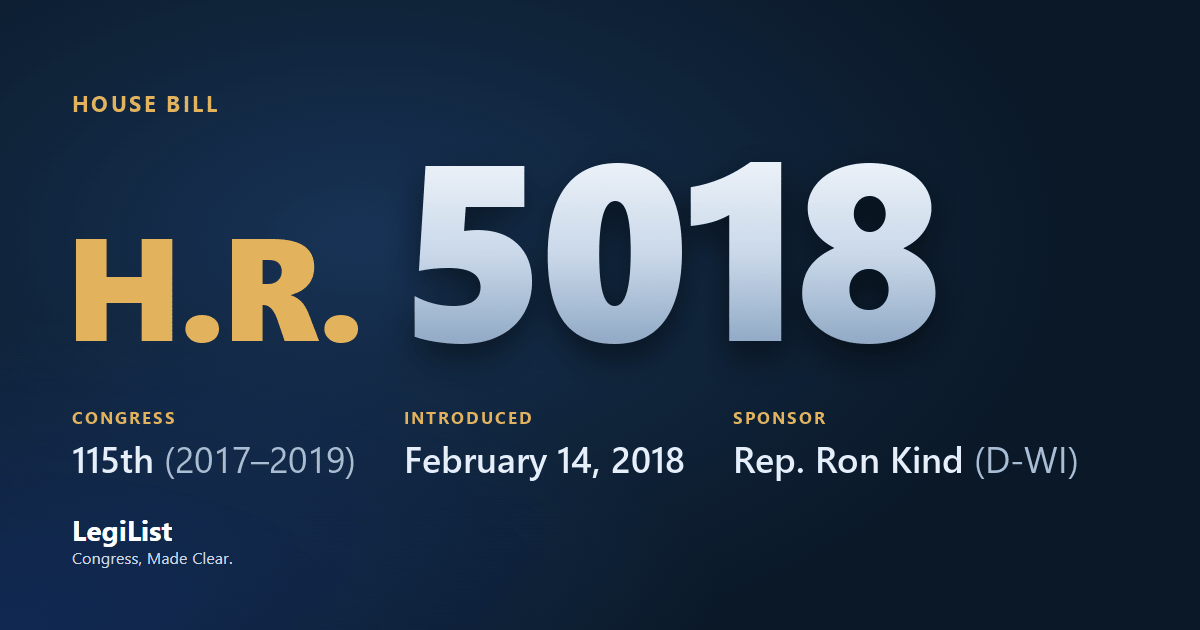
Education and Workforce Innovation Act
Latest action · Apr 5, 2018 Referred to the Subcommittee on Higher Education and Workforce Development.
Progress
Where this bill reached, and when. A stage with no date was not reached; one that failed a vote and later carried shows the date it carried.
- IntroducedFeb 14, 2018
- Passed HouseNot reached
- Passed SenateNot reached
- To the PresidentNot reached
- Became lawNot reached
Summary
Education and Workforce Innovation Act
This bill directs the Department of Education (ED) to carry out a pilot program to award grants to eligible entities for programs that provide direct skills and job training for individuals to enter and advance in high-growth, emerging, and in-demand industries, such as skilled labor and trade industries. The term "eligible entity" means a private company involved in the manufacturing, production, or technology industries, in partnership with a junior or community college, postsecondary vocational institution, or secondary school.
An eligible entity shall use grant funds for a multiyear program to provide students with education and training to enter and advance in such industries, by providing: (1) customized training valuable to such industries, (2) increased productivity and knowledge transfer, (3) a stable and predictable pipeline to a high standard of employment upon graduation from the program, (4) a proven model of success, and (5) an opportunity for career advancement.
The bill also directs ED and the Department of the Treasury, jointly with an advisory panel of business representatives, to administer a five-year pay-for-performance pilot program to raise funds from investors to cover the cost of a workforce training program that increases trade certifications or apprenticeships for unemployed individuals or dislocated workers and meets other specified requirements.
Cosponsors
Members who signed on, in the order they did.
Committees 1
Where it was sent and what each committee and subcommittee did with it, in order.
| Chamber | Committee | What it did |
|---|---|---|
| House | Education and Workforce Committee | Referred Feb 14, 2018 |
| Higher Education and Workforce Development Subcommittee | Referred Apr 5, 2018 |
Actions 3
Everything that happened, newest first.
- Apr 5, 2018Referred to the Subcommittee on Higher Education and Workforce Development.
- Feb 14, 2018Introduced in House
- Feb 14, 2018Referred to the House Committee on Education and the Workforce.
Research
What has been written about this bill: committee reports, cost estimates, the sponsor’s authority statement, printed hearings and the Congressional Research Service’s work.
Constitutional authority
The sponsor’s statement, as printed in the Congressional Record, vol. 164, no. 29, February 14, 2018, page H1178.
Printed hearings 1
Hearings whose printed record names this bill, newest first: hearings on it, and wider hearings where it came up.
| Number | Hearing | Committee | Held |
|---|---|---|---|
| S. Hrg. 115-432 | REAUTHORIZATION OF THE MAGNUSON-STEVENS FISHERY CONSERVATION AND MANAGEMENT ACT: OVERSIGHT OF FISHERIES MANAGEMENT SUCCESSES AND CHALLENGES (PART 2)153 pages | Commerce, Science, and Transportation Committee | Aug 23, 2017 |
Titles 2
Every title it has carried, official and short, at each stage.
- Official Title as Introduced
- To carry out pilot programs to improve skills and job training, and for other purposes.
- Short Titles as Introduced
- Education and Workforce Innovation Act
Subjects
Assigned by the Library of Congress. Policy area: Education.
Text 1
Each version as it was printed, newest first.
- Feb 14, 2018Introduced in House
Everything here is as published by Congress: the summary is the Congressional Research Service's, the action wording is the clerks', and the subjects are the Library of Congress's. How far it got is read from the actions themselves, taking the most recent one of each kind, so a bill that failed a vote and later passed is shown as having passed. Records come from this bill on Congress.gov and govinfo.gov; cost estimates are the Congressional Budget Office's, and the hearings are the printed hearings GovInfo publishes, which can appear months after the hearing.