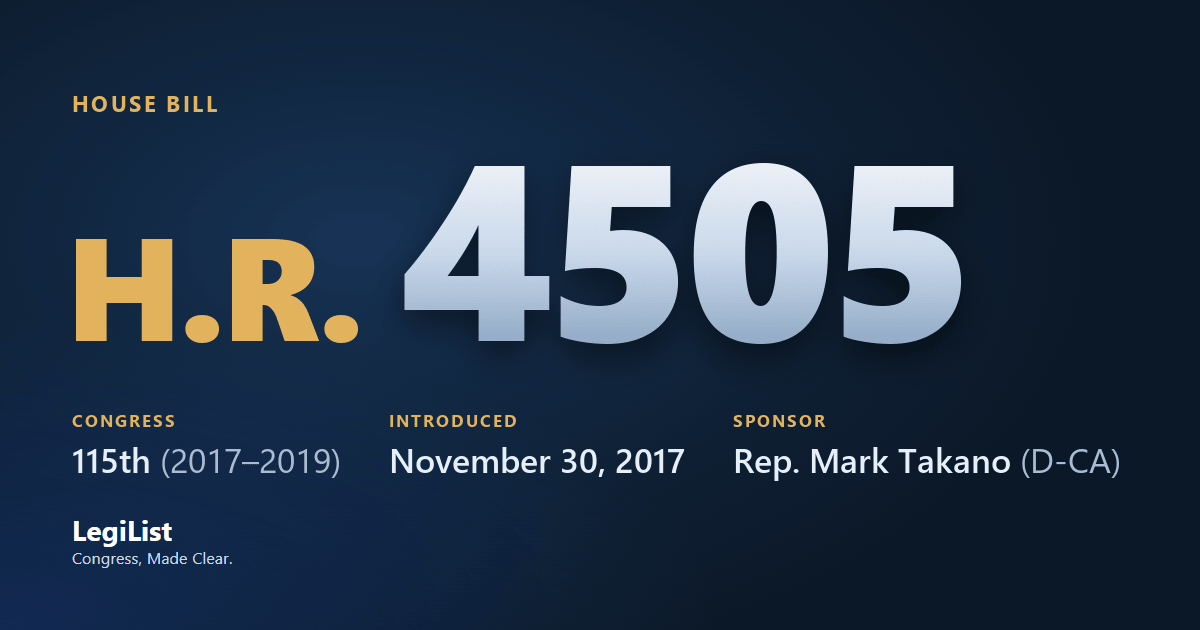
Restoring Overtime Pay Act of 2017
Latest action · Nov 30, 2017 Referred to the House Committee on Education and the Workforce.
Progress
Where this bill reached, and when. A stage with no date was not reached; one that failed a vote and later carried shows the date it carried.
- IntroducedNov 30, 2017
- Passed HouseNot reached
- Passed SenateNot reached
- To the PresidentNot reached
- Became lawNot reached
Summary
Restoring Overtime Pay Act of 2017
This bill requires the Department of Labor to update the salary threshold applicable to bona fide executive, administrative, and professional employees for purposes of determining eligibility for overtime pay. The bill adopts rulemaking promulgated by Labor in 2016 that established the threshold for exempting such employees from overtime requirements at the 40th percentile of earnings for full-time salaried employees in the lowest-wage census region. The bill also requires updates to the threshold amount every three years.
Cosponsors 57
Members who signed on, in the order they did. Signatures ran from Nov 30, 2017 to Sep 26, 2018; 43 are original cosponsors, there from the day it was introduced.
| Seat | Cosponsor | Signed on | |
|---|---|---|---|
| D-NY | Adriano Espaillat | Original | Nov 30, 2017 |
| D-NC | Alma S. Adams | Original | Nov 30, 2017 |
| D-CA | Anna G. Eshoo | Original | Nov 30, 2017 |
| D-CA | Barbara Lee | Original | Nov 30, 2017 |
| D-NJ | Bill Pascrell, Jr. | Original | Nov 30, 2017 |
| D-NJ | Bonnie Watson Coleman | Original | Nov 30, 2017 |
| D-PA | Brendan F. Boyle | Original | Nov 30, 2017 |
| D-HI | Colleen Hanabusa | Original | Nov 30, 2017 |
| D-IL | Danny K. Davis | Original | Nov 30, 2017 |
| D-FL | Debbie Wasserman Schultz | Original | Nov 30, 2017 |
| D-NJ | Donald Norcross | Original | Nov 30, 2017 |
| D-VA | Donald S. Beyer, Jr. | Original | Nov 30, 2017 |
| D-DC | Eleanor Holmes Norton | Original | Nov 30, 2017 |
| D-MD | Elijah E. Cummings | Original | Nov 30, 2017 |
| D-NJ | Frank Pallone, Jr. | Original | Nov 30, 2017 |
Committees 1
Where it was sent and what each committee and subcommittee did with it, in order.
| Chamber | Committee | What it did |
|---|---|---|
| House | Education and Workforce Committee | Referred Nov 30, 2017 |
Actions 2
Everything that happened, newest first.
- Nov 30, 2017Introduced in House
- Nov 30, 2017Referred to the House Committee on Education and the Workforce.
Research
What has been written about this bill: committee reports, cost estimates, the sponsor’s authority statement, printed hearings and the Congressional Research Service’s work.
Constitutional authority
The sponsor’s statement, as printed in the Congressional Record, vol. 163, no. 195, November 30, 2017, page H9570.
Printed hearings 1
Hearings whose printed record names this bill, newest first: hearings on it, and wider hearings where it came up.
| Number | Hearing | Committee | Held |
|---|---|---|---|
| Serial No. 115-22 | GROWTH, OPPORTUNITY, AND CHANGE IN THE U.S. LABOR MARKET AND THE AMERICAN WORKFORCE: A REVIEW OF CURRENT DEVELOPMENTS, TRENDS, AND STATISTICS96 pages | Education and Workforce Committee | Jun 21, 2018 |
Related bills 1
Companion bills and other measures the record links to this one.
| Bill | Title | Relationship | Latest action |
|---|---|---|---|
| S 2177 | Restoring Overtime Pay Act of 2017 | Related bill | Nov 30, 2017 |
Titles 2
Every title it has carried, official and short, at each stage.
- Official Title as Introduced
- To amend the Fair Labor Standards Act of 1938 to establish a minimum salary threshold for bona fide executive, administrative, and professional employees exempt from Federal overtime compensation requirements, and automatically update such threshold every 3 years.
- Short Titles as Introduced
- Restoring Overtime Pay Act of 2017
Subjects
Assigned by the Library of Congress. Policy area: Labor and Employment.
Text 1
Each version as it was printed, newest first.
- Nov 30, 2017Introduced in House
Support LegiList
This page is free, carries no paywall, and is built and maintained by one person. If the record here is useful to you, a few dollars keeps it going.
Everything here is as published by Congress: the summary is the Congressional Research Service's, the action wording is the clerks', and the subjects are the Library of Congress's. How far it got is read from the actions themselves, taking the most recent one of each kind, so a bill that failed a vote and later passed is shown as having passed. Records come from this bill on Congress.gov and govinfo.gov; cost estimates are the Congressional Budget Office's, and the hearings are the printed hearings GovInfo publishes, which can appear months after the hearing.