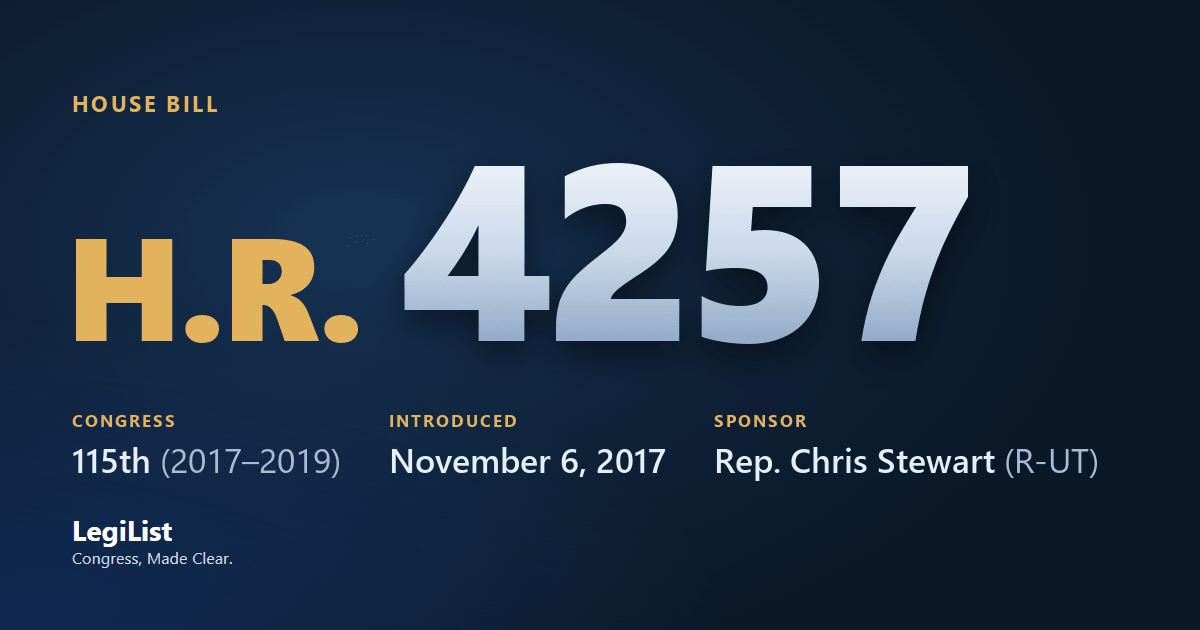
Advancing Conservation and Education Act
Latest action · Jun 26, 2018 Received in the Senate and Read twice and referred to the Committee on Energy and Natural Resources.
Progress
Where this bill reached, and when. A stage with no date was not reached; one that failed a vote and later carried shows the date it carried.
- IntroducedNov 6, 2017
- Passed HouseJun 25, 2018
- Passed SenateNot reached
- To the PresidentNot reached
- Became lawNot reached
Summary
Advancing Conservation and Education Act
This bill allows the states of Alaska, Arizona, California, Colorado, Idaho, Montana, New Mexico, North Dakota, Oregon, South Dakota, Utah, Washington, or Wyoming (western states) to relinquish state land grant parcels wholly or primarily within eligible areas and select, in exchange, public land within the state.
The bill defines "eligible areas" as lands within the outer boundaries of units or components of the National Park, National Wilderness Preservation, National Wildlife Refuge, or National Landscape Conservation Systems, areas identified by the Bureau of Land Management (BLM) of the Department of the Interior as having wilderness characteristics, certain designated lands within the National Forest System or administered by the BLM, and sentinel landscapes designated by the Department of Agriculture, Department of Defense, or Interior.
Interior shall create a process for the relinquishment of such parcels.
A western state may select, and Interior may convey, lands that are mineral in character.
The overall value of the state land grant parcels and the public land to be conveyed shall be equal.
The bill sets forth requirements regarding hazardous materials on land conveyed, water rights, grazing permits, and road rights-of ways and other valid existing rights.
Cosponsors 3
Members who signed on, in the order they did. Signatures ran from Nov 6, 2017 to Mar 15, 2018; 1 is an original cosponsor, there from the day it was introduced.
| Seat | Cosponsor | Signed on | |
|---|---|---|---|
| D-CO | Jared Polis | Original | Nov 6, 2017 |
| D-CA | John Garamendi | Mar 15, 2018 | |
| R-UT | John R. Curtis | Mar 15, 2018 |
Committees 2
Where it was sent and what each committee and subcommittee did with it, in order.
| Chamber | Committee | What it did |
|---|---|---|
| House | Natural Resources Committee | Referred Nov 6, 2017Markup Apr 11, 2018 |
| Federal Lands Subcommittee | Referred Nov 14, 2017Discharged Apr 11, 2018 | |
| Senate | Energy and Natural Resources Committee | Referred Jun 26, 2018 |
Actions 12
Everything that happened, newest first.
- Jun 26, 2018Received in the Senate and Read twice and referred to the Committee on Energy and Natural Resources.
- Jun 25, 2018Mr. Bishop (UT) moved to suspend the rules and pass the bill, as amended.
- Jun 25, 2018Considered under suspension of the rules. (consideration: CR H5607-5611)
- Jun 25, 2018DEBATE - The House proceeded with forty minutes of debate on H.R. 4257.
- Jun 25, 2018Passed/agreed to in House: On motion to suspend the rules and pass the bill, as amended Agreed to by voice vote. (text: CR H5607-5610)
- Jun 25, 2018Motion to reconsider laid on the table Agreed to without objection.
- Apr 11, 2018Subcommittee on Federal Lands Discharged.
- Apr 11, 2018Committee Consideration and Mark-up Session Held.
- Apr 11, 2018Ordered to be Reported (Amended) by Unanimous Consent.
- Nov 14, 2017Referred to the Subcommittee on Federal Lands.
- Nov 6, 2017Introduced in House
- Nov 6, 2017Referred to the House Committee on Natural Resources.
In the Congressional Record 1
Days the Record’s own index lists this bill, newest first, with the pages and the members it names. Pages starting H are the House, S the Senate, E Extensions of Remarks.
| Where | In the Record | Members | Date |
|---|---|---|---|
| House | Debate and remarks H5607–H5611Text printed H5607–H5610Analyses H5611Summaries H5610 | Anthony G. Brown D-MD, Chris Stewart R-UT, Rob Bishop R-UT | Jun 25, 2018 |
Research
What has been written about this bill: committee reports, cost estimates, the sponsor’s authority statement, printed hearings and the Congressional Research Service’s work.
Congressional Budget Office cost estimate
- Aug 20, 2018H.R. 4257, Advancing Conservation and Education ActAs passed by the U.S. House of Representatives on June 25, 2018
Constitutional authority
The sponsor’s statement, as printed in the Congressional Record, vol. 163, no. 180, November 6, 2017, page H8522.
Related bills 2
Companion bills and other measures the record links to this one.
| Bill | Title | Relationship | Latest action |
|---|---|---|---|
| HR 244 | Advancing Conservation and Education Act | Reintroduced Bill | Dec 14, 2020 |
| S 2078 | Advancing Conservation and Education Act | Identical bill | Aug 22, 2018 |
Titles 3
Every title it has carried, official and short, at each stage.
- Official Title as Introduced
- To maximize land management efficiencies, promote land conservation, generate education funding, and for other purposes.
- Short Titles as Introduced
- Advancing Conservation and Education Act
- Short Titles as Passed House
- Advancing Conservation and Education Act
Subjects
Assigned by the Library of Congress. Policy area: Public Lands and Natural Resources.
- Alaska
- Arizona
- California
- Colorado
- Environmental assessment, monitoring, research
- Forests, forestry, trees
- Idaho
- Intergovernmental relations
- Land transfers
- Land use and conservation
- Military facilities and property
- Mining
- Montana
- Monuments and memorials
- New Mexico
- North Dakota
- Oregon
- Parks, recreation areas, trails
- Public Lands and Natural Resources
- South Dakota
- State and local government operations
- Utah
- Washington State
- Wilderness and natural areas, wildlife refuges, wild rivers, habitats
- Wildlife conservation and habitat protection
- Wyoming
Text 3
Each version as it was printed, newest first.
- Jun 26, 2018Referred in Senate
- Jun 25, 2018Engrossed in House
- Nov 6, 2017Introduced in House
Support LegiList
This page is free, carries no paywall, and is built and maintained by one person. If the record here is useful to you, a few dollars keeps it going.
Everything here is as published by Congress: the summary is the Congressional Research Service's, the action wording is the clerks', and the subjects are the Library of Congress's. How far it got is read from the actions themselves, taking the most recent one of each kind, so a bill that failed a vote and later passed is shown as having passed. Records come from this bill on Congress.gov and govinfo.gov; cost estimates are the Congressional Budget Office's, and the hearings are the printed hearings GovInfo publishes, which can appear months after the hearing.