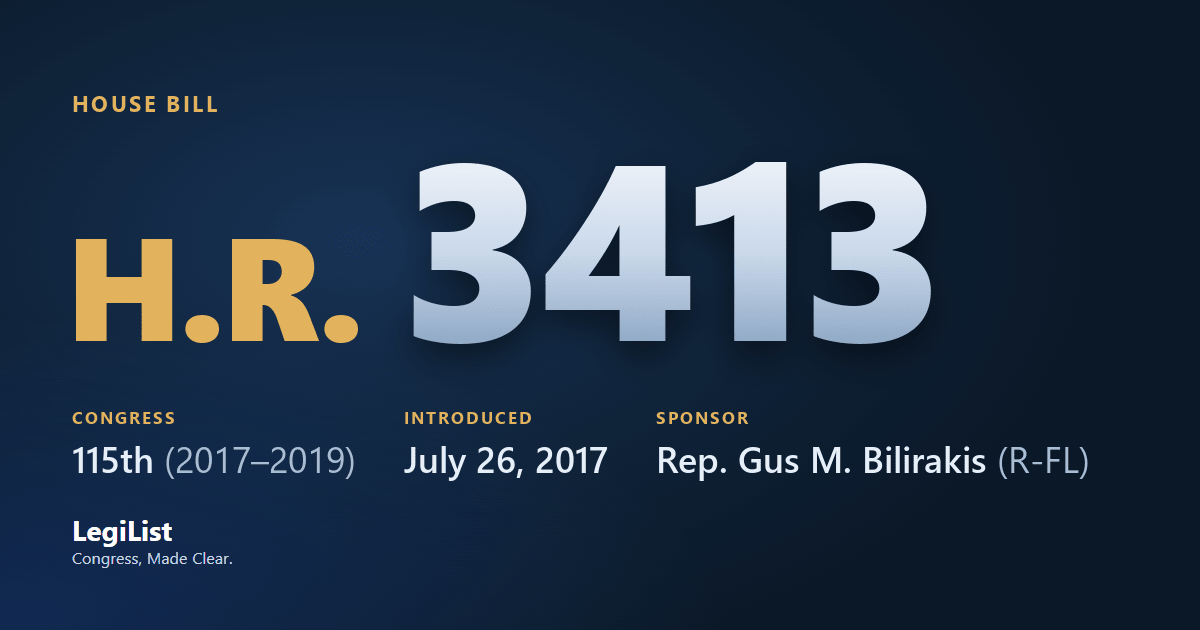
ACCESS Act
Latest action · Jul 27, 2017 Referred to the Subcommittee on Highways and Transit.
Progress
Where this bill reached, and when. A stage with no date was not reached; one that failed a vote and later carried shows the date it carried.
- IntroducedJul 26, 2017
- Passed HouseNot reached
- Passed SenateNot reached
- To the PresidentNot reached
- Became lawNot reached
Summary
Addressing Community Challenges Emerging From Self-Driving Systems or the ACCESS Act
This bill directs the Department of Transportation (DOT) to establish in the National Highway Traffic Safety Administration an Advisory Council on Improving Mobility Access for Underserved Populations and Senior Citizens. The council shall undertake information gathering activities, develop technical advice, and present best practices or recommendations to DOT regarding mobility access for senior citizens and populations underserved by traditional public transportation services and educational outreach efforts with respect to the testing and distribution of highly automated vehicles in commerce.
A "highly automated vehicle" is defined as a motor vehicle (excluding a commercial motor vehicle) equipped with an automated driving system.
An "automated driving system" is defined as the hardware and software that are collectively capable of performing the entire dynamic driving task on a sustained basis, regardless of whether such system is limited to a specific operational design domain.
Cosponsors 1
Members who signed on, in the order they did. All signed on Jul 26, 2017.
| Seat | Cosponsor | Signed on | |
|---|---|---|---|
| D-MI | Debbie Dingell | Original | Jul 26, 2017 |
Committees 1
Where it was sent and what each committee and subcommittee did with it, in order.
| Chamber | Committee | What it did |
|---|---|---|
| House | Transportation and Infrastructure Committee | Referred Jul 26, 2017 |
| Highways and Transit Subcommittee | Referred Jul 27, 2017 |
Actions 3
Everything that happened, newest first.
- Jul 27, 2017Referred to the Subcommittee on Highways and Transit.
- Jul 26, 2017Introduced in House
- Jul 26, 2017Referred to the House Committee on Transportation and Infrastructure.
Research
What has been written about this bill: committee reports, cost estimates, the sponsor’s authority statement, printed hearings and the Congressional Research Service’s work.
Constitutional authority
The sponsor’s statement, as printed in the Congressional Record, vol. 163, no. 126, July 26, 2017, page H6466.
Printed hearings 1
Hearings whose printed record names this bill, newest first: hearings on it, and wider hearings where it came up.
| Number | Hearing | Committee | Held |
|---|---|---|---|
| Serial No. 115-98 | OVERSIGHT OF THE NATIONAL HIGHWAY TRAFFIC SAFETY ADMINISTRATION80 pages | Energy and Commerce Committee | Feb 14, 2018 |
Related bills 1
Companion bills and other measures the record links to this one.
| Bill | Title | Relationship | Latest action |
|---|---|---|---|
| HR 3388 | SELF DRIVE Act | Related bill | Sep 7, 2017 |
Titles 3
Every title it has carried, official and short, at each stage.
- Official Title as Introduced
- To establish in the National Highway Traffic Safety Administration an Advisory Council on Improving Mobility Access for Underserved Populations and Senior Citizens.
- Short Titles as Introduced
- ACCESS Act
- Addressing Community Challenges Emerging From Self-Driving Systems
Subjects
Assigned by the Library of Congress. Policy area: Transportation and Public Works.
- Administrative law and regulatory procedures
- Advisory bodies
- Aging
- Computers and information technology
- Department of Transportation
- Executive agency funding and structure
- Hybrid, electric, and advanced technology vehicles
- Motor vehicles
- Product safety and quality
- Public transit
- Technology assessment
- Transportation and Public Works
- Transportation safety and security
Text 1
Each version as it was printed, newest first.
- Jul 26, 2017Introduced in House
Everything here is as published by Congress: the summary is the Congressional Research Service's, the action wording is the clerks', and the subjects are the Library of Congress's. How far it got is read from the actions themselves, taking the most recent one of each kind, so a bill that failed a vote and later passed is shown as having passed. Records come from this bill on Congress.gov and govinfo.gov; cost estimates are the Congressional Budget Office's, and the hearings are the printed hearings GovInfo publishes, which can appear months after the hearing.