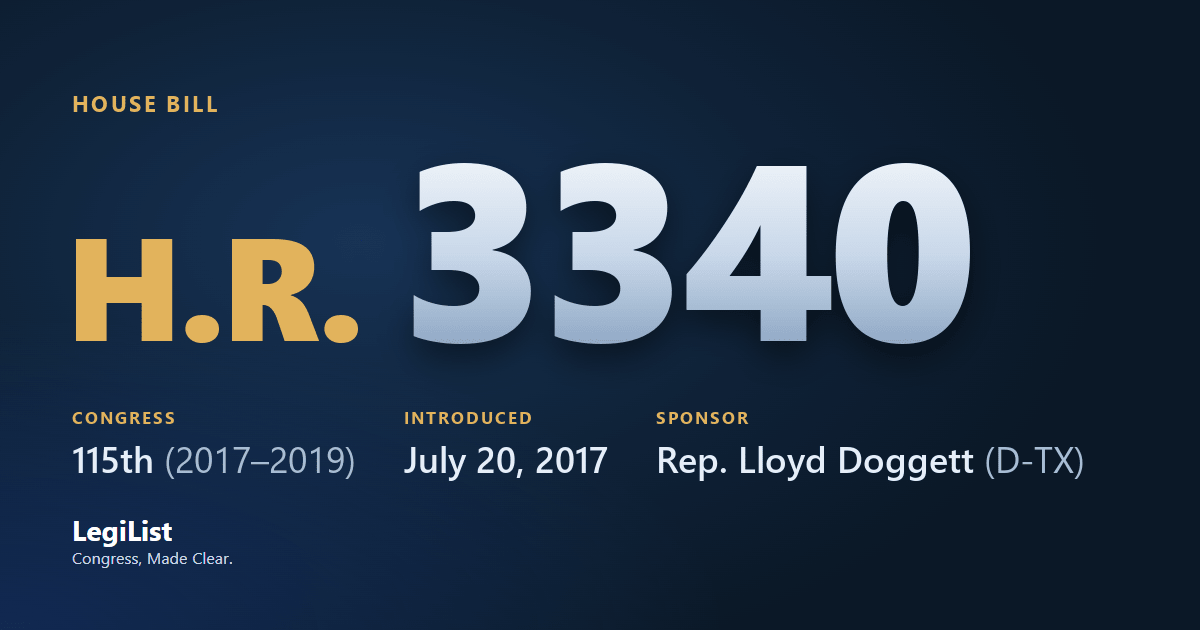
Strengthening Taxpayer Rights Act of 2017
Latest action · Jul 20, 2017 Referred to the Committee on Ways and Means, and in addition to the Committee on Financial Services, for a period to be subsequently determined by the Speaker, in each case for consideration of such provisions as fall within the jurisdiction of the committee concerned.
Progress
Where this bill reached, and when. A stage with no date was not reached; one that failed a vote and later carried shows the date it carried.
- IntroducedJul 20, 2017
- Passed HouseNot reached
- Passed SenateNot reached
- To the PresidentNot reached
- Became lawNot reached
Summary
Strengthening Taxpayer Rights Act of 2017
This bill modifies requirements for the preparation of tax returns and Internal Revenue Service (IRS) procedures for the collection of taxes.
The bill amends the Internal Revenue Code to:
- apply tax preparer penalties for the understatement of a taxpayer's liability and other violations to other submissions to the IRS, in addition to tax returns or refund claims;
- increase tax preparer penalties for gross misconduct and other violations;
- require identifying numbers to be included for all submissions to the IRS by tax return preparers (limited to tax returns or refund claims under current law);
- limit the disclosure of taxpayer information to the express purpose for which the taxpayer granted consent;
- provide for de novo review by the Tax Court of IRS innocent spouse relief determinations;
- specify that the determination of whether or not a debt has been discharged may not be based solely on a nonpayment period; and
- restrict the authority of the IRS to use a levy after the collection period has expired.
The bill amends the Fair Credit Reporting Act to reduce from seven years to two years the period that a tax lien may appear on a taxpayer's credit report.
Cosponsors 8
Members who signed on, in the order they did. Signatures ran from Jul 20, 2017 to Jul 28, 2017; 6 are original cosponsors, there from the day it was introduced.
| Seat | Cosponsor | Signed on | |
|---|---|---|---|
| D-NY | Brian Higgins | Original | Jul 20, 2017 |
| D-CA | Judy Chu | Original | Jul 20, 2017 |
| D-CA | Mike Thompson | Original | Jul 20, 2017 |
| D-MI | Sander M. Levin | Original | Jul 20, 2017 |
| D-WA | Suzan K. DelBene | Original | Jul 20, 2017 |
| D-AL | Terri A. Sewell | Original | Jul 20, 2017 |
| D-OR | Earl Blumenauer | Jul 28, 2017 | |
| D-CT | John B. Larson | Jul 28, 2017 |
Committees 2
Where it was sent and what each committee and subcommittee did with it, in order.
| Chamber | Committee | What it did |
|---|---|---|
| House | Ways and Means Committee | Referred Jul 20, 2017 |
| House | Financial Services Committee | Referred Jul 20, 2017 |
Actions 2
Everything that happened, newest first.
- Jul 20, 2017Introduced in House
- Jul 20, 2017Referred to the Committee on Ways and Means, and in addition to the Committee on Financial Services, for a period to be subsequently determined by the Speaker, in each case for consideration of such provisions as fall within the jurisdiction of the committee concerned.
Research
What has been written about this bill: committee reports, cost estimates, the sponsor’s authority statement, printed hearings and the Congressional Research Service’s work.
Constitutional authority
The sponsor’s statement, as printed in the Congressional Record, vol. 163, no. 123, July 20, 2017, page H6146.
Titles 2
Every title it has carried, official and short, at each stage.
- Official Title as Introduced
- To amend the Internal Revenue Code of 1986 to provide taxpayer protection and assistance, and for other purposes.
- Short Titles as Introduced
- Strengthening Taxpayer Rights Act of 2017
Subjects
Assigned by the Library of Congress. Policy area: Taxation.
Text 1
Each version as it was printed, newest first.
- Jul 20, 2017Introduced in House
Everything here is as published by Congress: the summary is the Congressional Research Service's, the action wording is the clerks', and the subjects are the Library of Congress's. How far it got is read from the actions themselves, taking the most recent one of each kind, so a bill that failed a vote and later passed is shown as having passed. Records come from this bill on Congress.gov and govinfo.gov; cost estimates are the Congressional Budget Office's, and the hearings are the printed hearings GovInfo publishes, which can appear months after the hearing.