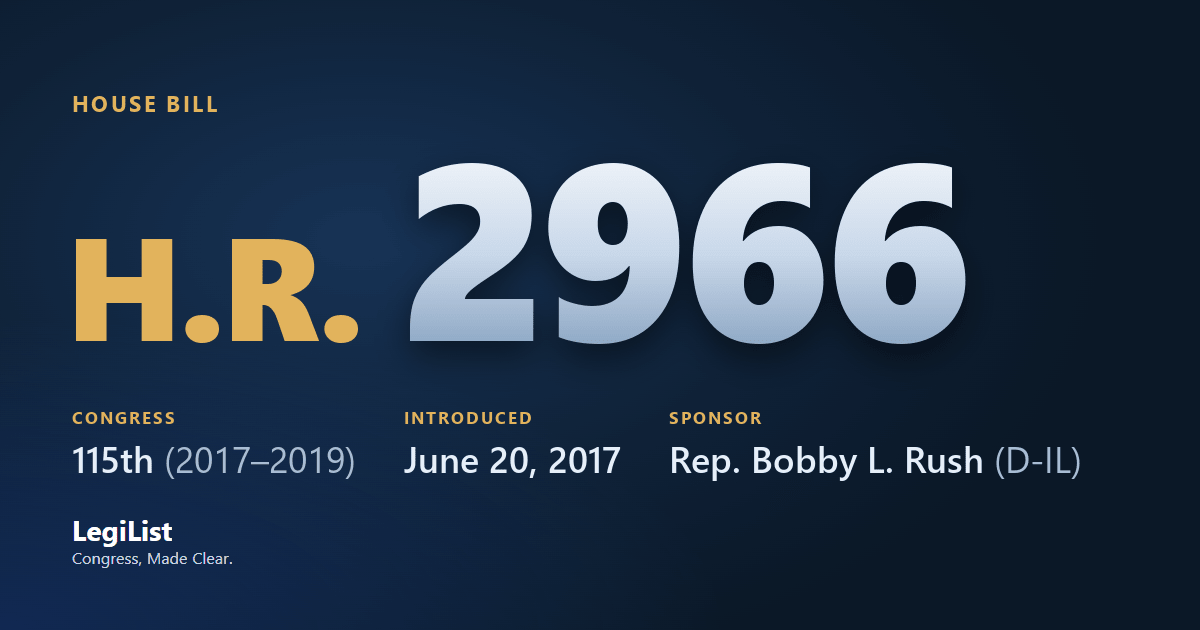
United States-Cuba Normalization Act of 2017
Latest action · Jun 29, 2017 Referred to the Subcommittee on Trade.
Progress
Where this bill reached, and when. A stage with no date was not reached; one that failed a vote and later carried shows the date it carried.
- IntroducedJun 20, 2017
- Passed HouseNot reached
- Passed SenateNot reached
- To the PresidentNot reached
- Became lawNot reached
Summary
United States-Cuba Normalization Act of 2017
This bill repeals the embargo on trade with Cuba.
The bill: (1) makes ineffective certain prohibitions on exports to Cuba; (2) extends nondiscriminatory treatment (normal trade relations) to Cuban products; (3) prohibits regulation or banning of travel to and from Cuba, or of any transactions incident to such travel, by U.S. citizens or residents; and (4) repeals the President's authority to continue direct restrictions on trade with Cuba.
The President shall take steps necessary to: (1) conduct negotiations with Cuba on settling claims of U.S. nationals for the taking of property by the Cuban government, and (2) engage in bilateral dialogue with Cuba on securing the protection of internationally recognized human rights.
The President may establish specified export controls and trade restrictions with respect to Cuba as of the effective date of this bill.
The President may impose export controls and exercise certain emergency economic authorities with respect to Cuba only if there is an unusual threat to U.S. national security.
The bill repeals: (1) the Cuban Democracy Act of 1992, (2) the Cuban Liberty and Democratic Solidarity (LIBERTAD) Act of 1996, (3) the prohibition against allocation of the annual sugar quota to a country unless such country verifies that it does not import Cuban sugar for reexport to the United States, and (4) the prohibition on transactions or payments respecting certain U.S. intellectual property.
Cuba is removed from the list of state sponsors of terrorism subject to agricultural and medical export restrictions.
Common carriers may provide telecommunications services, including installations and repairs, between the United States and Cuba.
The Department of the Treasury may not limit the amount of remittances to Cuba that may be made by any person subject to U.S. jurisdiction.
Cosponsors 2
Members who signed on, in the order they did. All signed on Apr 24, 2018.
| Seat | Cosponsor | Signed on | |
|---|---|---|---|
| D-WI | Gwen Moore | Apr 24, 2018 | |
| D-TN | Steve Cohen | Apr 24, 2018 |
Committees 6
Where it was sent and what each committee and subcommittee did with it, in order.
| Chamber | Committee | What it did |
|---|---|---|
| House | Foreign Affairs Committee | Referred Jun 20, 2017 |
| House | Ways and Means Committee | Referred Jun 20, 2017 |
| Trade Subcommittee | Referred Jun 29, 2017 | |
| House | Energy and Commerce Committee | Referred Jun 20, 2017 |
| Environment Subcommittee | Referred Jun 23, 2017 | |
| Commerce, Manufacturing, and Trade Subcommittee | Referred Jun 23, 2017 | |
| House | Judiciary Committee | Referred Jun 20, 2017 |
| House | Agriculture Committee | Referred Jun 20, 2017 |
| House | Financial Services Committee | Referred Jun 20, 2017 |
Actions 5
Everything that happened, newest first.
- Jun 29, 2017Referred to the Subcommittee on Trade.
- Jun 23, 2017Referred to the Subcommittee on Environment.
- Jun 23, 2017Referred to the Subcommittee on Digital Commerce and Consumer Protection.
- Jun 20, 2017Introduced in House
- Jun 20, 2017Referred to the Committee on Foreign Affairs, and in addition to the Committees on Ways and Means, Energy and Commerce, the Judiciary, Agriculture, and Financial Services, for a period to be subsequently determined by the Speaker, in each case for consideration of such provisions as fall within the jurisdiction of the committee concerned.
Research
What has been written about this bill: committee reports, cost estimates, the sponsor’s authority statement, printed hearings and the Congressional Research Service’s work.
Constitutional authority
The sponsor’s statement, as printed in the Congressional Record, vol. 163, no. 105, June 20, 2017, page H4994.
CRS reports 4
Congressional Research Service work that CRS links to this bill or the law it became, newest first.
Cite it 4
Products on other subjects that cite it, usually among other measures.
| Product | Title | Kind | Published |
|---|---|---|---|
| RL31139 | Cuba: U.S. Restrictions on Travel and Remittances Archived | Report | Dec 15, 2022 |
| R46484 | Understanding Federal Legislation: A Sectionby-Section Guide to Key Legal Considerations | Report | May 19, 2022 |
| R45120 | Latin America and the Caribbean: Issues in the 115th Congress Archived | Report | Jan 22, 2019 |
| R44822 | Cuba: U.S. Policy in the 115th Congress Archived | Report | Jan 15, 2019 |
Related bills 2
Companion bills and other measures the record links to this one.
| Bill | Title | Relationship | Latest action |
|---|---|---|---|
| S 1699 | United States-Cuba Trade Act of 2017 | Related bill | Aug 1, 2017 |
| HR 2404 | United States-Cuba Relations Normalization Act | Reintroduced Bill | May 20, 2019 |
Titles 2
Every title it has carried, official and short, at each stage.
- Official Title as Introduced
- To lift the trade embargo on Cuba, and for other purposes.
- Short Titles as Introduced
- United States-Cuba Normalization Act of 2017
Subjects
Assigned by the Library of Congress. Policy area: International Affairs.
- Agricultural trade
- Caribbean area
- Cuba
- Currency
- Detention of persons
- Diplomacy, foreign officials, Americans abroad
- Foreign and international banking
- Government liability
- Health care coverage and access
- Human rights
- Intellectual property
- International Affairs
- International exchange and broadcasting
- Latin America
- Medical tests and diagnostic methods
- Normal trade relations, most-favored-nation treatment
- Property rights
- Sanctions
- Trade restrictions
- Travel and tourism
- U.S. and foreign investments
- Visas and passports
Text 1
Each version as it was printed, newest first.
- Jun 20, 2017Introduced in House
Support LegiList
This page is free, carries no paywall, and is built and maintained by one person. If the record here is useful to you, a few dollars keeps it going.
Everything here is as published by Congress: the summary is the Congressional Research Service's, the action wording is the clerks', and the subjects are the Library of Congress's. How far it got is read from the actions themselves, taking the most recent one of each kind, so a bill that failed a vote and later passed is shown as having passed. Records come from this bill on Congress.gov and govinfo.gov; cost estimates are the Congressional Budget Office's, and the hearings are the printed hearings GovInfo publishes, which can appear months after the hearing.